

More news on this day
Oman’s charter aviation sector is emerging as a powerful economic engine, with the 2024–2025 tourism season estimated to have generated around OMR 30 million in direct and indirect returns, reflecting rapid growth in seasonal flights, passenger numbers and high-value tourism spending.
Get the latest news straight to your inbox!
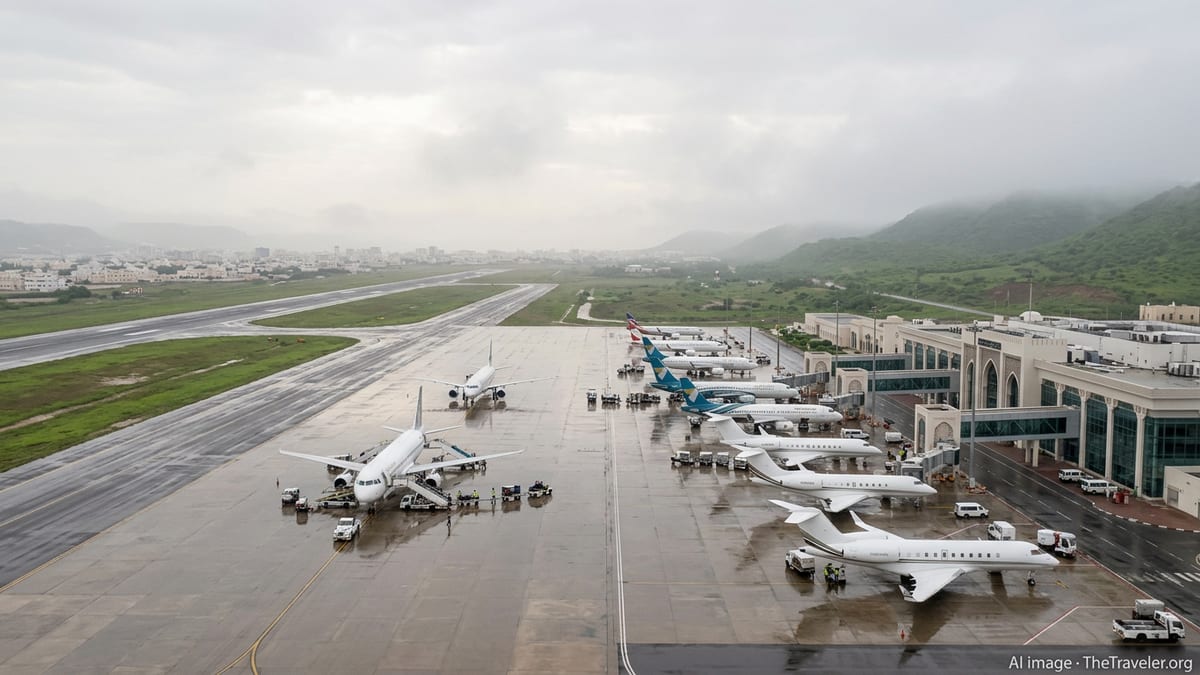
Record Season Caps Years of Steady Charter Growth
Recent tourism and aviation data point to a record-breaking 2024–2025 charter season, driven by rising arrivals into Salalah and Muscat and a marked shift toward non-scheduled leisure traffic. Publicly available figures for the 2024–2025 winter and khareef periods indicate that charter flights to Oman grew by more than a quarter year on year, with 588 seasonal flights carrying about 93,000 passengers. Reports indicate that this traffic produced roughly 80 million dollars in wider tourism returns, including accommodation, transport and local excursions, excluding airport and handling revenues.
When converted and rounded, sector analysts following Oman’s tourism performance estimate that charter-related value added for the 2025 season equates to roughly OMR 30 million within the broader visitor economy. This aligns with national tourism indicators that show direct tourism value added in Oman already above OMR 870 million in recent years, with charter and seasonal air services now forming a more visible slice of that total.
The charter boom is unfolding alongside wider gains across Oman’s tourism portfolio. Government and industry reporting for 2024 and early 2025 highlights growth in hotel revenues, higher average occupancies and steady gains in international arrivals, supporting the view that seasonal charter flying is reinforcing, rather than replacing, scheduled air services.
European and Russian Markets Drive High-Value Inflows
The latest breakdown of charter passenger flows underscores the importance of Central and Eastern Europe to Oman’s seasonal tourism strategy. According to published coverage of the 2024–2025 charter season, Poland led inbound charter arrivals with more than 30,000 passengers, followed by the Czech Republic, Slovakia, Hungary and Romania. These visitors are heavily concentrated in Salalah’s khareef season, but are increasingly spreading travel across the cooler winter months along Oman’s coast.
Separate tourism reports in late 2025 spotlight the emergence of Russia as another high-potential charter market. The launch of a Moscow–Salalah charter connection for the 2025 khareef is projected to support tens of millions of rials in additional tourism value in the coming years, as Oman targets travelers seeking a cooler summer alternative in the Gulf region. Industry analysis suggests that expanding direct connectivity from Russian cities could contribute to an overall tourism uplift of up to OMR 90 million when combined with other route initiatives, with charter aircraft forming the backbone of early capacity.
The profile of these markets is particularly attractive for Oman’s tourism planners. Tourists arriving on charter packages tend to stay in three- to five-star coastal and resort properties, often booking week-long or longer holidays. This pattern feeds directly into higher hotel occupancy, more predictable demand for ground transport and excursions, and a growing ecosystem of local tour operators along the Dhofar and Al Wusta coastlines.
National Carriers and Airports Pivot Toward Seasonal Demand
Oman’s charter boom is closely intertwined with changes across the country’s broader aviation sector. According to civil aviation performance updates for 2024 and projections for 2025, aircraft movements in Omani airspace are expected to rise by about 14 percent year on year, reaching more than 530,000 flights. Sector revenues for the national aviation authority have also climbed sharply, indicating higher utilization of airport infrastructure and air navigation services.
Oman Air and low-cost carrier SalamAir have both repositioned capacity toward routes that feed leisure destinations such as Salalah, while working with tour operators to slot in seasonal charter operations. Oman Air’s most recent traffic updates for early 2025 show a higher share of point-to-point passengers travelling directly into Oman, reflecting an emphasis on inbound tourism rather than pure transfer traffic. This strategy aligns with the national objective under Oman Vision 2040 to maximise tourism receipts and diversify away from hydrocarbon revenues.
The seasonal nature of charter flying is also reshaping airport operations in Salalah. During the 2025 khareef, Salalah handled more than 200,000 visitors across domestic and international services, supported by increased flight frequencies, the use of larger aircraft on some routes and targeted charter capacity from European and Russian markets. Airport and ground-handling providers have been investing in seasonal staffing and facilities to cope with peak arrivals, while local authorities promote attractions beyond the traditional monsoon coastline, including desert, mountain and cultural tours.
Economic Ripple Effects Across Hotels, Transport and Investment
The estimated OMR 30 million generated by Oman’s charter aviation sector in the 2025 season is felt far beyond the runway. Tourism and economic assessments for recent years indicate that each charter passenger contributes not only to hotel room nights but also to restaurant spending, car rentals, local flights, excursions and retail. With charter visitors typically arriving on pre-arranged packages, the yield per visitor can be higher and more predictable than purely independent travel.
Hotel performance data show that revenues and occupancy levels in Oman’s three- to five-star segment have been trending upward, with national hotel income surpassing OMR 200 million in recent reporting periods. Salalah and surrounding Dhofar resorts capture a significant portion of this spending during the monsoon season, while Muscat, Duqm and emerging coastal destinations are increasingly benefitting from shoulder-season charter arrivals and new niche products such as diving and adventure tourism.
The aviation upswing is also intersecting with a broader surge in tourism and real estate investment. Recent announcements detail large-scale mixed-use and resort projects valued in the billions of rials, many of which rely on expanding air access and consistent seasonal demand. Investors monitoring Oman’s tourism outlook often point to charter activity as an indicator of how quickly new markets can be activated and how reliably rooms and villas might be filled once projects open.
Charter Aviation’s Role in Oman Vision 2040
The charter aviation boom is emerging as a practical tool for delivering on Oman Vision 2040’s tourism ambitions. Strategic planning documents and recent economic briefings outline a long-term goal of boosting annual tourist arrivals to well over 10 million visitors by 2040 and raising tourism revenues into the multi-billion-rial range. To support that trajectory, authorities are planning to expand national airport capacity from roughly 14.5 million passengers a year to as many as 50 million through a mix of new airports and upgrades.
Charter operations provide a flexible bridge between current capacity and future demand. They allow Oman to quickly test new source markets, such as secondary cities in Europe or Russia, without committing airlines to year-round scheduled services. If routes perform strongly over several seasons, they can evolve into regular flights, deepening connectivity and encouraging additional hotel and infrastructure investment.
Sector watchers note that the 2025 charter season’s estimated OMR 30 million contribution, while still modest relative to total tourism receipts, is symbolically important. It highlights how targeted aviation policies, coordinated with tour operators and destination marketing, can convert aircraft movements into tangible economic value in coastal towns and secondary cities. As Oman continues to fine-tune its tourism mix, charter aviation looks set to remain a central lever for capturing seasonal demand and diversifying the national economy.