


It was not the lobby chandelier, the breakfast buffet, or the thread count on the sheets that changed how I judge midscale hotels. It was a single, easily missed detail in a standard Holiday Inn room off an interstate in the Midwest, the kind of place road trip travelers book on points and forget by the next exit. That one touch reframed how I look at Holiday Inn, Holiday Inn Express, and their midscale competitors, and it might change how you choose and judge your next hotel stay too.
Get the latest updates straight to your inbox!
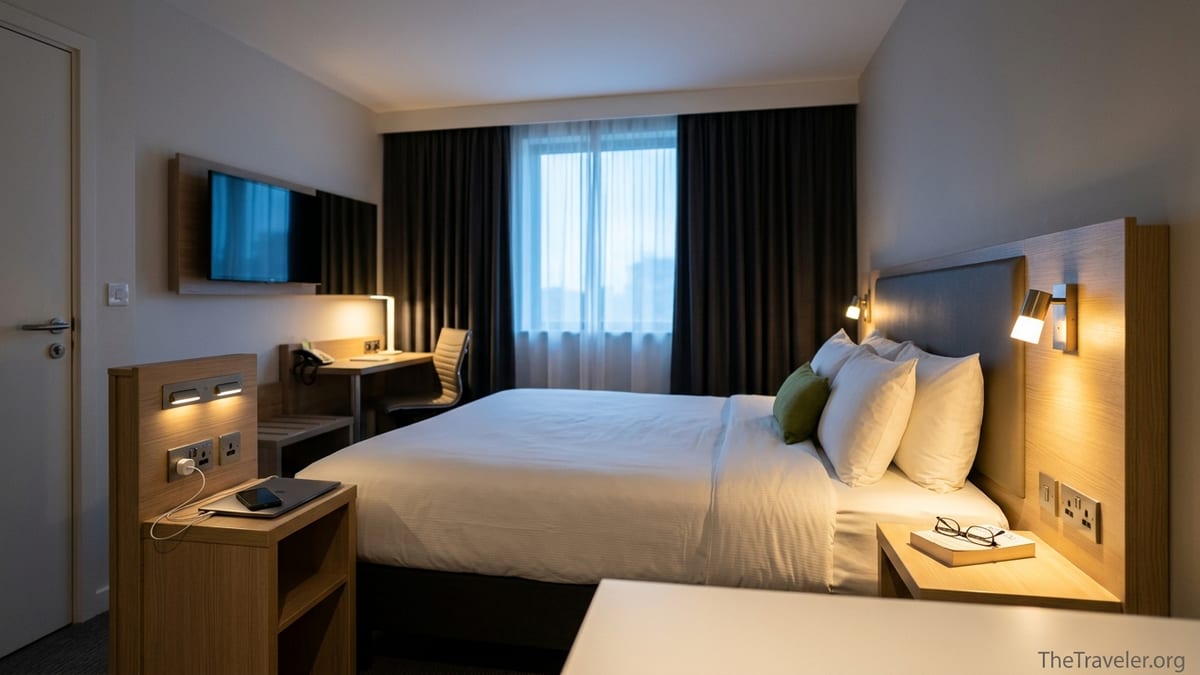
The Stay: A Very Ordinary Holiday Inn, Until It Wasn’t
The property itself could not have been more typical. It was a franchised Holiday Inn near a busy suburban highway outside Columbus, Ohio, priced around 140 to 170 dollars per night depending on the night of the week. Like most Holiday Inns in the United States, it sat in the middle of the IHG portfolio, squarely in the midscale segment with a full-service lean: an all-day restaurant, a modest bar, a small indoor pool, and meeting rooms aimed at regional sales teams and youth sports tournaments.
Check-in was efficient but unremarkable. The front desk agent recognized my IHG One Rewards status, offered a bottle of water and a snack, and quickly handed over keys. The lobby decor followed the current brand look: neutral greys, accent greens, vinyl plank flooring, and a large Holiday Inn logo behind the desk. It was contemporary in the way so many midscale chains are today: designed not to offend or enchant, simply to feel up to date.
Upstairs, the room layout echoed what you find at countless midscale properties, whether they belong to Holiday Inn, Hampton by Hilton, or Fairfield by Marriott. A king bed, a small sofa, a rolling desk chair, the now-standard wall-mounted television, a combination wardrobe and luggage bench, and the familiar under-window HVAC unit. The bathroom was compact but bright, with a walk-in shower and bulk toiletries instead of tiny bottles.
At first glance, it was the definition of generic midscale. Clean, functional, and aligned with what IHG publicly describes as its Holiday Inn promise: a reliable, family-and-business-friendly midscale stay with on-site dining and practical amenities at a mid-range price point. It was exactly what I expected, until I noticed the detail that shifted everything.
The Small Detail: A Thoughtful Bedside Power & Light Hub
On the wall between the bed and the window, Holiday Inn had installed a narrow, custom headboard panel that integrated a reading light, two standard power outlets, and two USB-A ports, all at shoulder height. That alone is not groundbreaking in 2026, but the way it was executed mattered. The controls were clearly labeled, the reading light was independently dimmable, and the outlets were angled so that bulky chargers did not block adjacent ports.
Most importantly, there were identical hubs on both sides of the bed. If you have ever fought with a short phone cable, stretched an extension cord across a pillow, or discovered that all the outlets are on “your partner’s” side of the bed, you know why this is significant. A huge number of midscale rooms across major brands still offer good power access on only one side. Even newer properties sometimes combine the bedside alarm clock and outlets on a single nightstand, leaving the other guest to improvise.
Here, the design signaled something different. Someone on the Holiday Inn design or ownership side had clearly walked the room the way guests would use it. They anticipated two people working on laptops, streaming shows, charging multiple devices overnight, and reading at different brightness levels. This was less about having more outlets and more about them being exactly where real travelers need them, all the time.
Compared with many competing midscale brands, where power access can still be wildly inconsistent from one property to another, that little strip of thoughtful design felt like a quiet but meaningful promise. It suggested that if the hotel paid attention to this detail, there might be other small but important choices woven through the stay.
What That Detail Revealed About Holiday Inn’s Priorities
Power hubs and reading lights do not exist in a vacuum. They are part of a broader brand standard. IHG has spent the past decade upgrading Holiday Inn and Holiday Inn Express, especially in North America and Europe, to focus on what it calls “essential” elements: quality sleep, practical design, and reliable connectivity. More than 90 percent of the Holiday Inn family in Europe, for example, has recently committed to extensive room and public area transformations centered on these basics.
In practice, that means Holiday Inn guest rooms increasingly look and function like the one I stayed in. The headboard panel is part of a larger room concept: a proper mattress and bedding package, blackout shades that actually block light, a desk that can double as a dining space, and multiple layers of lighting. Holiday Inn Express, the limited-service sibling that dominates IHG’s upper midscale segment, uses a similar philosophy in its “Next Generation” rooms, which standardize bedside power, movable desks, and smart storage across thousands of properties.
The detail I noticed was a visible, tactile sign that IHG’s design team had not only drawn plans, but that this particular franchise owner chose to implement them faithfully. In a midscale world where properties are often a patchwork of brand-era updates, this kind of consistency matters. It means that whether you are staying at a Holiday Inn in Ohio, a Holiday Inn Express near an airport in Texas, or a similar midscale property in France, there is a good chance your room will support how you actually travel in 2026: with multiple devices, flexible work habits, and a need for easy control over lighting and power.
It also hinted at a broader service mindset. When a hotel invests in guest-centric design details, it is often a sign that they have thought through other parts of the experience, from Wi-Fi coverage to breakfast seating. That bedside power hub became a small but powerful proxy for how seriously this Holiday Inn took its core promise.
How One Detail Changed the Way I Judge Midscale Hotels
After that stay, I began using the bedside setup as a quick test of any midscale room, whether under the IHG flag or a competitor like Hampton, Fairfield, La Quinta, or Wingate. Rather than being impressed first by the lobby or the number of pillows on the bed, I now start with a simple question: can two people realistically sleep, work, and charge their devices without inconvenience or clutter?
If the answer is yes, it usually means the hotel has followed through on a cluster of related details. The HVAC unit tends to be quieter and easier to control. The Wi-Fi often requires fewer login steps and remains stable enough to stream video in the evening. The desk chair is at a usable height. The lighting in the bathroom is bright enough for practical tasks rather than just for mood.
When the answer is no, the cracks appear quickly. At one midscale property in the Southeast, operated under a different major brand, outlets were buried behind the nightstand, forcing guests to move furniture to plug anything in. The only accessible ports were on the base of a lamp that flickered when bumped. The room rate was similar to that Holiday Inn, but the experience felt immediately more dated and less guest focused.
That shift in perspective changed how I evaluate value too. Instead of thinking primarily in terms of room size, pool availability, or whether breakfast is free, I weigh how well the space supports the way modern travelers actually live for a night or two. An 18-square-meter Holiday Inn Express room with excellent power access and clever storage can feel more premium than a larger but poorly designed room in an older full-service property.
Reading Midscale Brands Through Their Small Choices
Zooming out from one Holiday Inn room, that small detail illustrates how different midscale brands signal their priorities. Holiday Inn, as a full-service midscale brand, promises on-site dining and family-friendly features along with practical rooms. Holiday Inn Express, which today accounts for roughly half of IHG’s properties worldwide, focuses even more tightly on essentials: a good night’s sleep, a powerful shower, reliable Wi-Fi, and a complimentary breakfast.
Other groups use similar formulas. Hampton by Hilton and Fairfield by Marriott target many of the same value-conscious business and family travelers, often in comparable roadside or airport-adjacent locations. Tru by Hilton, launched more recently, emphasizes playful public spaces and stripped-down but modern rooms, while Marriott’s SpringHill Suites and Hyatt Place offer slightly larger rooms aimed at travelers who want more separation between sleeping and working areas.
In all of these brands, the big promises are easy to copy: free breakfast, free Wi-Fi, comfortable beds. The real differentiation shows up in the execution of small touches. Does the breakfast area have enough seating for a full hotel on a Sunday morning when the youth soccer teams come down at once? Are the blackout curtains the proper width, or do they let in a stripe of light at dawn? Does the in-room coffee station have enough counter space to prepare it without juggling mugs over the ice bucket?
Holiday Inn’s bedside hub became my shorthand for this entire layer of quality. It stands for the idea that midscale hotels are no longer defined by how much they exclude compared with upscale properties, but by how intelligently they deliver the basics that most travelers truly care about. When you walk into a room and see thoughtful choices like this, it is a cue that the hotel, and often the wider brand, understands that good design is now a non-negotiable part of value.
Practical Ways Travelers Can Spot Thoughtful Design
The next time you check into a midscale hotel, whether it is a Holiday Inn, Holiday Inn Express, or a comparable brand, you can borrow this small-detail lens to judge whether the property is truly worth its nightly rate. Start at the bed. Count the accessible outlets and USB ports on both sides, without moving furniture. If you must unplug a lamp or alarm clock to charge a phone, the hotel has not fully caught up with how people travel today.
Then look at lighting. Are there separate controls for bedside reading, general room illumination, and a desk lamp, or is everything on one harsh overhead switch? Thoughtfully designed rooms allow you to work on a laptop while a partner sleeps, or to read in bed without bright light spilling across the entire space. Many newer Holiday Inn and Holiday Inn Express rooms have this layering built in; so do a growing number of refreshed competitors.
Next, check the work surface and seating. Can you comfortably open a laptop without pushing the television remote, room service menu, and coffee maker out of the way? Is the chair adjustable enough for an hour or two of email? In many Holiday Inn properties, a long, narrow multi-purpose table has replaced the traditional heavy desk, a sign that the brand expects people to use the surface for both dining and working.
Finally, step into the bathroom. A solid shower head, consistent water pressure, bulk toiletries that are easy to pump, and floor drains that do not flood the entire room are all signals of recent investment. Midscale does not mean spa-level finishes, but it should mean a bathroom that feels clean, modern, and easy to use. In my experience, when Holiday Inn properties deliver on these small elements, the rest of the stay often follows suit.
What This Says About Holiday Inn and Its Midscale Competitors
Holiday Inn’s focus on elevating essentials is not happening in isolation. Across the industry, midscale and upper midscale segments have become some of the most competitive battlegrounds. Large hotel groups now rely heavily on these brands as their growth engines, adding new hotels along highways, near airports, and in secondary cities where luxury brands would not make financial sense.
That competition benefits travelers because it pushes brands to refine their standards. Holiday Inn and Holiday Inn Express are expected to deliver a predictable experience worldwide, from North America to Europe and Asia. Marriott, Hilton, and others are making similar commitments for their own midscale families. The result is that the gap between a good midscale property and a more expensive upscale hotel can feel smaller than it did a decade ago, especially if you judge the stay by function and comfort rather than by whether there is a white-tablecloth restaurant in the lobby.
At the same time, the franchise nature of these brands means quality still varies. Even when IHG, Hilton, or Marriott specify certain features, local owners choose how aggressively to invest and how well to maintain them over time. That is why paying attention to small details on arrival is so useful. The bedside hub in that Ohio Holiday Inn told me that this particular owner was keeping pace with current standards, not just meeting the bare minimum from when the sign first went up.
For frequent travelers, those signals can guide real decisions. If a Holiday Inn or similar midscale hotel clearly invests in thoughtful design and upkeep, it may be worth paying a modest premium of 10 or 20 dollars per night over a cheaper but visibly aging alternative. Over the course of a multi-night stay, the compound effect of those small comforts often outweighs saving a few dollars to wrestle with extension cords and squeaky climate-control units.
The Takeaway
That single Holiday Inn detail changed how I judge not only IHG’s midscale brands, but the entire category. It reminded me that in everyday travel, what matters most is not the grandeur of the lobby or the length of the amenity list, but how well a hotel delivers on the basics of sleep, work, and simple comfort.
Midscale hotels are where most business travelers, road trippers, and family vacationers actually live their travel lives. In that world, thoughtful design choices like well-placed outlets, layered lighting, practical breakfast layouts, and sensibly arranged bathrooms say more about a hotel’s real quality than marble reception desks or trendy light fixtures ever will.
The next time you roll your suitcase into a Holiday Inn, Holiday Inn Express, or any similar midscale property, take a moment before you unpack. Look at the details around the bed, the desk, and the bathroom. Those quiet choices will tell you almost everything you need to know about whether the nightly rate is fair, the brand is keeping its promises, and the stay will fade from memory or stand out as unexpectedly comfortable.
For me, it started with a simple, well-designed bedside power hub. Today, that small touch has become the lens through which I judge every midscale hotel I enter.
FAQ
Q1. Are Holiday Inn and Holiday Inn Express considered midscale hotels?
Yes. Holiday Inn typically sits in the full-service midscale to upper midscale category, while Holiday Inn Express is an upper midscale, select-service brand focused on essentials like breakfast, Wi-Fi, and efficient rooms.
Q2. Is Holiday Inn more expensive than Holiday Inn Express?
Often, yes, though it depends on the market and date. Holiday Inn properties usually charge a bit more because they offer on-site restaurants, bars, and meeting facilities, while Holiday Inn Express keeps costs down by focusing on limited services and a free breakfast.
Q3. What small room features should I check first when I enter a midscale hotel?
Start with bedside power and lighting, then look at the work surface, chair, and bathroom layout. Accessible outlets on both sides of the bed, layered lighting, and a functional desk and chair are strong signs of guest-focused design.
Q4. Do all Holiday Inn rooms have bedside USB ports and modern power hubs?
Not yet. Many newer or recently renovated Holiday Inn and Holiday Inn Express properties do, but older hotels may still be transitioning. If power access is important to you, it can help to look at recent guest photos and reviews before booking.
Q5. How does Holiday Inn compare with other midscale brands like Hampton or Fairfield?
In general, Holiday Inn competes directly with brands such as Hampton by Hilton and Fairfield by Marriott on price and amenities. Differences often come down to specific properties and how well each one maintains rooms, breakfast areas, and small design details.
Q6. Are midscale hotels a good choice for business travelers who need to work from the room?
Yes, as long as the room supports basic work needs. Many modern midscale hotels now offer solid Wi-Fi, usable desks or multi-purpose tables, and convenient power access, making them practical for a night or two of remote work.
Q7. Do midscale hotels always include free breakfast?
No. Select-service brands like Holiday Inn Express, Hampton, and many others typically include breakfast, while full-service midscale brands like Holiday Inn often have on-site restaurants where breakfast is paid separately unless it is part of a rate package.
Q8. How can I tell from photos if a midscale hotel has been recently updated?
Look for modern flooring instead of wall-to-wall carpet, integrated headboard panels with outlets and lights, bulk toiletries in the bathroom, and contemporary color schemes. These visual cues usually indicate a more recent renovation.
Q9. Is paying a bit more for a newly renovated midscale hotel worth it?
For many travelers, yes. A modest price difference can buy better sleep, quieter HVAC units, more reliable Wi-Fi, and a room layout that makes working or relaxing easier, which can significantly improve the overall trip.
Q10. What should I do if my midscale hotel room lacks enough outlets or has poor lighting?
You can ask the front desk for extension cords, additional lamps, or a room change. While not every request can be met, many properties will try to accommodate, and your feedback may encourage future upgrades.