


More news on this day
Palma de Mallorca and Perpignan are turning back to their medieval roots as twin capitals of the Kingdom of Majorca, using royal palaces, coastal crossings and curated heritage routes to build a fresh cultural tourism bridge across the western Mediterranean.
Get the latest news straight to your inbox!
Reviving the Twin Capitals of a Mediterranean Kingdom
For more than a century in the late Middle Ages, Palma and Perpignan shared a rare distinction in European history. Both cities served as capitals of the Kingdom of Majorca, a short-lived but strategically important realm that stretched from the Balearic Islands to the Roussillon coast. Historical overviews of the kingdom highlight that its political life alternated between Palma, today the Balearic capital, and Perpignan on the French side of the Pyrenees, reflecting a court that moved regularly between island and mainland.
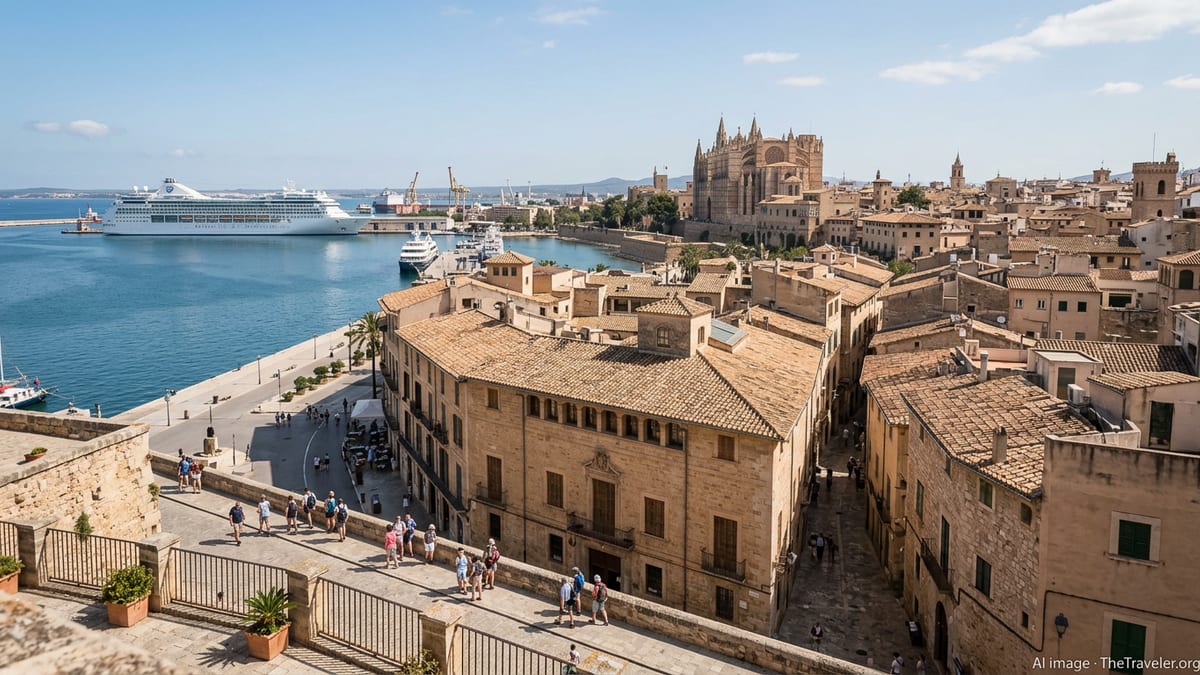
Perpignan’s hilltop Palace of the Kings of Majorca, a fortified Gothic complex overlooking the city, remains the most visible reminder of this era. Heritage documentation on the site notes that the palace was conceived as both royal residence and administrative center when Perpignan became capital of the mainland territories in 1276. In Palma, the circular Bellver Castle and the waterfront royal palace of La Almudaina anchor a dense historic quarter that modern tourism material increasingly presents as the island’s royal heart.
Recent tourism strategies in both destinations are placing renewed emphasis on this shared royal narrative. Publicly available information from Balearic and local French tourism bodies points to a shift from purely sun and beach promotion toward cultural storytelling that situates Palma and Perpignan within a common medieval Mediterranean network.
Palma Builds Royal Narratives Into Urban Routes
Palma has spent the past decade reshaping its old town as an open-air museum of Gothic, Islamic and Modernist layers, with several official walking routes now foregrounding its royal legacy. Destination guides produced for the Balearic Islands describe themed itineraries that pass La Seu cathedral, La Almudaina, Bellver Castle and a string of aristocratic courtyards, presenting them as the architectural backdrop to the Majorcan monarchy.
In addition to long-established “monumental Palma” tours, newer cultural routes in the city highlight Art Nouveau facades around the former Gran Hotel, now a cultural center, as symbols of a later urban renaissance. Tourism planners frame these routes as ways to disperse visitors beyond the waterfront and cruise terminal while strengthening the sense of a historic capital whose influence once extended far beyond Mallorca.
The city’s ongoing seafront redevelopment, described in municipal and tourism updates as a bid to create a more pedestrian-friendly promenade, is also being tied into this positioning. By improving access between the port, La Almudaina and the old town, Palma aims to make the arrival experience feel closer to a ceremonial gateway, echoing the movements of medieval courts that reached the city by sea.
Perpignan Leans on Its Palace and Cross‑Border Identity
On the northern side of the old kingdom, Perpignan is likewise stepping up promotion of its royal assets. The Palace of the Kings of Majorca has long hosted concerts and summer events, but recent cultural programming increasingly highlights its role as the nerve center of a Mediterranean court that linked Roussillon with Palma, Collioure and other coastal sites.
French regional tourism materials describe Perpignan as a “southern capital” with a Catalan identity, emphasizing the period when the city flourished under the Majorcan kings. Exhibitions and guided tours at the palace focus on the ceremonial life of the court and the city’s golden age in the late thirteenth and early fourteenth centuries, presenting Perpignan as a key stop on cross-border heritage circuits that also include the nearby Royal Castle of Collioure.
Urban renewal projects around the historic center and railway station are being framed as opportunities to reconnect Perpignan with its medieval core. Planning documents point to improved wayfinding and new cultural signage that draw visitors from modern arrival points toward the palace hill, effectively reinstating the royal complex as a symbolic anchor of the city’s tourism offer.
From Maritime Crossings to Modern Cultural Corridors
Historical research into the court of the Kings of Majorca notes that monarchs and their retinues routinely traveled between Palma, Perpignan and coastal strongholds such as Collioure. These journeys created a steady flow of people, ideas and goods across the western Mediterranean, long before modern tourism routes. Contemporary operators are now seeking to echo this movement with themed itineraries by sea and land that conceptually reconnect the former capitals.
Ferry links between mainland Spain and the Balearic Islands, as well as high-speed train connections to Perpignan from Paris and Barcelona, are being marketed in combination with cultural packages that include palace visits, gastronomy experiences and heritage walks. Regional tourism campaigns refer to the idea of traveling “in the footsteps of the Majorcan kings,” inviting visitors to pair a stay in Palma’s historic center with time in Perpignan’s old town and palace district.
These initiatives reflect a broader Mediterranean trend in which ports and coastal cities reposition themselves as gateways to culture rather than purely transit points. By framing crossings between island and mainland as part of a historical journey, travel providers and destination managers aim to encourage longer stays and more evenly distributed visitor flows across both territories.
Heritage, Identity and the Search for Higher‑Value Tourism
The renewed focus on royal heritage in Palma and Perpignan coincides with wider debates about tourism models on both sides of the sea. In the Balearic Islands, policy documents and academic studies describe efforts to reduce dependence on peak-season beach tourism and to promote cultural and urban experiences that spread visitors across the year. Palma’s emphasis on museums, architectural routes and historic neighborhoods forms part of this diversification strategy.
Perpignan faces its own balancing act as a regional hub near the French coast and the Spanish border. Local development plans highlight culture and heritage as tools to stimulate the city center, attract overnight stays and reinforce a distinct Catalan-influenced identity. The Palace of the Kings of Majorca, together with surrounding squares and viewpoints, is central to this narrative, serving as a visual reminder that Perpignan once stood at the crossroads of island and mainland politics.
Observers of European tourism policy note that cultural routes certified at continental level have become increasingly influential in shaping such strategies. While Palma and Perpignan are not yet formally tied together within a single branded royal route, the growing emphasis on their shared Majorcan past suggests that a more explicit joint product could emerge, positioning the two cities as complementary gateways to a revived Mediterranean kingdom in the imagination of travelers.