


More news on this day
Recent incidents in which passengers were ordered off planes and trains mid-journey and left to navigate unfamiliar cities on their own are sharpening concerns about how well major carriers handle disruptions and protect stranded travelers.
Get the latest news straight to your inbox!
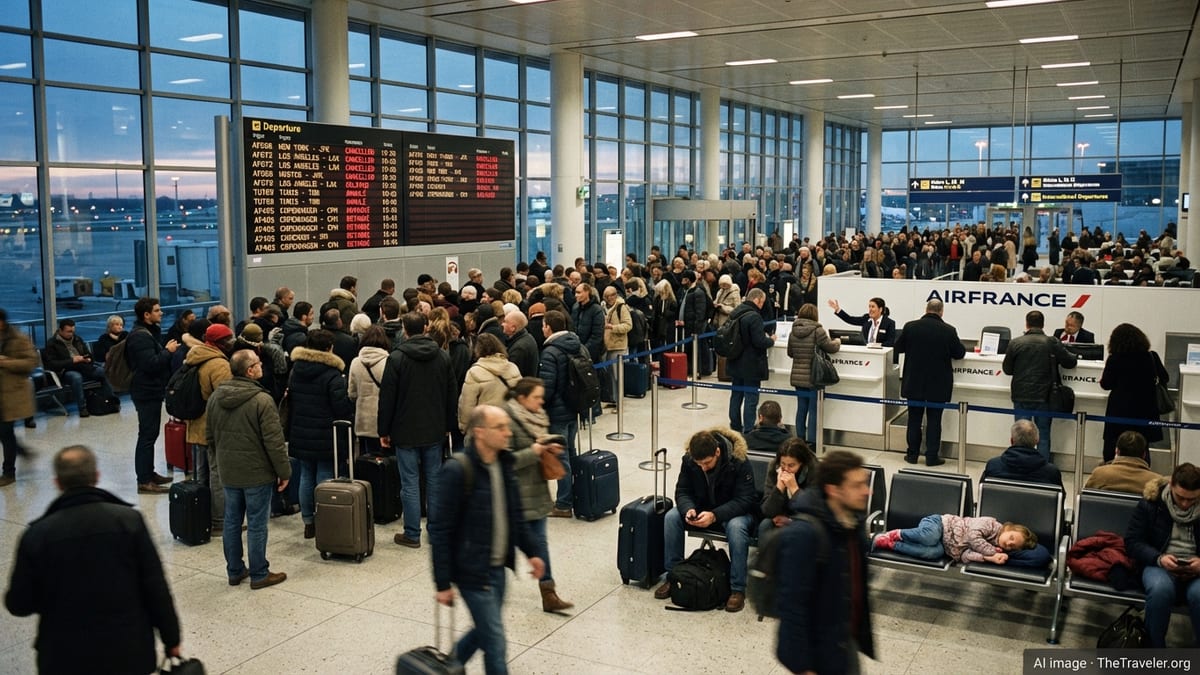
Storm diversion leaves airline passengers marooned between cities
One of the most widely discussed recent cases involves a U.S. domestic flight that diverted during severe weather, leaving customers unexpectedly on the ground at a different Florida airport with no clear path to their final destination. According to published coverage, the flight, operated by a major U.S. carrier, was en route to Tampa when storms forced a diversion to Southwest Florida International Airport in Fort Myers.
Reports indicate that after landing to refuel and wait for clearance, passengers were told to deplane and collect their luggage, only to later learn that the aircraft would continue to Tampa without them. Travelers described being trapped between airports, with bags in transit and limited guidance on rebooking or ground transportation, illustrating how a short operational delay can cascade into an overnight ordeal.
Publicly available information shows that the airline later said the aircraft remained on the ground for around 80 minutes before departing again, framing the sequence as a standard weather diversion and turnaround. For those left behind, however, the experience highlighted how opaque communication, confusion over baggage handling and a lack of on-the-ground support can leave passengers feeling effectively abandoned mid-journey.
The episode has sparked renewed debate among consumer advocates over how much responsibility airlines should bear when a flight is technically able to continue and reach its scheduled destination, but some passengers are left to reconstruct their own itineraries from a diversion point.
Mechanical failures halt trains and strand hundreds on remote stretches
Rail passengers have also faced abrupt mid-route disruptions in recent weeks. In Southern California, a Metrolink commuter train broke down on the tracks in Anaheim Hills in July, leaving hundreds of people in limbo between stations. Local reporting describes how a mechanical failure stopped the train in an area where it was not considered safe to disembark directly onto the right-of-way.
Because of the train’s position, passengers could not simply be walked along the tracks to the nearest platform. Public information indicates that crews instead had to wait for another train and specialized equipment to reach the location, extending the delay and leaving travelers uncertain about when, or how, they would complete their journeys.
Similar constraints have appeared in other rail incidents, from power disruptions on urban lines to infrastructure faults that immobilize trains in tunnels or on bridges. In many of these cases, safety rules prevent operators from allowing passengers to exit until emergency teams and alternative transport are in place, which can turn a routine commute into an hours-long wait in a stationary carriage.
For travelers, the distinction between being kept on board for safety reasons and being formally “stranded” can feel academic. Limited information, intermittent air conditioning and the absence of clear timelines often fuel frustration, particularly when connecting services, work commitments or hotel reservations are at stake.
Collision and infrastructure incidents expose limits of contingency planning
Other recent disruptions have been triggered not only by mechanical faults but by collisions and infrastructure damage that suddenly halt long-distance services. In August, passengers aboard an Amtrak train in Hancock County, Mississippi, were left without onward transport after the train struck an 18-wheeler at a grade crossing. Regional news coverage notes that the collision sent nine people to hospital and left the train unable to continue, stranding the remaining passengers in a rural area.
According to publicly available statements from local agencies, buses were eventually organized to move people to their destinations, with assistance from the area school district in providing vehicles. Even with that support, the incident underscored how fragile end-to-end travel plans can be when a single crash blocks a mainline and there is no immediate substitute service.
Elsewhere, national rail networks in Europe and Australia have confronted infrastructure failures that forced mid-route evacuations. Overhead power lines coming down on a Sydney passenger train in August caused major delays and prompted a complex operation to get people safely off a train that had stopped in a difficult location. In the United Kingdom, a series of derailments and weather-related disruptions over the summer have also highlighted how quickly a routine intercity trip can turn into an unplanned overnight stay for hundreds of passengers.
In each of these scenarios, operators are required to prioritize safety, sometimes at the cost of timely information or seamless transfers. For travelers left waiting in remote stations, highway crossings or improvised bus hubs, the practical effect can feel much the same as being forced out midway and left on their own.
Consumer rules lag behind real-world disruption scenarios
The patchwork of national and regional passenger-rights regimes leaves significant gray areas when travelers are removed from vehicles or stranded between origin and destination. In the United States, federal rules for air travel primarily govern issues such as tarmac delays and denied boarding, rather than what happens when a flight diverts and only some passengers complete the journey. The result, consumer advocates argue, is that many mid-journey disruptions fall into a gap between formal cancellation and routine delay.
On rail systems, the picture is similarly uneven. In Europe, common rules promise assistance and in some cases compensation for long delays, but their application can vary depending on whether disruptions stem from weather, third-party incidents or operator fault. In North America and parts of Asia-Pacific, long-distance train passengers often depend on company policy and goodwill rather than clear statutory guarantees when services stop short of their advertised endpoint.
Legal specialists point out that even where protections exist, they may not anticipate scenarios in which passengers are instructed to leave an aircraft or train while the vehicle itself eventually proceeds, as seen in the Florida diversion case. Questions remain over whether such customers should be treated as having experienced a cancellation, a diversion or a voluntary change, each of which triggers different levels of support.
As major transport networks grapple with aging infrastructure, more extreme weather and congested airspace, the number of partial journeys and mid-route disruptions is likely to grow. Policy discussions are increasingly focused on how to make sure that when passengers are forced out midway, they are not left stranded without clear rights to accommodation, rebooking and safe onward travel.
Travelers adapt with new strategies amid recurring disruptions
In the absence of uniform protections, experienced passengers are adopting their own strategies to reduce the risk of being left in an unfamiliar place without options. Frequent flyers increasingly monitor weather and air-traffic patterns before travel days, opting for morning departures that are less vulnerable to cascading delays and diversions. Some choose routings that keep connections within driving distance of home, so that if they are forced off mid-itinerary they can rent a car or call for a pickup.
Rail travelers, especially commuters on busy regional networks, are building extra buffer time into their schedules when moving between trains, buses and ferries. Reports from recent breakdowns suggest that passengers who had flexible tickets or travel insurance found it easier to pivot to alternate services when a train stopped between stations, while others were left with limited recourse but to wait.
For the wider travel industry, each incident in which passengers are forced out midway and left to improvise raises reputational stakes. Airlines and rail operators are under increasing pressure not only to prevent disruptions, but also to provide clearer communication, more transparent escalation procedures and rapid coordination with ground transportation partners when journeys cannot be completed as planned.
With peak holiday seasons and severe-weather periods ahead, the way carriers handle the next wave of mid-journey disruptions will help determine whether passengers see these cases as unfortunate one-offs or as a systemic weakness in global mobility.
https://nz.news.yahoo.com/passengers-left-behind-crew-allegedly-160537971.html