


Travelers heading into the central mountains of Puerto Rico often face a deceptively simple choice: stop at Jayuya’s riverside petroglyphs at Piedra Escrita, or drive on to the larger Taíno ceremonial complex at Caguana in neighboring Utuado. On a recent research trip for this article, I visited both on the same day, taking notes on driving times, costs, accessibility, and how much each place actually taught me about precolonial Taíno life. What follows is a practical, experience-based comparison to help you decide how to spend your precious hours in the Cordillera Central.
Get the latest updates straight to your inbox!
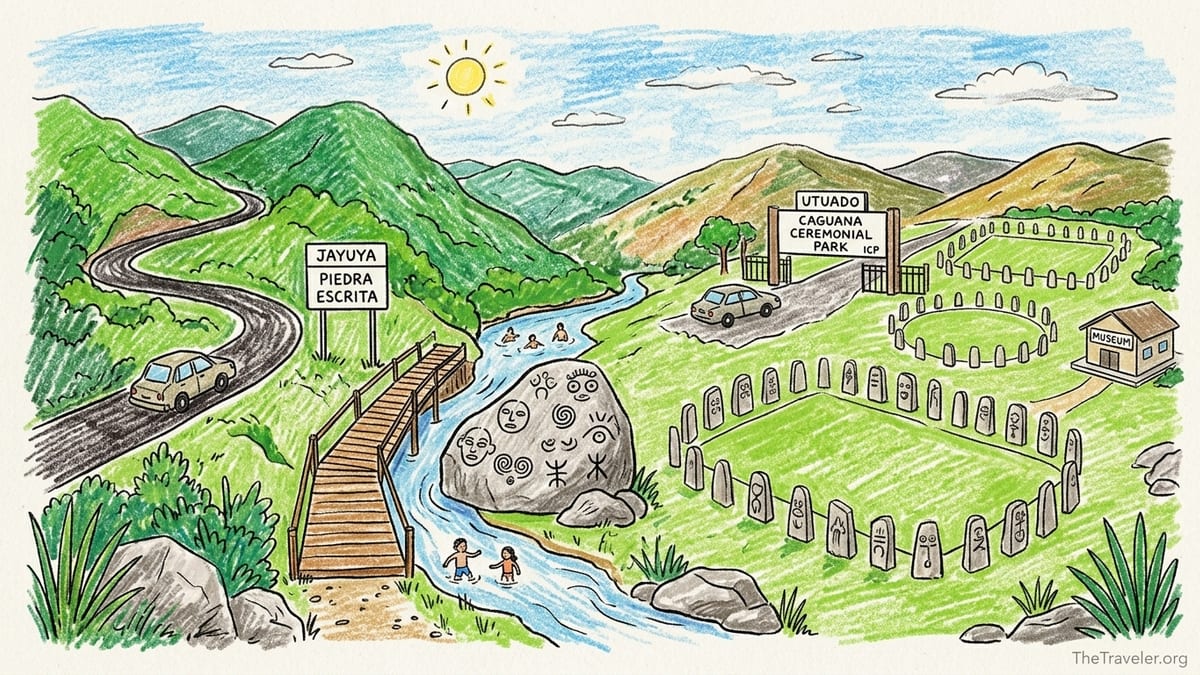
Getting There: Distances, Driving Times and First Impressions
I began the day in Utuado town and used it as my base to visit both sites. From Utuado’s central plaza, it took me about 35 minutes to reach Piedra Escrita in Jayuya via PR-140 and then PR-144, a winding but paved mountain road. From Piedra Escrita, driving back through the hills to Caguana Ceremonial Park in barrio Caguana took roughly 40 minutes, mostly along PR-144 and PR-111. Travelers coming from San Juan can expect about 1 hour 30 minutes to Caguana via PR-22 and PR-10, and roughly 1 hour 45 minutes to reach Piedra Escrita in Jayuya, depending on traffic and weather.
Piedra Escrita is signposted as Área Recreativa La Piedra Escrita along PR-144 in Jayuya. The setting felt distinctly local: a small parking area, a kiosk-style restaurant overlooking the valley, and the sound of the Río Saliente far below. In contrast, Caguana Ceremonial Park sits along PR-111 at kilometer 48.6 in Utuado, with an entrance gate, a paved parking lot, and signage indicating it is administered by the Instituto de Cultura Puertorriqueña. Even before stepping out of the car, it was clear that Caguana operates as an organized archaeological park, while Piedra Escrita remains a community-oriented riverside recreation area with a major petroglyph boulder.
Because mountain weather can change quickly, I started early. I arrived at Piedra Escrita around 9:30 a.m., when temperatures were still comfortable and the light on the river was gentle for photography. I reached Caguana shortly after midday, around 12:15 p.m., with bright sun illuminating the bateyes and carved stone monoliths. This timing matters in practice, since midday light can be harsh on the river at Jayuya, and rain can temporarily close off parts of the ball courts at Caguana when the ground is saturated.
In terms of costs and logistics, Piedra Escrita itself did not charge admission during my visit. Parking by the recreational area was free, and the main expense was a simple lunch and cold drink at the small restaurant above the boardwalk, which came to under 20 dollars for one person. At Caguana, entry to the archaeological grounds and small museum was 5 dollars for adults and 3 dollars for children ages 6 to 13, cash only, consistent with rates confirmed by tourism and museum guides updated in mid-2026. Including a cold drink from a roadside colmado on PR-111, my total direct out-of-pocket spending for both sites came in under 30 dollars.
Walking the Boardwalk to Piedra Escrita: A Close Encounter with Petroglyphs
From the roadside parking at Piedra Escrita, a sloping wooden boardwalk and ramp descend to the river. The structure is wide and has railings, and it is broadly wheelchair-friendly on the way down, though pushing back up its steady incline would require assistance or a strong companion. The walk takes only a few minutes, but it feels like a transition: the sound of traffic fades, replaced by birds, rushing water, and occasional shouts from swimmers below.
The boardwalk ends near broad, smooth rocks that serve as a natural viewing platform for the main attraction: a huge granite boulder sitting directly in the Río Saliente, its surfaces covered in carved Taíno petroglyphs. Even after seeing photographs in guidebooks, encountering the stone in person was striking. Human-like faces, spiral motifs, and abstract symbols emerge slowly as your eyes adjust to the interplay of light and wet rock. Depending on water level, some carvings sit just above the flow, others higher on the boulder, all framed by the narrow valley of green hills.
This is an intimate encounter with rock art in a living landscape. Children splashed in the river pool just upstream, families sat on towels on the flat rocks, and yet the boulder clearly commanded a different kind of attention. Small signs and travel resources explicitly remind visitors not to touch or walk on the carvings, even though the stone sits within a public swimming spot. Part of the experience here is negotiating that tension: you can approach very close, but ethical visiting means keeping hands, feet, and inflatable tubes off the carved surfaces.
Interpretive information on site was minimal during my visit. I did not encounter a formal guide, and the signs near the boardwalk mostly focused on safety and basic site identification rather than detailed Taíno history. To understand more, I relied on prior reading about the Saliente River valley and later checked municipal information that describes the boulder as one of Puerto Rico’s most significant concentrations of indigenous petroglyphs. Standing there, however, what I felt most strongly was not an abstract archaeological narrative, but the continuity of place: the same river, same boulder, and likely similar patterns of gathering and bathing that must have occurred here for centuries.
Exploring Caguana: Bateyes, Monoliths and a Museum in the Taíno Heartland
Caguana Ceremonial Park offered a very different scale and structure of visit. After parking in the large, free lot by the entrance, I walked into the main building where a staff member collected the cash admission and offered a brief introduction in Spanish, with basic information also available in English. The ground floor includes a small but focused museum room displaying Taíno artifacts, models of ball courts, and interpretive panels on precolonial societies in Borikén, the Taíno name for Puerto Rico.
From there, a short path leads out to the grassy ceremonial complex. The site includes around ten rectangular and circular bateyes, or ceremonial ball courts, defined by rows of standing stone monoliths. Many of these stones bear carved petroglyphs similar in style to those at Piedra Escrita, but here the carvings align with the layout of plazas used for areytos, ancestral dances, and ball games that carried political and spiritual meaning. Walking slowly among the courts, I could imagine spectators gathered on the edges, leaders making decisions, and ritual performances embedded in daily life.
The park has designated walking paths that guide visitors around and, in some cases, between the bateyes. On dry days, you are allowed to traverse the grassy courts themselves, although staff may restrict access when heavy rain has left the ground muddy to protect both visitors and the site. Simple interpretive panels, mostly in Spanish with some bilingual content, identify the main plazas, describe how Taíno communities organized around caciques, and explain the significance of ball games in mediating disputes and honoring deities.
Compared with Piedra Escrita, Caguana provided much broader social and ceremonial context. While the petroglyphs at Jayuya sit in a narrow canyon framed by water and cliffs, here the carvings are part of a recognizable village-scale layout. The surrounding karst landscape of Utuado, with its cone-shaped mogote hills visible from the park, reinforces historical accounts that describe Caguana as a regional ceremonial center. Walking through multiple courts, seeing the repeating patterns of monoliths, and then returning to the museum exhibits created a loop that connected individual carvings to a whole lived world.
Admission, Hours, Parking and What Was Actually Open
For travelers, practical details can make or break a visit to mountain sites. When I visited, Piedra Escrita functioned as an open recreational area with no gate or fixed schedule. The boardwalk, riverside rocks, and main boulder were accessible, and the adjacent restaurant was open for lunch service. Because there is no staffed entrance booth, facilities like restrooms depend on the restaurant and may not be available at all hours. I recommend arriving earlier in the day, both to enjoy gentler temperatures and to avoid the busiest swimming period.
Caguana, by contrast, operates as a managed heritage park. Current information from cultural and tourism sources indicates it is generally open daily from mid-morning to mid-afternoon, with typical posted hours around 9:00 a.m. to 4:00 p.m. Because both hours and access to the grass courts can change on short notice, it is wise to call one of the published phone numbers for the park office or check with the Instituto de Cultura Puertorriqueña or local tourism offices shortly before you travel. During my midday weekday visit, the parking lot, museum room, restrooms, and main ceremonial plazas were all open, though one smaller area near the tree line was roped off for maintenance.
Admission at Caguana in 2026 stands at 5 dollars for adults and 3 dollars for children 6 to 13, cash only, which I verified by confirming both tourism publications and a printed fee sheet at the entrance desk. That single fee covered parking, the museum exhibit, and access to the archaeological grounds. The modest price means that for a couple or small family, you can budget roughly 10 to 16 dollars for entry, plus any snacks or drinks purchased in Utuado or at small colmados along PR-111.
In terms of what was actually open and usable, both sites were fully accessible on the day I went, but each is vulnerable to weather. Heavy rains can make the descent to the river at Piedra Escrita slick and may raise water levels to the point where safe viewing platforms are reduced. At Caguana, staff told me they sometimes close access to the grassy courts and ask visitors to remain on the perimeter paths when the ground is saturated. Neither site guarantees full access after major storms, so checking local conditions before departure is essential, particularly during the Atlantic hurricane season.
Accessibility, Language and On-Site Interpretation
Accessibility differs noticeably between the two sites. At Piedra Escrita, the wooden ramp and boardwalk offer an important measure of access for visitors who cannot manage steep dirt trails, yet there are trade-offs. The descent is long and sloping, and although the surface is smooth, pushing a wheelchair or stroller back up requires stamina and possibly assistance. Once at river level, stepping onto the natural rock platforms involves uneven surfaces and occasional wet patches. Someone using a cane could manage with care, but visitors with significant mobility challenges may find the final approach to the water’s edge difficult.
Caguana’s main building, including the museum space and restrooms, is on level ground and easier to navigate for visitors with limited mobility. The archaeological area itself, however, is largely grass and compacted soil. Paths are not fully paved, and there are occasional small slopes between courts. Official guidance notes that while the museum is wheelchair accessible, the ceremonial plazas are not. In practice, a visitor using a wheelchair can still enjoy the interior exhibits, views from the edge of the site, and some of the monoliths closest to the main path, but reaching every batey would be challenging.
Language and interpretation also diverged. At Piedra Escrita, I did not find layered interpretive panels or staff-led tours. Most informational signs were in Spanish and limited to place names, safety, and rules. Travelers who arrive without prior reading may appreciate the beauty of the setting and the mystery of the carvings, but they will not receive a deep explanation of Taíno cosmology or the specific meanings archaeologists associate with these motifs. That gap can be partially filled by consulting reliable articles or guidebooks before or after your visit.
At Caguana, the experience felt more structured. The staff member at the entrance offered a short orientation in Spanish, answered questions about the history of the park, and pointed me to bilingual panels summarizing Taíno social organization, subsistence, and religious practices. Some labels in the museum room remained Spanish-only, but the overall storyline was clearer even for visitors with intermediate Spanish or minimal background knowledge. While there was no continuous guided tour on offer during my visit, the availability of a person to ask, physical models of bateyes, and maps of the site made Caguana easier to understand as a functioning ceremonial center rather than a collection of mysterious stones.
Photography, Respect and Why You Should Not Touch the Carvings
Both Piedra Escrita and Caguana are visually compelling, and photography is generally permitted at each. At Piedra Escrita, the interplay of rock, water, and carved faces invites close-up shots. At Caguana, wide-angle photos capturing multiple courts against a backdrop of green hills highlight the scale of Taíno ceremonial architecture. In both places, however, the ease of access can create ethical blind spots for visitors who treat the petroglyphs as props rather than fragile cultural heritage.
Multiple heritage and travel resources emphasize that, despite being in the public eye, neither site is an invitation to touch, trace, or climb on the carvings. Oils from skin accelerate the deterioration of rock surfaces, and repeated friction can soften or erase shallow incisions that have survived for centuries. At Piedra Escrita, where swimmers wade around the boulder, it can be tempting to scramble up for a photo. Responsible guides and municipal information explicitly warn against stepping onto the engraved panels, even if other visitors do so.
Caguana’s regulations are equally clear. Posted rules and cultural organizations associated with the site ask visitors not to touch petroglyphs or climb on stone monoliths. The courts remain active sacred spaces for contemporary Taíno communities who hold areytos and other ceremonies there on special dates. Respecting boundaries is not only about preserving archaeology for future generations but also about recognizing that these are living ceremonial landscapes, not abandoned ruins.
From a photographer’s perspective, the restrictions did not feel limiting. At both sites, I was able to capture detailed images using a moderate zoom lens without stepping off designated areas. Oblique angles with raking light in the morning at Piedra Escrita made the petroglyphs stand out vividly, while late-morning sun at Caguana highlighted the relief on carved monoliths along the main bateyes. Anyone serious about ethical travel photography should plan shots that honor both preservation guidelines and the wishes of descendant communities.
Educational Value: Which Site Taught Me More?
In preparing for this comparison, I expected Caguana to deliver a broader, more structured lesson in Taíno history, and Piedra Escrita to offer a powerful but less explained encounter with individual carvings in nature. That expectation largely held true. Caguana’s combination of museum displays, labeled bateyes, and available staff made it easier to connect dots between social hierarchy, cosmology, and daily life in precolonial Borikén.
For example, standing in the largest central batey at Caguana, with panels explaining that such plazas hosted political councils and ritual ball games, helped anchor abstract concepts of “chiefdoms” and “ceremonial centers” in a real, walkable space. Seeing multiple courts laid out in sequence suggested a regional hub that drew people from surrounding communities, a point reinforced by the archaeological literature highlighted in the museum. The visit left me with a much clearer mental map of how Taíno society may have organized leadership, worship, and conflict resolution.
Piedra Escrita, by contrast, excelled at conveying the intimacy of symbol-making and the persistence of place. Without extensive signage, I found myself studying the individual faces and spiral motifs, imagining the hands that carved them while water rushed around my ankles. That focus on a single monumental rock invited reflection on how a specific feature in the landscape can accumulate meanings over generations. The lack of formal interpretation meant I learned less in terms of names, dates, and political structures, but I felt a strong emotional and sensory connection to the petroglyphs themselves.
If I had to rate the sites purely on educational content delivered during the visit, Caguana clearly came out ahead. It provided narrative coherence, chronological context, and concrete examples of Taíno social and ceremonial life. Piedra Escrita, however, contributed something that the more organized park could not replicate fully: the felt sense of rock art embedded in a flowing river environment that local families still use as a natural swimming hole. Ideally, travelers with an interest in Taíno heritage will experience both, allowing the strengths of each to complement the other.
Expectations vs Reality, Spending, and Whether I Would Visit Again
Going into the day, I expected Caguana to feel somewhat museum-like and Piedra Escrita to feel wild and unstructured. The reality was more nuanced. Caguana did indeed function as an archaeological park complete with a small indoor exhibit and staffed entrance, but the open fields, birdsong, and mountain backdrop kept it from feeling sterile. Piedra Escrita turned out not to be an isolated “hidden” site but a well-known family recreation area where archaeology and everyday leisure blend in a single riverside setting.
In terms of what I actually saw, the artifacts and landscapes at Caguana provided a layered experience. I walked several bateyes, examined carved monoliths at varying heights, and spent time in the museum studying ceramic fragments and stone tools. At Piedra Escrita, the focus remained on one extraordinary rock, the river pools around it, and the way the canyon narrows to frame the site. Together, these visits created a composite picture of Taíno cultural expressions: large-scale ceremonial planning on a hill-framed terrace in Utuado, and dense clusters of symbols carved into a single granite boulder in Jayuya’s mountain river.
My total direct spending for both visits was modest: under 20 dollars for lunch and a drink at the restaurant above Piedra Escrita, around 5 dollars for my adult admission at Caguana, a couple of dollars for extra bottled water and a snack from a roadside shop, and the unavoidable but unitemized cost of gasoline for the rental car. The combined driving time between all three points Utuado, Piedra Escrita, and Caguana stayed under two hours, which made visiting both sites in one long day entirely realistic.
What disappointed me most was the relative lack of detailed on-site interpretation at Piedra Escrita. Given its archaeological importance, even a single well-designed panel summarizing research on the petroglyphs and their possible meanings would dramatically improve the educational value for visitors arriving without background knowledge. At Caguana, the main limitation was accessibility to the inner areas of some courts for people with mobility challenges and the possibility of weather-related closures. Neither of these drawbacks outweighed the benefits, and if anything, they underscored the need to prepare with accurate information and realistic expectations.
Would I visit both again? Absolutely. For a traveler with genuine interest in Taíno heritage, the combination of Caguana’s broad context and Piedra Escrita’s intimate river setting feels greater than the sum of its parts. If I had only three or four hours in central Puerto Rico, I would prioritize Caguana for its interpretive depth, especially for a first visit. With a full day and private transportation, however, pairing an early stop at Piedra Escrita with an unhurried afternoon at Caguana is one of the most rewarding archaeological itineraries in the central mountains.
The Takeaway
When I weigh expectations against what I actually encountered, Caguana Ceremonial Park emerges as the stronger choice for travelers who want to understand Taíno social and ceremonial life in a structured way. Its network of bateyes, carved monoliths, museum exhibits, and available staff guidance collectively offer a coherent narrative of precolonial Borikén. Walking from court to court, then back inside to examine artifacts, gave me the clearest sense of how ritual, politics, and daily existence may have woven together for Taíno communities in the Utuado highlands.
Piedra Escrita, meanwhile, shines as an intimate, symbol-focused experience that fuses archaeology with a living river landscape. Descending the boardwalk, hearing families laugh in the natural pools, and then standing quietly before the petroglyph-covered boulder reminded me that sacred and everyday spaces often overlap. The site did not teach me as much factual history on its own, but it deepened my appreciation for Taíno artistic expression and for the endurance of place-based cultural meaning.
For archaeology enthusiasts with the time and mobility to tackle mountain roads, my recommendation is clear: visit both, ideally on the same day, so that Caguana’s big-picture context can frame the more intimate encounter at Piedra Escrita. Families with school-age children might also benefit from doing Caguana first, where museum displays and staff explanations can answer basic questions, then rewarding the kids with a supervised swim and petroglyph viewing at Jayuya. Photographers should consider early-morning light at Piedra Escrita for raking shadows on the rock, and late morning or early afternoon at Caguana to capture the full sweep of the courts and surrounding hills.
For travelers with only a few hours in central Puerto Rico or those relying on limited mobility, Caguana is the more efficient and accessible way to gain meaningful insight into Taíno heritage. Yet even in that scenario, keeping Piedra Escrita in mind for a future trip or pairing it with an overnight in Jayuya can pay dividends. Both sites reward unhurried, respectful attention, and both remind visitors that public access does not equate to casual treatment of ancient carvings. Arrive informed, move with care, and let each landscape teach you in its own language of stone, water, and memory.
FAQ
Q1. Can I visit both Piedra Escrita and Caguana in one day?
Yes, it is realistic to visit both in one day if you have a rental car. Driving between Jayuya’s Piedra Escrita and Caguana Ceremonial Park in Utuado takes roughly 40 minutes, and each site can be explored meaningfully in about one to two hours.
Q2. How much does it cost to visit Caguana Ceremonial Park?
As of 2026, admission to Caguana is 5 dollars for adults and 3 dollars for children ages 6 to 13, payable in cash at the entrance desk. This fee includes access to the small museum, restrooms, parking and the archaeological grounds.
Q3. Is there an admission fee at Piedra Escrita in Jayuya?
During my visit, access to the Área Recreativa La Piedra Escrita and the boardwalk to the river was free. Costs were limited to optional food and drinks at the nearby restaurant and transportation expenses. Because local arrangements can change, it is wise to bring some cash in case a parking or facility fee is implemented in the future.
Q4. Are the petroglyphs at either site protected by law?
Yes, both sites form part of Puerto Rico’s protected archaeological heritage. Caguana is managed by the Instituto de Cultura Puertorriqueña as a formal ceremonial park, and Piedra Escrita has been the subject of efforts to recognize it as a national monument. Visitors are expected to help protect the carvings by not touching, climbing, or defacing them.
Q5. Is it appropriate to swim at Piedra Escrita?
The Río Saliente around Piedra Escrita is a popular local swimming spot, and many visitors do enter the water and enjoy the natural pools. Swimming itself is acceptable where conditions are safe, but you should avoid touching or climbing on the carved surfaces of the main boulder and stay mindful of river levels and currents, especially after heavy rain.
Q6. How accessible are the sites for visitors with limited mobility?
Piedra Escrita features a long sloping boardwalk that is technically wheelchair-friendly, though pushing back up can be strenuous and the final approach onto natural rocks may be difficult. At Caguana, the museum building and restrooms are on level ground and easier to access, while the grass-covered ceremonial plazas pose challenges for wheelchairs and some mobility aids.
Q7. Are guided tours available at Caguana and Piedra Escrita?
At Caguana, staff at the entrance provide brief orientations, and on some days guides or educators may be available for more detailed explanations, especially for groups. At Piedra Escrita, there was no formal guiding presence during my visit, and interpretation consisted mainly of simple signs, so visitors interested in deeper context should read up on Taíno rock art beforehand.
Q8. Is photography allowed at the sites?
Photography is generally allowed at both Piedra Escrita and Caguana. Visitors are encouraged to take photos from designated paths and viewing areas without touching the carvings or climbing on stones. At Caguana, you should also respect any posted restrictions in the museum room and avoid photographing active Taíno ceremonies without explicit permission.
Q9. Which site is better for learning about Taíno culture with children?
For structured learning, Caguana is usually better for families. The small museum, labeled courts, and staff orientation make it easier for school-age children to grasp who the Taíno were and how they lived. Piedra Escrita can be an engaging follow-up, combining a short walk and river time with a close look at petroglyphs if adults provide the historical context.
Q10. If I only have time for one site, which should I choose?
If you must choose, Caguana Ceremonial Park is the stronger single stop for most travelers, especially first-time visitors or those interested in archaeology. It offers a broader view of Taíno ceremonial life, multiple courts, a museum space, and staff support. Piedra Escrita is ideal if you prioritize a natural river setting and an intimate encounter with a single, heavily carved boulder, but it delivers less structured historical interpretation on its own.