

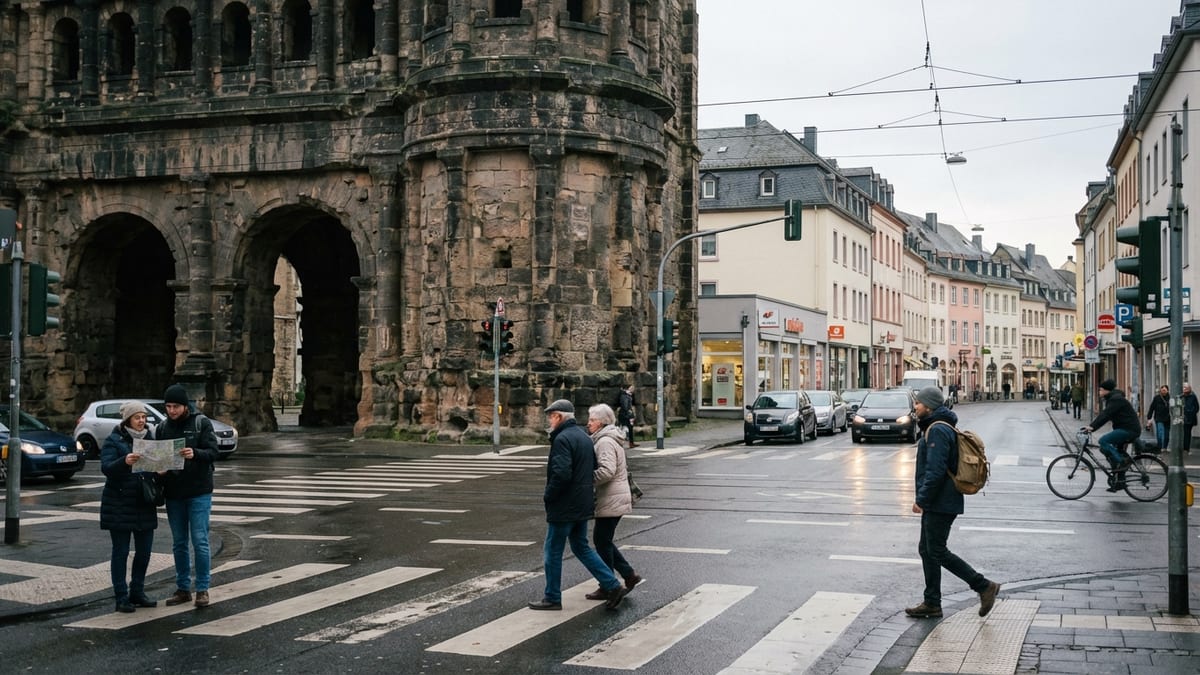
Rising dark and monumental above the old town of Trier, the Porta Nigra is more than a photogenic Roman ruin. It is a rare survivor of imperial ambition, medieval piety, and modern conservation, layered in sandstone that has blackened over nearly two millennia. For travelers, it offers not only a dramatic gateway into Germany’s oldest city but also into the story of how Europe’s Roman past is still lived with and interpreted today.
The Story Behind the “Black Gate”
The Porta Nigra stands at the northern edge of Trier’s historic core, where it originally functioned as a monumental entrance to the Roman city. Construction began shortly after the year 170, when Trier was an important urban center of the Roman province in the Moselle valley. At the time, it was one of four main gateways punctuating the defensive wall that encircled the city. Porta Nigra is central to the main things to do in Trier.
The name “Porta Nigra” itself is a medieval invention. In antiquity, the gate likely had a Latin name linked to its function as the northern city gate, but that designation has not survived. By the Middle Ages, locals started calling it the “Black Gate” because the pale sandstone had darkened with age, pollution, and lichen, giving the structure its now-iconic somber tone. The nickname stuck and has been in use for at least nine centuries. This landmark plays a major role when deciding if Trier is worth visiting.
Over its lifetime, Porta Nigra has been adapted, dismantled in part, repurposed and “rescued” multiple times. Remarkably, each of these phases has left a trace, turning the building into a kind of three-dimensional archive of European history. When you explore the interior today, you are not just walking through a Roman military structure but also through a medieval church and a carefully restored 19th century monument.
Roman Origins and Military Purpose
When the Romans erected Porta Nigra in the late second century, Trier was expanding as a strategic and administrative hub along the Moselle River. The city walls and gates projected power and security, expressing Rome’s authority on a frontier not far from tribal territories. Porta Nigra was part defensive work, part imperial showpiece, announcing the city’s importance to anyone arriving from the north.
The gate was constructed using massive blocks of local grey sandstone. Many individual stones weigh up to six tons, and some even more. In Roman fashion, these blocks were not held together with mortar. Instead, builders used iron clamps set into carved grooves to bind the stones. This method, combined with the sheer weight and precision of the masonry, produced a remarkably stable structure that has survived earthquakes, wars, and centuries of neglect.
Functionally, the Porta Nigra was a controlled passage through the city wall. Its design included multiple passageways, internal staircases, and rooms for guards. It provided a vantage point over approaching traffic and could be defended if necessary. Yet, like other grand Roman gates, it was also ceremonial, framing processional entries, military parades, and the daily flow of commerce into the city.
Architecture: A Roman Giant in Sandstone
Even at first glance, the scale of Porta Nigra is striking. The gate rises nearly 30 meters above street level in a series of stacked arcades, giving it a towering, fortress-like presence. From the outside, you see two main levels of arches, with an additional story and attic-like upper zone that you experience more fully once inside. The play of light and shadow across the darkened stone emphasizes its mass and age.
The architecture draws on Roman military and Hellenistic traditions, with heavy projecting towers flanking the central passageways. Originally, the structure combined four arched openings at ground level, though changes over the centuries have altered the exact arrangement. Above, arcaded galleries and windows overlook what used to be the exterior and interior sides of the city wall, inviting comparison with Roman amphitheaters and city gates in Italy and North Africa.
Inside, the design is more intricate than its severe exterior suggests. Narrow staircases, vaulted rooms, and long corridors lead you through multiple levels. Some spaces are surprisingly light and airy, with views across Trier’s rooftops and to the hills that encircle the Moselle valley. Others remain low and dim, hinting at the strictly utilitarian world of Roman sentries who once guarded the gateway day and night.
From Fortress to Sanctuary: The Medieval Transformation
After the end of Roman rule, Trier’s defensive needs changed and the city walls gradually lost their original purpose. Between the early Middle Ages and the High Middle Ages, parts of the fortifications were dismantled or incorporated into new structures. Porta Nigra survived in part because it was reborn as a place of Christian devotion rather than demolished for building stone.
According to medieval tradition, a Greek monk named Simeon settled in one of the gate’s towers as a hermit in the early 11th century. Following his death, he was venerated as Saint Simeon. In his honor, the archbishop of Trier transformed the Roman gate into a church. Substantial alterations followed: the interior was divided, new floors were inserted, and chapels were created within the ancient masonry. The exterior was partly dressed with Romanesque architectural elements that softened its military character.
Over time, this church became known as the Simeonstift complex, incorporating the gate and adjacent monastery buildings. Pilgrims visited the shrine of Saint Simeon, and the once-secular gateway was now integrated into the sacred topography of medieval Trier. For centuries, Porta Nigra functioned less as an urban threshold and more as a sanctuary, its Roman origins partly obscured by towers, apse-like additions, and ecclesiastical decoration.
Modern Restoration and UNESCO Status
The transition from medieval church back to Roman monument began in the early 19th century. After Napoleon’s forces seized the region, the French administration initiated a programme to “purify” the structure. Much of the medieval church fabric was removed in an attempt to restore the gate’s ancient appearance. While this resulted in the loss of some important medieval layers, it also saved the overall structure from continued ad hoc alteration and possible collapse.
Throughout the 19th and 20th centuries, archaeologists, historians, and architects continued to study and conserve Porta Nigra. Their work helped clarify the original Roman layout while also acknowledging the enduring traces of its time as a church. Conservation efforts focused on stabilizing the stonework, managing weathering, and preserving the building as a public monument and symbol of the city.
In 1986, Porta Nigra was inscribed as part of the UNESCO World Heritage listing for “Roman Monuments, Cathedral of St Peter and Church of Our Lady in Trier.” This designation recognized the gate’s exceptional testimony to the Roman urban landscape north of the Alps, as well as its continuous historical significance. For visitors, UNESCO status has ensured ongoing investment in conservation and interpretation, making the experience of exploring the structure more informative and accessible.
Planning Your Visit: Practical Information
Porta Nigra is located at the northern end of Trier’s pedestrianized Simeonstraße, an easy 10-minute walk from Trier’s main railway station. The city’s bus network also serves stops at Porta Nigra and Simeonstiftplatz, placing the monument at the heart of most visitor itineraries. If you arrive by car, multi-storey and underground parking garages are available in the immediate vicinity of the old town.
As of early 2026, the interior of Porta Nigra is generally open daily from 9:00 to 16:00 during the winter months, with extended hours into the early evening in spring and summer. A simple rule of thumb is that the gate typically opens at 9:00, closing around 16:00 in the low season and 17:00 or 18:00 during busier months. Opening hours can shift on public holidays and special event days, so it is advisable to confirm the schedule shortly before your visit, especially if you are planning a same-day trip from another city.
Admission remains relatively modest for a major heritage site. Current adult tickets are around 4 euros, with reduced rates for students, seniors, and groups. Children and teenagers pay a lower fee, and very young children often enter free with a paying adult. Family tickets typically offer good value, particularly for one or two adults with several children. Tickets are available on site, and in peak summer periods advance online purchase may help avoid short queues.
What to Expect Inside the Gate
Stepping through the arches of Porta Nigra, you immediately sense its scale and thickness. The central courtyard provides an opportunity to look up at the stacked arches and towers from within, an angle that makes the building feel even more like a fortress. From here, stone staircases lead upward through narrow shafts to different levels and viewpoints.
Inside, you will find a sequence of halls and chambers that once served distinct functions. Some rooms are stark and utilitarian, with little decoration beyond chisel marks and the scars where medieval alterations were later removed. Others retain details from the time when Porta Nigra was a church, such as traces of altars or blocked openings that once connected chapels and naves. Interpretive panels in multiple languages help visitors imagine each historical phase as they climb.
The upper galleries are among the highlights. They offer views over Trier’s rooftops, the green hills beyond the Moselle, and down into Simeonstraße with its steady stream of shoppers and tourists. Being able to look both outward over the landscape and inward across the core of the city gives a powerful sense of why Trier was so strategically important in Roman times. Plan on spending about one hour exploring the interior at a relaxed pace, slightly longer if you wish to linger over every detail.
Experiences, Guided Tours and Nearby Attractions
For those who prefer context and storytelling, guided tours of Porta Nigra are widely available. Standard city tours often start or end at the gate, combining it with other Roman monuments and the cathedral. These tours are a good way to understand how the site fits into Trier’s wider urban and religious history.
In addition, immersive “adventure tours” are periodically offered on-site. One of the most popular is a dramatized experience in which an actor appears as a Roman centurion, leading visitors through the structure while recounting stories of garrison life, border conflicts, and the realities of serving in the imperial army. These theatrical visits tend to appeal to families and history enthusiasts who want more than a conventional lecture-style tour.
Immediately beside Porta Nigra, the former Simeonstift monastic complex now houses the Stadtmuseum, the city museum of Trier. Exhibitions here cover the development of the city from Roman times through the Middle Ages and into the modern era, making it an excellent complement to a visit inside the gate. Given the proximity, you can easily pair both experiences in a single morning or afternoon.
Tips for a Smooth and Rewarding Visit
Porta Nigra is compact enough that even a short visit can be meaningful, but a bit of planning enhances the experience. Morning visits often provide softer light for photography and fewer crowds, especially outside the main school holiday periods. Late afternoon can also be atmospheric, with the warm light emphasizing the varied tones of the weathered stone, though winter closing times may limit late-day access.
The interior of the monument is not fully accessible to visitors with limited mobility. Reaching the upper levels requires climbing steep stone staircases without lifts, and some passages are narrow. Those who prefer to avoid stairs can still enjoy the imposing exterior from Simeonstraße and the viewing area in front of the gate, as well as the nearby museum, which offers step-free access via a separate entrance.
Comfortable footwear is essential. The stone steps are worn and can be slightly uneven, and the interior temperature is often cooler than the street outside. In winter and shoulder seasons, bringing a light jacket or extra layer is advisable, even on sunny days. Families with very young children should be aware that strollers cannot easily navigate the staircases, so baby carriers are generally more practical than pushchairs.
Photography is usually allowed for personal use, though tripods or professional equipment may require special permission. Taking your time to look closely at the stone surfaces, the joints between blocks, and the remnants of different construction phases reveals subtleties that many visitors miss in a quick walk-through.
The Takeaway
Visiting Porta Nigra is one of the most memorable experiences in Trier, not only because of the monument’s age or its role as a city symbol, but because it condenses nearly 2,000 years of European history into a single structure. From Roman frontier gate to medieval church, from Napoleonic restoration project to UNESCO-recognized landmark, it embodies changing ideas about power, faith, heritage, and identity.
For travelers, the site is approachable and relatively low-cost, with straightforward access from the city center and a visit duration that can be tailored from a brisk half-hour to an in-depth multi-hour exploration. Whether you are passionate about archaeology, architecture, or simply enjoy atmospheric historic places, Porta Nigra offers an authentic encounter with the Roman world in a modern German city.
Standing beneath its darkened arches, looking out over the lively streets of Trier, it is easy to appreciate why this gate has endured while so many others vanished. Porta Nigra is not just an entry point to the old town. It is a gateway into the layered story of Europe, open to anyone willing to climb its steps and read its stones.
FAQ
Q1. Where is Porta Nigra located and how do I get there from Trier’s main station?
Porta Nigra stands at the northern end of Trier’s pedestrianized old town on Simeonstraße. From Trier Hauptbahnhof, it is about a 10-minute walk: follow signs toward the city center and then toward Porta Nigra. Local buses also stop at Porta Nigra and Simeonstiftplatz, which are adjacent to the monument.
Q2. What are the current opening hours for Porta Nigra?
As of early 2026, Porta Nigra is generally open daily from 9:00 in the morning, closing around 16:00 in winter and up to 17:00 or 18:00 in spring and summer. Exact hours can vary by season and on public holidays, so it is wise to verify the schedule just before your visit, especially in December and on major festival days.
Q3. How much time should I plan for a visit inside Porta Nigra?
Most visitors spend between 45 minutes and one hour exploring Porta Nigra. This allows time to walk through the interior, climb to the upper galleries, read basic information panels, and enjoy the views. If you are particularly interested in Roman history or photography, you may wish to allow up to 90 minutes.
Q4. Is Porta Nigra suitable for children and families?
Yes, families are very welcome and many children find the fortress-like architecture and high viewpoints exciting. However, the steep staircases and uneven floors can be challenging for toddlers and those who are not steady on their feet. Strollers cannot be taken up the stairs, so baby carriers are usually the better option for very young children.
Q5. Is the site accessible for visitors with limited mobility?
The exterior area around Porta Nigra is accessible on foot or by wheelchair, but the interior is not fully accessible due to multiple flights of historic stone stairs and narrow passages. Visitors who cannot climb stairs can still appreciate the scale and details of the facade from the surrounding square, and may wish to visit the nearby city museum, which offers step-free access.
Q6. Are guided tours available at Porta Nigra?
Yes, guided tours are regularly offered, both as part of broader city walks and as site-specific visits. Some tours are led by costumed interpreters, such as an actor playing a Roman centurion, who provides a dramatized account of life at the gate. Tour schedules and languages vary by season, so checking ahead is recommended if you want a particular format or language.
Q7. Can I buy tickets on site, or do I need to book in advance?
Individual visitors can usually buy tickets directly at the entrance without difficulty, especially outside the peak summer months. During busy holiday periods or weekends, advance online booking may be helpful to avoid waiting times, and is essential if you are joining a specific scheduled tour with limited capacity.
Q8. Are there other attractions near Porta Nigra that I should combine with my visit?
Immediately adjacent to Porta Nigra is the Stadtmuseum in the former Simeonstift monastery, which explores Trier’s history from Roman times onward. Within a short walk you will also find Trier Cathedral and the Church of Our Lady, both part of the same UNESCO World Heritage ensemble. Many visitors combine Porta Nigra, the museum, and the cathedral quarter in a half-day walking circuit.
Q9. What is the best time of day to visit for photography and views?
Morning light often works well for photographing Porta Nigra’s facade, especially in spring and autumn when the sun angle is softer. For rooftop and city views from the upper levels, late morning to mid-afternoon typically provides the clearest visibility. In winter, remember that early closing times may limit late-afternoon visits.
Q10. Why is Porta Nigra considered so important compared with other Roman gates?
Porta Nigra is widely regarded as one of the best preserved Roman city gates north of the Alps, both in terms of its structural integrity and the amount of original fabric still in place. Its continuous use and adaptation as a church and later monument prevented its complete dismantling. This remarkable state of preservation, along with its role in the wider ensemble of Roman monuments in Trier, underpins its recognition as part of a UNESCO World Heritage Site and makes it a key destination for anyone interested in the Roman world.