


I thought I knew what to expect from Psarou Beach. Every description of Mykonos’s most famous cove makes it sound exclusive, glossy, and saturated with superyachts. Yet arriving in person, walking past the line of black SUVs and stepping onto the sand, I realised Psarou looked and felt even more exclusive than I had imagined. This is not simply a pretty Greek beach with a few luxury touches. It is a tightly choreographed stage where every lounger, yacht and chilled bottle of rosé seems designed to broadcast a certain lifestyle.
Get the latest updates straight to your inbox!
First Impressions: When the Myth Becomes Reality
The approach to Psarou sets the tone long before your feet touch the sand. Located on the sheltered south coast about 5 kilometres from Mykonos Town, the road that winds down to the bay is a parade of hotel porters, private drivers and rental Jeeps trying to squeeze into any remaining space. At midday in high season, the small turning circle above the sand can hold a handful of taxis, a couple of Mercedes vans and not much else. For many visitors, this first bottleneck is their introduction to just how sought-after a patch of Psarou sand has become.
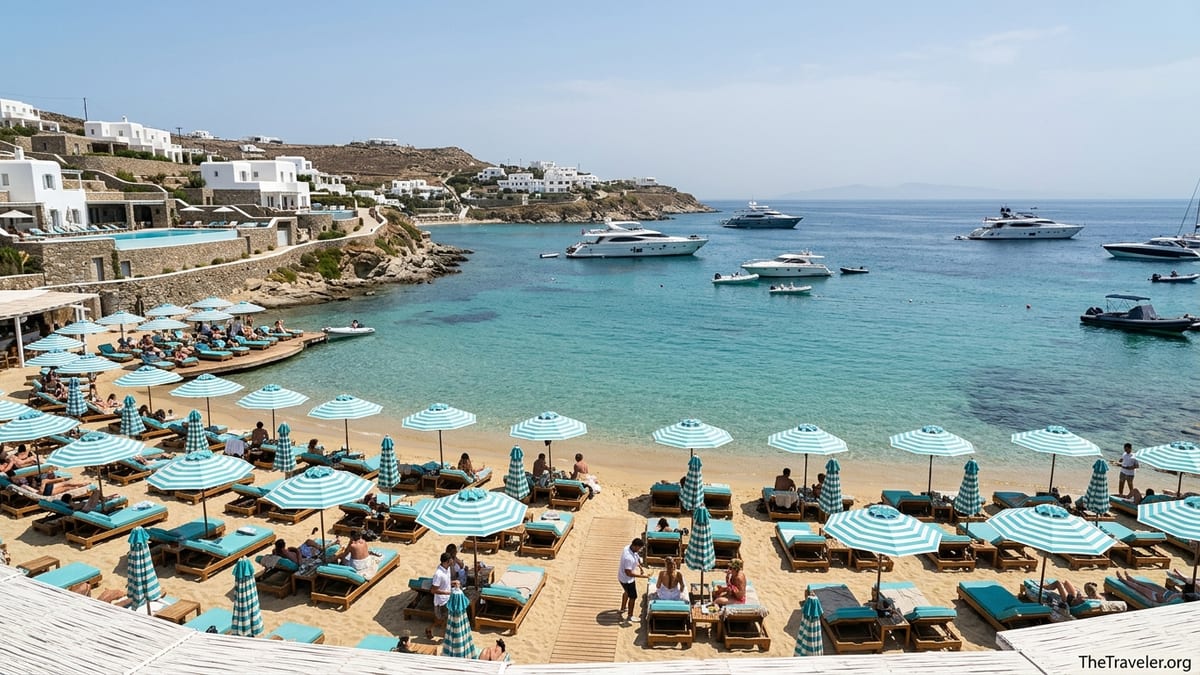
From the lookout above the beach, the scene feels more like a Riviera harbour than a classic Cycladic bay. The cove is compact, around 150 metres of sand wrapped in a tight arc, and yet offshore you often see a line of multi-million-euro yachts anchored so close that tenders shuttle guests back and forth all afternoon. On shore, there is almost no “empty” beach. Sunbeds fill the sand in regimented rows, with classic turquoise-and-white umbrellas signalling the territory of Nammos and neighbouring venues. Even compared to other busy Mykonos strands such as Paradise or Super Paradise, the density of loungers and staff here creates an immediate sense of curated exclusivity.
What surprised me most on that first walk along the shore was how little feels casual. At many popular Greek beaches, you still have pockets where families spread towels and teenagers bring a supermarket picnic. At Psarou, the atmosphere skews heavily toward people who have arrived to participate in a very specific scene: designer swimwear, carefully chosen beach outfits, chilled champagne at 11 a.m., phones angled just so to capture the backdrop of yachts. It is not unfriendly, but it is unmistakably high-end, and it hits you within minutes.
How Expensive Is Psarou Really?
Psarou’s reputation for eye-watering prices is well-earned, and the numbers in 2026 can still shock first-time visitors. At the marquee venue Nammos, a pair of sunbeds in the second or third row typically runs around 180 to 280 euros for the day in high season, while the coveted front row closer to the water can climb to roughly 350 to 500 euros. On top of that, most premium sections come with a minimum spend on food and drinks that can easily range from about 200 to 600 euros, depending on how close you sit to the sea and whether there is a special event.
Put differently, a late-morning arrival for two people, with a front-row set and a few cocktails, a bottle of wine, and a seafood lunch, can push a casual beach day toward the 700 to 900 euro mark before you have considered shopping or evening plans. Even more moderate spending, such as taking a mid-row set, sharing a light lunch and a few glasses of wine, will frequently land in the 250 to 400 euro range. For groups, the numbers climb quickly. A party of four reserving a cabana, ordering sushi platters, a magnum of sparkling wine and afternoon cocktails can easily breeze past 1,200 euros by sunset.
Not every lounger on Psarou commands those headline prices, but the overall cost level is consistently high compared with other Mykonos beaches. Even less-hyped venues on the same strip tend to charge significantly more than what you would pay at Ornos or Platis Gialos. Simple items tell the story: an iced coffee that might cost 4 euros in Mykonos Town could be closer to 8 or 10 euros here; a standard cocktail often starts in the low to mid-teens and climbs steeply with premium brands. Menus rarely shout these numbers; instead, you discover them as you go, another reminder that Psarou is built for travellers who treat a beach club tab as part of the holiday’s theatre rather than a budget concern.
The Nammos Effect: Beach Club as Global Stage
Psarou’s entire identity today is inseparable from Nammos, the beach club and restaurant that turned this once-quiet cove into a global social-media fixture. The club’s striped umbrellas and teak decks occupy a commanding stretch of the sand, and for many visitors, a day at Psarou effectively means a day at Nammos. The format feels like a blend of seaside dining, daytime clubbing and catwalk show, with staff ferrying sushi platters and Champagne from the beachside terrace to loungers that double as front-row seats on the bay.
By early afternoon in high season, music drifts across the sand as DJs move from laid-back daytime sets to a more upbeat soundtrack. Tables inside the restaurant often fill with large groups celebrating an event, while on the sand, you will see everything from couples quietly sunbathing to clusters of friends filming arrival videos as speedboats pull up. For some guests, the real performance happens on the pier, where yacht tenders deliver new arrivals who pause just long enough for a round of photos before being escorted to their reserved loungers.
The club’s retail extension, Nammos Village, sits just behind the beach and pushes the exclusivity story even further. Here, air-conditioned boutiques showcase luxury brands in an open-air mall format. It is entirely possible to spend a late afternoon drifting between sunbed, bar, and designer store without ever leaving the Psarou ecosystem. For travellers used to low-key Greek beach towns, this seamless blending of sea, shopping and nightlife feels startling in its intensity. Yet it explains why Psarou has become a magnet for those who want everything, from concierge services to late-night dining, within a few minutes’ walk.
Staying on Psarou: Hotels That Match the Hype
Given the price of a single beach day, staying in one of the hotels that overlook Psarou can make a certain kind of financial sense for travellers committed to this scene. The options here are almost entirely five-star, with nightly rates in peak summer often starting in the mid-hundreds of euros and climbing well into four figures for suites with private pools. Properties like Mykonos Blu from Grecotel, Kensho Psarou, and the newer Nammos Hotel have built their identities around direct access to this coveted cove and panoramic views of its yacht-filled bay.
Mykonos Blu occupies a terraced hillside above the beach, with whitewashed bungalows and suites that look straight down over the sand. Guests walk down a private path or take a short lift ride to reach the water, and many never feel the need to venture to other parts of the island. Kensho Psarou, set just behind the beach, leans into contemporary design: stone and wood textures, private hot tubs, and a sophisticated bar-restaurant scene that attracts non-guests in the evenings. The Nammos Hotel, meanwhile, effectively builds a resort around the villa-style living that regulars to the beach club already expect, with suites that blur the line between private residence and serviced hotel.
For travellers whose visits to Psarou are occasional rather than daily, it can be more practical to base in nearby areas like Platis Gialos or Mykonos Town and commute in. Platis Gialos is just a short drive or coastal walk away and has a mix of midrange and upscale hotels, while Mykonos Town offers a broader spread of price points and easier access to the rest of the island. Many visitors choose to splurge on one “big” Psarou beach day rather than paying for premium accommodation there all week, a strategy that allows them to experience the glamour without committing to its costs at every turn.
Can Psarou Be Done on a Relative Budget?
Calling Psarou a budget destination would be misleading, but there are ways to experience the beach without committing to a full luxury spend. The shoreline itself is public, which means you are legally entitled to access the sand and the sea without paying a euro. In practice, however, the rows of organised loungers leave limited free space, especially at midday. Your best chance to find a patch of sand for a towel is early in the morning or later in the afternoon at the edges of the bay, away from the main clubs.
Arriving outside peak hours can also soften costs in more subtle ways. If you reach the beach in the late afternoon, for example, some venues may reduce their lounger rates or become more flexible about minimum spends as they transition toward evening service. You might pay for a couple of drinks and light snacks instead of committing to a full lunch. Walking down from a bus stop in Platis Gialos or using a shared taxi rather than a private transfer can pare back transport costs, although queues at bus stops in high season can be long and patience is required.
Another strategy is to treat Psarou primarily as a place to swim and people-watch for a couple of hours, then relocate to a nearby beach for a more relaxed and affordable afternoon. Agios Ioannis, Ornos, and Platis Gialos all offer a softer version of the Mykonos south-coast experience, with organised sunbeds plus stretches of more casual sand, at generally lower prices. You might, for example, visit Psarou early to swim in its sheltered, clear water and observe the superyacht theatre, then move on to Platis Gialos for lunch at a taverna where a main dish might cost half of what you would pay at an ultra-premium Psarou venue.
Atmosphere Beyond the Luxury: What It Actually Feels Like
Strip away the branding and price tags for a moment, and Psarou is still an undeniably beautiful cove. The water here tends to be calm thanks to the sheltered orientation on the south coast, often a turquoise gradient that is just shallow enough near the shore for children to paddle. The sand is soft and golden, and on a calm morning before the music starts, the beach can feel surprisingly peaceful, especially in shoulder season months such as late May or late September.
Once the day begins in earnest, the atmosphere shifts. Staff weave between loungers with trays of oysters and chilled wine, music from beach clubs grows louder, and the sense of performance ramps up. This is a place where people dress for the beach: linen shirts, wide-brimmed hats, logoed swimwear, and statement sunglasses are far more common than old T-shirts and flip-flops. You will hear a cosmopolitan blend of languages, from Greek to English, Italian, Arabic and beyond, with many guests arriving as part of larger groups or celebrations.
Yet there are still moments and corners where Psarou feels more human than glossy. Families coax children into the shallows, older couples sit close to the water watching the choreography of tenders and jet-skis, and hotel guests wander down in the early evening when the worst of the heat has passed. The exclusivity is real, but it exists alongside these quieter rituals that remind you this is, ultimately, still a beach where people come to swim and unwind, even if their definition of relaxation involves a champagne bucket.
Logistics: Getting There, Access and Practical Tips
Reaching Psarou requires a small amount of planning. From Mykonos Town, the beach sits about 5 kilometres away. In season, buses usually run to the nearby village of Platis Gialos, from where you can either walk along the coastal path or take a short taxi ride to Psarou itself. Taxis can be scarce at peak times, so many groups pre-arrange transfers through their hotel or a local driver, especially if they have lunch reservations at Nammos or another high-profile venue.
Parking can be one of Psarou’s greatest challenges. A small private lot behind the beach fills quickly, and fees are typically higher than elsewhere on the island. If you are driving, it is wise to arrive early in the morning before 11 a.m., or later in the afternoon after some day visitors have departed. Otherwise, be prepared for a slow crawl down the access road while attendants attempt to squeeze additional cars into already full spaces. For many visitors, the stress of parking is one more reason to leave the car at the hotel and rely on transfers or taxis instead.
On the practical side, it is worth emphasising that reservations are more necessity than luxury at the most popular Psarou venues in high season. Booking sunbeds and lunch weeks in advance for peak dates such as August or major holiday weekends is common practice, particularly for front-row seating. Dress codes by day are relaxed but stylish; by evening, venues shift toward smart-casual, and swimwear alone will feel out of place at dinner. Card payment is widely accepted, but tabs can climb quickly, so setting a rough budget before you arrive can prevent surprise when the bill lands at your sunbed.
The Takeaway
Psarou Beach confirms almost every story you have heard about it, then quietly amplifies them. Yes, it is a beautiful Cycladic cove with limpid water and soft, pale sand. Yes, the prices are high enough to make even seasoned travellers pause. And yes, the superyachts anchored a short swim from shore give the whole scene a distinctly international, almost Riviera-like energy. What you cannot fully appreciate until you arrive, though, is how comprehensively the beach has been shaped into a self-contained luxury ecosystem.
If you come prepared, that ecosystem can be thrilling. With reservations in place, an understanding of likely costs and a willingness to embrace the performance of it all, a day at Psarou can easily become one of the most memorable, indulgent experiences of a Greek-island trip. If your idea of a beach day is more about quiet coves, simple tavernas and the sound of waves over music, you may find Psarou fascinating for a few hours and then be ready to retreat to gentler shores. Either response is valid. The key is to recognise that Psarou is not simply a beach, but an emblem of a certain way of travelling: curated, conspicuous, and, for better or worse, uncompromisingly exclusive.
FAQ
Q1. Is Psarou Beach worth visiting if I am not staying in a luxury hotel?
Yes, Psarou is still worth a visit even if you are not staying at one of the five-star properties. You can come for a few hours to swim, people-watch and get a taste of the atmosphere, then move on to a more relaxed beach nearby. Just be aware of the high prices for sunbeds and food and consider visiting early in the morning or late in the afternoon if you do not plan to rent a lounger.
Q2. Can I use Psarou Beach without paying for a sunbed?
The shoreline is public, so you are allowed to access the sand and the sea without renting a lounger. In practice, organised sunbeds occupy most of the beach, especially in high season, leaving limited free space near the edges. Arrive early if you hope to find a towel spot, and be prepared for staff to encourage you toward paid options once the beach gets busier.
Q3. How much should I budget for a day at Psarou in 2026?
Costs vary widely, but couples who reserve loungers at a major beach club and order a full lunch with drinks can easily spend several hundred euros. A front-row set at a high-profile venue, plus cocktails and a bottle of wine, might push the total toward the upper hundreds. Travellers on tighter budgets often limit themselves to a drink or two and a short stay rather than a full day.
Q4. Do I need to book sunbeds at Psarou in advance?
For peak season visits, especially in July and August, advance reservations are strongly recommended at the main beach clubs. Popular rows may be booked days or weeks ahead for prime dates. If you arrive without a booking, you may still find space further back or at less prominent spots, but your options will be more limited and you are unlikely to secure the front rows.
Q5. What is the best time of day to visit Psarou?
Early mornings offer the calmest atmosphere, clearer water and the best chance of finding space without a reservation. Late afternoon is another good window, when the light softens and some loungers free up as day visitors depart. Midday can be the busiest, loudest and most expensive period, particularly when beach clubs are in full swing.
Q6. How do I get to Psarou Beach from Mykonos Town?
Most visitors travel by taxi, pre-arranged transfer or a combination of bus and short walk. Buses often run between Mykonos Town and nearby Platis Gialos, from where Psarou is reachable by coastal path or a brief taxi ride. In high season, taxis can be in high demand, so it is wise to allow extra time or organise transport through your hotel.
Q7. Is Psarou suitable for families with children?
The water at Psarou is generally calm and shallow near the shore, which is positive for families. However, the beach can be extremely busy, loud and expensive, and sunbed policies may require even young children to have their own paid space. Families who prefer a more relaxed, low-key environment may prefer other Mykonos beaches, visiting Psarou only briefly if at all.
Q8. What should I wear to fit in at Psarou?
By day, stylish beachwear is the norm: quality swimsuits, cover-ups, linen shirts, and polished sandals rather than casual flip-flops. In the evening, venues move toward a smart-casual dress code, with light summer dresses, tailored shorts and shirts, and dressier footwear. While you do not need designer labels, the overall look is more polished than at typical island beaches.
Q9. Are there more affordable alternatives near Psarou?
Yes. Nearby beaches such as Platis Gialos, Ornos and Agios Ioannis offer organised sunbeds, tavernas and clear water at generally lower prices. Many travellers combine a short visit to Psarou with longer, more relaxed days on these neighbouring shores, using buses or taxis to move between them.
Q10. Is Psarou Beach open year-round?
The beach itself is always accessible, but the full Psarou experience depends on the seasonal operation of beach clubs, hotels and shops. Most high-profile venues operate from late spring through early autumn, with July and August as peak months. Outside this period, you will find a much quieter, more local-feeling beach with fewer services and no party atmosphere.