


Psarou Beach is one of those names that circulates in conversation long before most travelers ever set foot on Mykonos. It is the place of champagne-fueled beach parties, front-row sunbeds that cost more than a hotel room, and glossy social media shots of yachts anchored in a turquoise bay. But if you are planning a trip and looking at a real-world budget rather than an influencer expense account, a fair question arises: is Psarou Beach actually worth visiting, or is it simply too expensive for most travelers?
Get the latest updates straight to your inbox!
What Makes Psarou Beach So Famous?
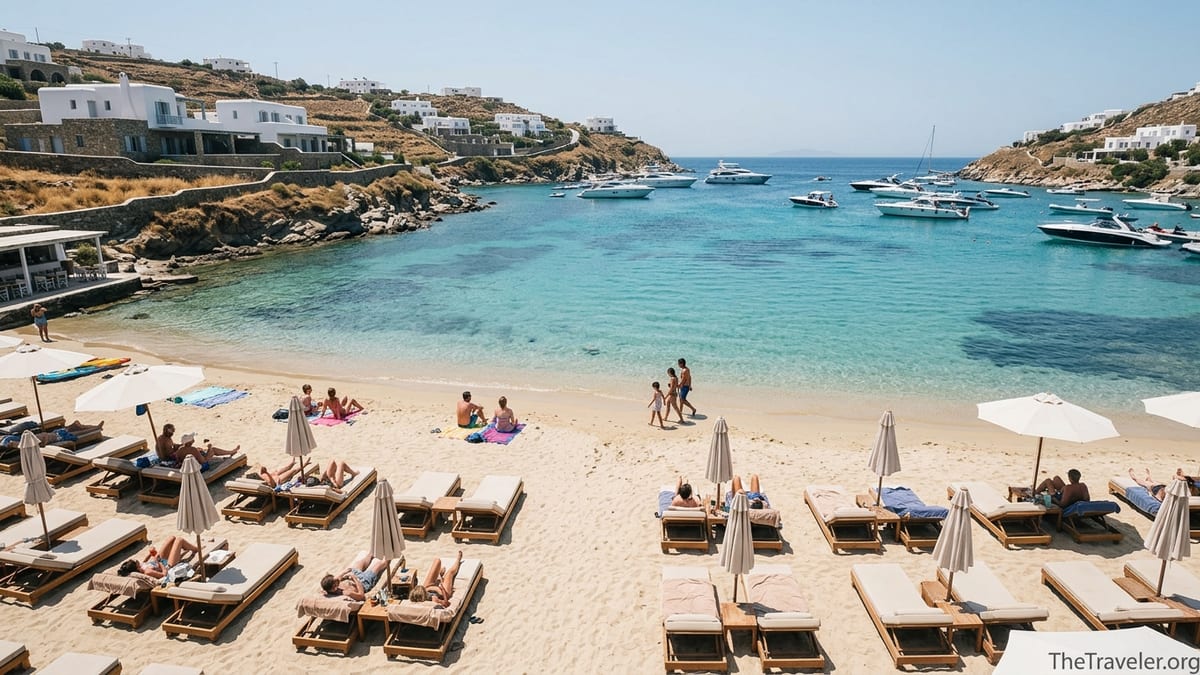
Psarou Beach sits in a small, sheltered bay on the south coast of Mykonos, about 4 to 4.5 kilometers from Mykonos Town. The geography is genuinely special. The bay is almost enclosed, which means the prevailing Meltemi winds that whip other beaches often barely ruffle the surface here. In practice, that translates into unusually calm, clear water where you can see fish darting around your ankles as soon as you wade in.
Over the past decade, that natural advantage has combined with heavy development to turn Psarou into the island’s most high-profile luxury beach. The shoreline is now closely associated with the celebrity-centric Nammos beach club, the newer Cavo Psarou, and a cluster of ultra-upscale hotels and villas. In summer, the bay is dotted with yachts and speedboats, and it is not uncommon to see high-profile visitors ferried ashore by tender.
This reputation has real economic consequences. Travel guides and local tourism sites consistently describe Psarou as one of the most commercially intense and expensive beaches in Greece, where nearly every meter of sand behind the waterline is monetized through sunbeds, table bookings, or hotel frontage. At the same time, they note that the beach itself remains a public space, and there is still a strip of sand where you can lay a towel for free if you know where to look.
That tension between natural beauty and luxury commercialization is at the heart of the “worth it or not” question. To understand whether Psarou belongs in your itinerary, you need to know what you are actually paying for here, and what you can access without handing over a credit card.
How Expensive Is Psarou Beach in Practice?
The headline cost at Psarou Beach is the price of sunbeds at its flagship beach clubs. Recent traveler reports and 2026 beach guides describe entry-level sunbed sets at Nammos running well into the three-figure range in high season. One recent visitor who messaged the venue directly was quoted around 360 euros per set, including two loungers, one umbrella, and towels, with that fee not redeemable against food or drinks. Other sources cite minimum prices in the 150 to 250 euro range depending on row, day, and time of year, again for two beds and an umbrella.
Prices at neighboring Cavo Psarou have been reported in a similar band, with some tiers slightly lower and others comparable to Nammos. Even more mid-tier operators on Psarou tend to start from at least 25 to 40 euros for a basic pair of beds further back from the waterline. Compared with other beaches on Mykonos, where 40 to 60 euros for a pair of loungers at a premium club is considered typical in 2026, Psarou clearly sits at the top of the price scale.
Food and drink prices follow the same pattern. A simple cocktail at one of Psarou’s top clubs can easily cost 25 to 30 euros, and a casual lunch for two with a starter, main course, and drinks can climb past 150 euros before any bottles of wine or champagne appear. Accounts of four-figure bills for group lunches at Nammos are common in travel forums, often tied to premium seafood platters and high-end wines rather than outright scams, but still eye-watering for many visitors.
Accommodation surrounding Psarou reflects this premium positioning. Five-star hotels with direct or near-direct access to the bay, such as Nammos Hotel Mykonos or high-end suites in the hills above, routinely price standard rooms in the peak summer season at several hundred dollars per night, often pushing above 900 dollars in late July and August. For some travelers, that is the entire weekly budget for an island-hopping trip elsewhere in the Cyclades.
Hidden Free Options: Can You Enjoy Psarou on a Budget?
Amid the stories of 300 euro sunbed sets and 30 euro cocktails, it is easy to assume Psarou is entirely off-limits to travelers on a normal budget. That is not quite true. Despite the dominance of luxury clubs, the shoreline remains legally public, and there is a modest stretch of open sand between and to the sides of the organized sections where you can lay your own towel at no cost.
Independent guides that specialize in Mykonos beaches point out that the simple act of skipping the loungers can turn Psarou into an affordable stop. A traveler might, for example, take the bus to nearby Platis Gialos and walk the short coastal path to Psarou, carrying a light foldable umbrella, a towel, and a bottle of water bought at a minimarket for a couple of euros. With that setup, they can swim in the same calm emerald water as the guests in front-row cabanas without paying for a single organized service.
Real-world examples from travelers show this in practice. Some describe spending an hour or two at Psarou purely for a swim and some people-watching, then retreating to more budget-friendly beaches like Ornos or Super Paradise for the rest of the day, where back-row beds might cost 40 to 60 euros per pair and food prices are somewhat less inflated. Others mention using Psarou as a quick stop on a self-drive circuit of the south coast, arriving early in the morning when crowds are lightest, taking photos and a quick dip, and then moving on before the beach clubs hit full volume.
This approach requires a shift in expectations. You are not coming to Psarou for all-day waiter service and plush mattresses if you are on a tight budget. You are coming for the natural bay, the curiosity of seeing one of Europe’s most expensive beach scenes up close, and perhaps the contrast with more relaxed spots elsewhere. For travelers comfortable with a bit of improvisation and carrying their own gear, that can be satisfying enough to justify the trip without a crushing bill.
Who Actually Gets Value From Psarou’s Luxury Scene?
For some visitors, the high prices at Psarou are not a deterrent but part of the appeal. If your travel style centers on luxury experiences, status venues, and long days of full-service comfort by the water, Psarou can deliver exactly that. A couple celebrating an anniversary or honeymoon might choose to splurge on a front-row sunbed set at Nammos, order champagne, and share an elevated seafood lunch, viewing the cost as a once-in-a-trip indulgence rather than a daily routine.
Groups of friends on a celebratory holiday often approach Psarou in a similar way. Splitting a premium sunbed set among four people, for example, can soften the sting of a 300 to 360 euro fee, especially if the group intends to stay from late morning until early evening and make use of the full food-and-drink offering. For such travelers, the ability to swim between rounds of attentive service, listen to a curated soundtrack, and perhaps spot a few famous faces can feel like money well spent.
High-earning visitors who value brand recognition and a party-forward environment may also perceive Psarou as good value compared with comparable luxury beach clubs in the south of France, Ibiza, or Dubai. In that context, a 25 euro cocktail and 150 euro sunbed set may feel more acceptable, particularly when folded into an overall budget where five-star hotels and private transfers are already assumed.
However, it is important to recognize that this is a narrow slice of the travel spectrum. Even among travelers with comfortable budgets, some decide that paying several hundred euros to sit on a beach chair is simply not aligned with their values or priorities. They prefer to spend that same amount on a charter boat trip, a fine-dining dinner in Mykonos Town, or two extra nights on a quieter island. For them, Psarou’s luxury scene can easily feel more like a display of conspicuous consumption than an authentic Aegean experience.
Comparing Psarou With Other Mykonos Beaches
To evaluate whether Psarou is worth it, it helps to compare it with what else is available on Mykonos. On nearby Ornos Beach, for example, travelers regularly report more approachable pricing: sunbed sets at mid-range beach bars often fall in the 40 to 80 euro range for two loungers and an umbrella, and meal prices, while not cheap by Greek standards, are less likely to trigger sticker shock than those at the front-row clubs of Psarou.
Super Paradise and Paradise Beaches have long been associated with all-day parties and a younger crowd, but even there, back-row sunbeds can be significantly cheaper than Psarou’s flagship options. A second-row lounger at a popular club like Tropicana has been reported at around 40 euros per person in recent seasons, and while drinks are still expensive, they seldom reach the extremes that surface in Psarou anecdotes.
Travelers looking for quieter, more traditional beach days often gravitate toward Elia, Agrari, or Agios Ioannis. At these spots, you are more likely to find a blend of organized sections and open sand, where you can either pay a reasonable fee for a pair of beds or simply put your towel down for free. Beach taverna prices for a Greek salad, grilled fish, and a carafe of wine are also more in line with broader Greek island norms.
The critical comparison is this: the sea is just as blue in these other bays. The sand is equally golden, and in some cases the setting feels more authentically Cycladic. Psarou’s true differentiator is not the water or the scenery but the density of high-end infrastructure, from designer boutiques in the back of the bay to the roster of luxury yachts offshore. If that context matters to you, Psarou might justify its costs. If it does not, the same island offers similar natural experiences at a fraction of the price.
Practical Tips If You Decide to Visit Psarou
If you decide Psarou is worth seeing, some planning can help control both spending and expectations. First, think carefully about timing. High-season weekends in late July and August see the steepest prices and heaviest crowds. Visiting in June or September, or on a weekday, often means slightly more availability and sometimes marginally lower minimums for sunbeds and tables. Even within a single day, arriving early in the morning typically offers a calmer, less pressured experience than turning up mid-afternoon when the party vibe peaks.
Second, decide in advance whether you want to commit to a beach club or stick to the public section. If you are set on Nammos or Cavo Psarou, make a reservation well ahead of time, and ask clearly about the current price for your chosen row, whether the fee is redeemable against consumptions, and what cancellation terms apply. That way, you avoid awkward surprises like minimum spends that effectively double the advertised cost. If your plan is to use the free sand, pack like a local: a lightweight travel umbrella, reef-friendly sunscreen, water, and a snack from a supermarket can make a short visit comfortable without any on-the-spot purchases.
Third, consider transport. There is no bus stop directly on Psarou’s beachfront, though some guides mention services stopping at nearby Platis Gialos, from which you can walk. Taxis from Mykonos Town typically run in the region of 15 to 20 euros each way, depending on traffic and time of day. If you are renting a car or quad, arrive early, as parking in the tight roads around Psarou fills quickly and is heavily controlled by nearby businesses.
Finally, set a mental budget before you arrive and stick to it. For example, you might decide that your total spend at Psarou will not exceed 80 euros for a couple, which could reasonably cover a pair of mid-tier sunbeds for a few hours and a round of drinks, or a purely free visit with a late-afternoon cocktail at the back bar. With boundaries in place, it becomes easier to enjoy the scene without the constant worry of a runaway bill.
The Takeaway
Psarou Beach embodies the contradictions of modern Mykonos. On one hand, it is a stunning, sheltered bay with some of the clearest, calmest water on the island. On the other, it has become a symbol of extreme beach commercialization, where a single set of sunbeds can cost more than an entire week’s accommodation on another Greek island.
For travelers who actively seek luxury beach clubs, enjoy the energy of celebrity-centric venues, and have the budget to treat high prices as part of the experience rather than a painful exception, Psarou can be worth every euro. A carefully planned day here can feel like stepping into a glossy magazine spread, with attentive service, high-end dining, and top-tier people-watching.
For most travelers, however, Psarou is best approached as a short, curious detour rather than a daily hangout. A brief visit to swim from the public strip of sand, snap a few photos of the yacht-lined bay, and experience the atmosphere first-hand can be rewarding. After that, many will find better value, more relaxed hospitality, and equally beautiful water at other Mykonos beaches or on neighboring islands.
In the end, whether Psarou is worth visiting comes down to what you value in your travel days. If your priority is the sea itself, local food at reasonable prices, and a more traditional Greek island feel, you may find Psarou too expensive for what it offers. If you are curious about or genuinely enjoy high-end beach culture, it can be an unforgettable, if costly, highlight of a Mykonos trip.
FAQ
Q1. Is Psarou Beach free to enter, or do I have to pay to get in?
The beach itself is free to enter because the shoreline is public, but you pay for services like sunbeds, umbrellas, and food from the beach clubs.
Q2. How much do sunbeds cost at Psarou Beach in 2026?
Prices vary by venue and row, but recent reports suggest basic sets start around a few dozen euros and can climb to 300 euros or more for front-row pairs at top clubs.
Q3. Can I visit Psarou without renting a sunbed?
Yes. There is a modest stretch of public sand where you can lay your own towel and swim for free, though space can be limited in peak season.
Q4. Is Psarou worth it if I am on a tight budget?
It can be worth a brief visit to see the bay and atmosphere, but most budget-conscious travelers prefer to swim, eat, and relax at less expensive beaches elsewhere on Mykonos.
Q5. How do I get to Psarou Beach from Mykonos Town?
Most travelers use taxis, which typically cost around 15 to 20 euros each way, or take a bus to nearby Platis Gialos and walk the short coastal path to Psarou.
Q6. What is the best time of day to go to Psarou?
Mornings are quieter and better for swimming, while afternoons bring louder music, larger crowds, and a full party atmosphere at the beach clubs.
Q7. Are there more affordable beaches than Psarou on Mykonos?
Yes. Beaches like Ornos, Super Paradise, Elia, and Agrari generally offer lower sunbed prices and more relaxed food costs while still providing beautiful water and sand.
Q8. Do I need to book sunbeds in advance at Psarou?
For popular clubs like Nammos and Cavo Psarou in July and August, advance reservations are strongly recommended, as front rows can sell out days ahead.
Q9. Is Psarou suitable for families with children?
The calm, shallow water is good for kids, but parents should consider whether the loud music, dense loungers, and high prices match the type of family day they want.
Q10. If I only have one day on Mykonos, should I choose Psarou or another beach?
If you are curious about luxury beach culture and can accept higher prices, Psarou is interesting. If you want a more relaxed, better-value beach day, another bay is likely a wiser choice.