

Indiana’s public transportation picture is changing quickly, especially in its largest cities. While the state is still shaped by car travel, Indianapolis and several regional hubs are investing in new bus rapid transit lines, local bus upgrades, and better connections to Chicago by commuter rail. For travelers and newcomers, understanding how buses, rideshares, and regional trains fit together can make the difference between a frustrating trip and a smooth, affordable journey.
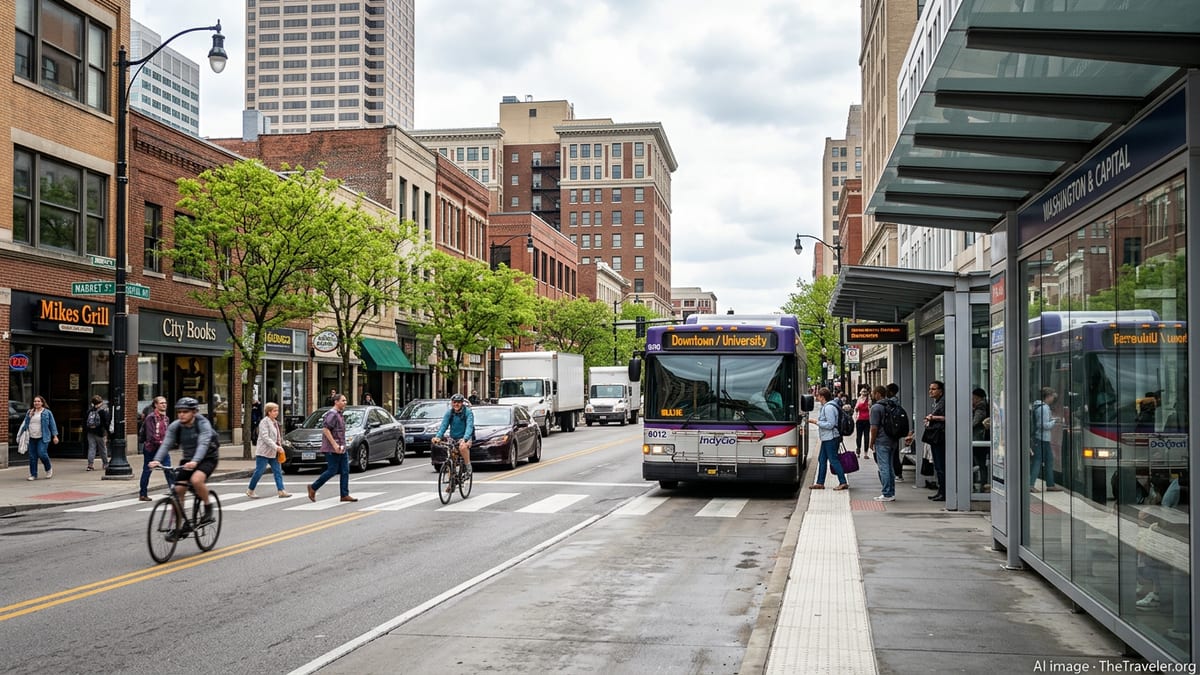
The Big Picture: How Hoosiers Get Around
Public transportation in Indiana reflects the state’s strong driving culture. Outside the largest cities, most residents rely on cars, and transit options can be limited or designed primarily for people without access to vehicles. In urban areas, though, systems are in transition as agencies modernize fleets, experiment with bus rapid transit, and add tools like mobile ticketing and real time tracking.
For visitors, the most robust transit networks cluster in a few places. Indianapolis is home to IndyGo, a countywide system anchored by new rapid bus corridors such as the Red Line and the recently opened Purple Line, with the Blue Line under construction. In the north, South Bend and Mishawaka are served by Transpo buses, Fort Wayne runs Citilink service across much of the city, and northwest Indiana ties into the Chicago region using the South Shore Line commuter rail along Lake Michigan.
Even in these core markets, service patterns can feel lean compared with larger coastal cities. Most Indiana systems still operate primarily on fixed routes with 30 to 60 minute headways, modest evening service, and reduced or no operations on Sundays and major holidays. That makes planning ahead essential. Rideshare services such as Uber and Lyft often fill the gaps, especially late at night or in neighborhoods or suburbs with limited bus coverage.
Despite these constraints, there is genuine momentum. The rollout of new bus rapid transit in Indianapolis, the South Shore Line’s double track project, growing use of mobile fare apps, and pilot partnerships with on demand vans and microtransit services show that transit is not standing still. For travelers willing to study routes and schedules, Indiana’s networks can provide cost effective access to downtowns, campuses, medical centers, and key attractions.
IndyGo in Indianapolis: Bus Rapid Transit and Citywide Routes
IndyGo is Indiana’s largest transit agency and the one most visitors encounter first. It operates a network of dozens of bus routes across Indianapolis and Marion County, anchored by the Julia M. Carson Transit Center downtown. The system has been reshaped by the Marion County Transit Plan, a long term program funded through a local income tax that focuses on higher frequency corridors and three bus rapid transit lines known as the Red, Purple, and Blue Lines.
The Red Line was the first of these rapid routes and runs north to south across the city using dedicated lanes in some segments, off board fare payment at stations, and all door boarding. More recently, the Purple Line opened along East 38th Street between downtown Indianapolis and the city of Lawrence, sharing central stations with the Red Line before branching east. It quickly emerged as one of the system’s strongest performing routes, reflecting the dense neighborhoods and zero car households along its corridor. Planning and early construction work on the east west Blue Line, which will connect the Indianapolis International Airport area with the east side, continues with a target opening later this decade.
Outside the rapid corridors, IndyGo runs a grid of local and express routes that connect most major destinations, including downtown office towers, major hospitals, university campuses, and some suburban job centers. Service levels are strongest on weekdays, when many core routes operate every 15 to 20 minutes during peaks, with less frequent service in evenings and on weekends. Some suburban and crosstown routes may only appear once or twice per hour, so riders should check schedules carefully and build in buffer time for transfers.
IndyGo offers a range of payment options designed to reduce friction. Riders can pay with cash on board, use reloadable cards, or purchase fares through mobile apps on smartphones. The agency has adopted contactless validators at rapid transit stations and on most buses, though some riders note that scanning app based tickets can still take a bit of patience. For visitors, the simplest approach is often to buy a day pass or short term fare product that allows unlimited rides and takes the pressure off making exact change for each trip.
Local Transit in South Bend and Mishawaka: Transpo’s Regional Role
In the northern part of the state, the South Bend Public Transportation Corporation, known locally as Transpo, serves South Bend, Mishawaka, and nearby communities including the University of Notre Dame and other college campuses. The system is anchored by South Street Station near downtown South Bend and operates a network of fixed routes that radiate to shopping districts, medical centers, and residential neighborhoods. Transpo focuses on daytime and early evening operations, with schedules that often thin out at night and on Sundays.
Recent planning work in the region has focused on refreshing routes and schedules under the banner of a Connect style transit plan that aims to simplify patterns and improve reliability. Changes include the realignment of existing lines, the introduction or extension of certain routes to serve growing employment areas, and refinements to timing so that buses meet more consistently at the central station for transfers. Local news outlets in South Bend have highlighted how these updates are intended to streamline trips between South Bend, Mishawaka, and neighboring communities, including growing suburbs.
Transpo has also modernized its fare collection. Riders can purchase paper passes at South Street Station or online, but many now rely on the Token Transit app for mobile ticketing. This system allows users to buy and activate passes on their phones, then show a visual validation to the driver upon boarding. Announcements from the agency emphasize this visual verification process so that operators can quickly confirm active fares without specialized hardware.
For travelers, Transpo is most useful for trips within South Bend and to nearby destinations such as Mishawaka shopping corridors or university districts. It is less geared to long range travel beyond the metropolitan area, though it connects with intercity buses and is part of a wider regional network that includes Amtrak and the South Shore Line at separate nearby stations. Because frequencies can be modest, especially outside peak hours, visitors should consult schedules in advance and leave extra time for transfers, particularly when connecting to time sensitive services such as trains.
Fort Wayne’s Citilink: A Growing but Limited Network
Fort Wayne’s primary public transit provider is Citilink, operated by the Fort Wayne Public Transportation Corporation. Citilink runs a set of fixed routes and a small number of flexible or deviation services that cover most of the city and the neighboring community of New Haven. The system centers on Citilink Central Station downtown, with routes branching toward major corridors, retail areas, and medical and educational campuses. Service typically runs on weekdays from early morning to late evening and on Saturdays with shorter spans, with no regular service on Sundays or on several major holidays.
Historically, most Citilink routes operated on 30 minute headways, but funding and staffing challenges in recent years have led to hourly service on many lines. Riders and agency staff alike describe this as a constraint that can make spontaneous travel difficult, especially for those who need to make multiple transfers. Despite this, Citilink remains a lifeline for many residents who do not drive and rely on it to reach work, school, and essential services. Recent downtown development and renewed interest in walkable neighborhoods have revived calls for more frequent and later service, particularly in the evenings.
Citilink has adopted several tools to make the system easier to use. Riders can pay cash on board, purchase passes in advance, or use the Token Transit mobile app for electronic tickets. Real time bus tracking is available through digital tools that allow passengers to see bus locations and estimated arrival times, which helps offset the impact of lower frequencies by reducing wait time uncertainty. The agency also offers travel training where staff will ride along with new users to help them learn how to read schedules, make transfers, and identify stops.
Accessibility is another focus. Citilink operates paratransit services for riders with disabilities who cannot use fixed route buses, and recent updates include a partnership with an on demand mobility provider to modernize scheduling and routing. These services are crucial given the city’s spread out land use and the fact that some key destinations, such as the Fort Wayne International Airport, remain outside the reach of regular bus routes. For those airport and far edge trips, taxis and rideshare services are often the only realistic options for travelers without cars.
Northwest Indiana and the South Shore Line: Linking to Chicago
Northwest Indiana sits within the broader Chicago region and benefits from one of the Midwest’s most important commuter rail lines, the South Shore Line. Operated by the Northern Indiana Commuter Transportation District, the line runs between downtown Chicago and South Bend, with a string of stations along Lake Michigan in communities such as Hammond, Gary, Portage, Michigan City, and others. It functions as both a commuter route for workers heading to Chicago and a regional connector for students, tourists, and residents traveling between lakeside cities.
In recent years the South Shore Line has undergone a major Double Track Northwest Indiana project between Gary and Michigan City. The work has restored a second track along much of this corridor, allowing more frequent trains, better on time performance, and the introduction of additional express service. Construction led to periods of bus substitution on some segments, but by spring 2024 the rail line was restoring full train operations and moving toward new schedules with faster one seat rides.
Local bus networks in northwest Indiana, such as Gary Public Transportation Corporation routes and small municipal or county systems, provide connections to South Shore stations and to local destinations. These buses often serve downtowns, community colleges, and major employers, but they may run on limited schedules, especially outside weekday daytimes. Riders making cross border trips typically combine local buses or park and ride lots with the South Shore Line and sometimes use Chicago Transit Authority services once they reach the city.
For travelers, the key to using this network effectively is coordination. Train timetables, bus schedules, and transfer windows all matter when moving between systems, and some stations are more transit friendly than others. Many visitors choose to stay near stations with high frequency service or ample parking and then use the train as their primary long distance mode, turning to rideshare or local buses for the first and last mile. This approach can offer a comfortable alternative to driving on congested interstates between Chicago and northern Indiana.
Rideshares, Taxis, and Microtransit: Filling the Gaps
Across Indiana, rideshare services like Uber and Lyft play a crucial role in complementing fixed route transit. In many cities, especially after dark or outside core corridors, buses may be infrequent or not operating at all. Rideshares step in to connect passengers to late evening flights, nightlife districts, or neighborhoods that lack convenient bus stops. This is particularly true in metropolitan areas where sprawling development patterns make it hard for fixed routes to cover every subdivision or office park cost effectively.
Traditional taxis and airport shuttles still exist but have become more specialized. In cities such as Indianapolis, Fort Wayne, and South Bend, regulated taxi services often focus on downtown hotels, major events, and airport trips. Some hotels and campuses run their own shuttles or partner with private van companies for scheduled service, especially when public transit hours do not align with early morning flights or late night arrivals.
Several Indiana transit agencies are experimenting with microtransit and on demand services as well. These models typically use smaller vans or accessible vehicles that operate within defined zones, allowing riders to book trips through apps or call centers. Fort Wayne’s Citilink, for example, has integrated technology partners into its paratransit operations so that scheduling and routing can adjust more dynamically to rider demand. Other systems have explored similar concepts for first and last mile links to rail stations or transit hubs.
For travelers, the practical lesson is that a blended strategy often works best. Fixed route buses and trains provide the backbone of affordable travel, while rideshares, taxis, and microtransit cover the gaps in time and geography. Budget conscious visitors sometimes use buses or rail for long segments of a journey, then reserve rideshares for the last short leg where transit coverage is thin or schedules are sparse.
Planning, Tickets, and Rider Tips for Indiana Cities
Using public transportation in Indiana’s major cities requires more planning than in some larger metropolitan areas, but a few basic habits can make the experience smoother. The first is to confirm whether your destination is served by frequent routes or only by occasional buses. Many agencies highlight core high ridership corridors on maps and schedule books, and those lines are usually a better bet for reliable service and simpler transfers.
Another important step is to choose the right fare product. Most Indiana transit systems offer single ride fares, day passes, and longer term passes, with discounts for seniors, people with disabilities, and in some cases students or low income riders. For short visits, a day pass or 10 ride ticket can be cost effective and eliminates the need to carry exact change. Mobile ticketing apps such as Token Transit are now common in systems like Transpo and Citilink, and IndyGo has its own digital tools, which allow riders to purchase and store tickets on smartphones and then present a code or visual validation to drivers or station validators.
Real time information tools are increasingly available and can be invaluable in systems with 30 to 60 minute headways. Many agencies publish live bus locations and predicted arrival times on their own websites or through third party apps. Checking these tools before leaving a hotel or home can prevent long waits at unsheltered stops and provide a more accurate sense of when to make transfers. Riders should still allow extra time, especially in winter weather or during construction seasons when delays are more likely.
Finally, visitors should study service hour patterns, which can vary widely between weekdays, Saturdays, and Sundays. In cities like Fort Wayne, buses do not run on Sundays or certain holidays, catching some travelers off guard. In other cities, evening service may end much earlier than nightlife or event schedules would suggest. When in doubt, pairing transit with rideshare or planning to be back near a hotel or transit hub before the last buses depart is a prudent strategy.
The Takeaway
Public transportation in Indiana’s major cities is best understood as a patchwork undergoing gradual improvement rather than a seamless statewide network. Indianapolis stands out for its investment in bus rapid transit, with the Red and Purple Lines in operation and the Blue Line in development, while cities like South Bend and Fort Wayne are refining local bus networks, adding mobile ticketing, and testing new technology for paratransit and real time tracking. Northwest Indiana’s South Shore Line provides a valuable rail link to Chicago, highlighting what robust regional transit can look like when supported over time.
For travelers, success depends on matching expectations to reality. Buses and trains can be reliable, affordable tools for reaching downtowns, campuses, and many major attractions, but they often require advance planning, schedule awareness, and flexibility about timing. Rideshares, taxis, and microtransit options help bridge the remaining gaps, especially late at night or in lower density areas that are hard to serve with fixed routes.
As Indiana continues to grow and urbanize, debates over funding, land use, and climate policy will shape how far these transit investments go. For now, visitors who take the time to learn local systems, experiment with new rapid lines and apps, and combine modes strategically will find that public transportation can be a workable, and sometimes even enjoyable, way to explore the Hoosier State.
FAQ
Q1. Does Indiana have a statewide public transit system?
Indiana does not operate a single statewide transit agency. Instead, local systems such as IndyGo in Indianapolis, Transpo in South Bend, Citilink in Fort Wayne, and several smaller city and county providers run their own services, while the South Shore Line offers regional rail between northwest Indiana and Chicago.
Q2. How useful is IndyGo for visitors staying in downtown Indianapolis?
IndyGo is very useful for downtown visitors, especially along the Red and Purple bus rapid transit corridors, which provide relatively frequent service to key neighborhoods, cultural districts, and some major employers. Many hotels and attractions sit within walking distance of rapid transit stations or frequent local bus routes.
Q3. Can I reach the Indianapolis International Airport by public transportation?
Yes, IndyGo operates bus routes that serve the airport area, and the planned Blue Line bus rapid transit project is expected to strengthen that connection once it opens later this decade. Until then, riders may need to rely on existing bus routes, airport shuttles, or rideshare services depending on time of day and luggage needs.
Q4. Does Fort Wayne’s Citilink go to the airport?
Citilink currently does not provide regular fixed route service directly to Fort Wayne International Airport. Travelers typically use rideshare, taxis, or private shuttles to reach the airport, sometimes connecting with Citilink buses downtown or at other transfer points.
Q5. Is public transit in South Bend and Mishawaka reliable?
Transpo’s buses generally provide dependable daytime service on their fixed routes, especially on weekdays. However, frequencies can be modest and evening and Sunday service may be limited, so riders should check current schedules carefully and build in extra time for transfers.
Q6. How do I buy bus tickets in Indiana’s major cities?
Most agencies allow riders to pay cash on board, buy paper passes at stations or retail outlets, or use mobile ticketing apps. Token Transit is common in systems like Transpo and Citilink, while IndyGo offers its own digital fare tools, letting riders purchase and activate tickets with a smartphone.
Q7. What is the South Shore Line and how does it help travelers?
The South Shore Line is a commuter rail service linking downtown Chicago with cities in northwest Indiana and South Bend. It is valuable for travelers who want a car free way to move between Chicago and Indiana’s lakeside communities or to connect with local buses and campuses in the region.
Q8. Are Indiana buses accessible for riders with disabilities?
Yes, fixed route buses in major Indiana systems are equipped with ramps or lifts and priority seating, and agencies operate complementary paratransit services for riders who cannot use regular buses. Some providers are upgrading paratransit with new scheduling software and on demand elements to improve flexibility.
Q9. Do public transit systems in Indiana run late at night?
Late night service is limited in many Indiana cities. Core routes in Indianapolis may run later than in smaller systems, but in places like Fort Wayne and South Bend, evening service can taper off well before midnight and some systems do not operate at all on Sundays, so rideshares often cover late trips.
Q10. Is it realistic to rely on public transportation without a car in Indiana?
Relying entirely on transit is most realistic in central Indianapolis near IndyGo’s rapid lines and frequent routes, and in compact areas of cities like South Bend or Fort Wayne. In many suburbs and small towns, sparse service and limited hours make a blended approach that includes rideshares, carpooling, or occasional car rentals more practical.