

More news on this day
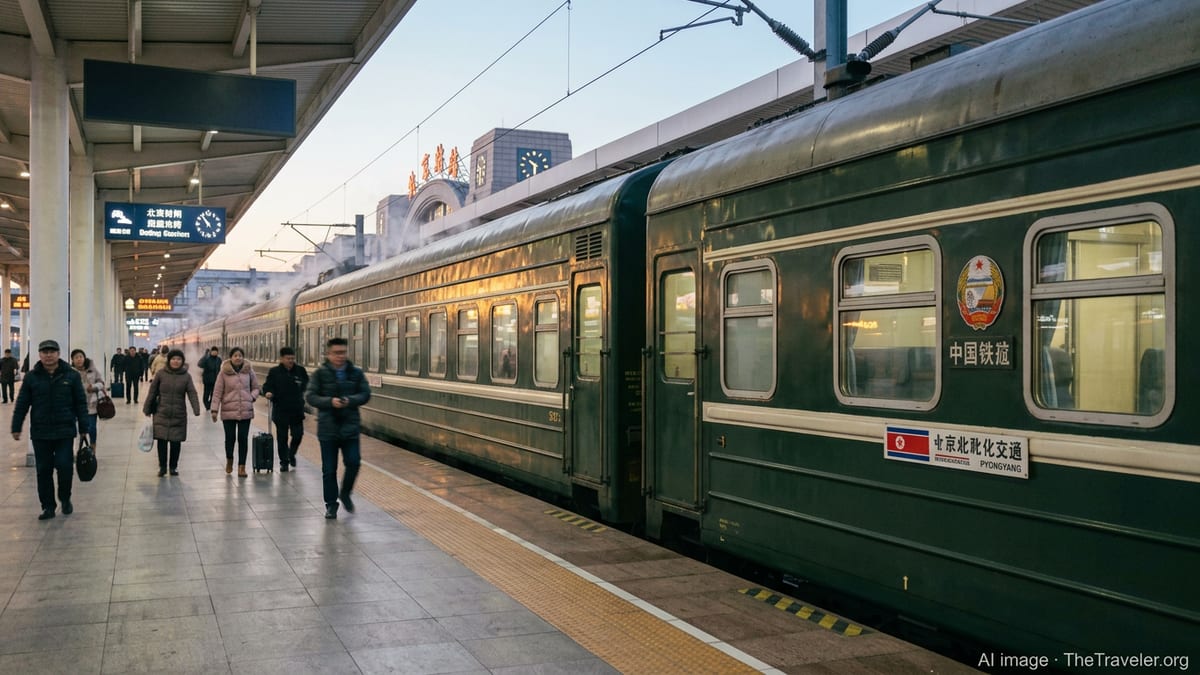
The long-silent rails between Pyongyang and Beijing are set to hum again this week, as China and North Korea revive their historic capital-to-capital passenger train for the first time in six years, signaling a cautious reopening of one of the region’s most politically sensitive routes.
Historic Line Returns After Pandemic Freeze
China’s rail authorities have confirmed that round-trip passenger services between Beijing and Pyongyang will restart on Thursday, restoring a Cold War–era corridor that had been shut since early 2020 at the height of the Covid-19 pandemic. The resumption covers the classic K27 and K28 international services, a staple of cross-border travel before the health crisis forced North Korea into one of the world’s longest and strictest border closures.
The revived trains will run four times a week between the two capitals, with departures from Beijing in the early evening and arrivals in Pyongyang the following day after an overnight journey via the Chinese border city of Dandong. According to schedules released by Chinese railway officials, the Beijing service is slated to leave shortly after 5 p.m., reaching Pyongyang around 6 p.m. local time the next day, broadly matching pre-pandemic timings on the route.
The reopening of the line comes six years after passenger services were quietly suspended as North Korea sealed off nearly all cross-border traffic. While freight trains gradually returned from 2022 to keep essential trade flowing, passenger coaches remained off-limits, leaving diplomats, aid workers and the few approved travelers reliant on rare charter flights and circuitous routes via third countries.
For rail historians and North Korea watchers, the return of the Pyongyang–Beijing train also marks a symbolic restoration of one of Asia’s most storied international services. The through-train link dates back to agreements signed in the early 1950s, when China and the newly founded Democratic People’s Republic of Korea sought to knit their postwar economies together by rail.
Limited Access Signals Cautious Reopening
Despite the fanfare around the announcement, the new phase of service will be tightly controlled. Travel agents in Beijing and Dandong handling official ticketing say that, at least initially, seats will be available only to Chinese nationals working or studying in North Korea, along with North Koreans traveling for work, study or family visits. That mirrors the highly managed approach Pyongyang has taken as it slowly eases out of its pandemic isolation.
North Korea began allowing small numbers of foreign visitors to return in 2024, prioritizing tightly organized Russian tour groups and official delegations while keeping broader tourism channels effectively shut. The government has also resumed certain marquee events, such as limited sports exchanges, while abruptly canceling others, including this year’s scheduled Pyongyang Marathon, in moves that underline how conditional and reversible any opening remains.
Tickets for the Pyongyang–Beijing trains will be sold offline rather than through China’s widely used digital booking platforms, another reminder that this is not yet a route for spontaneous backpacking or mass tourism. Travelers are expected to book through authorized agencies or dedicated international ticket counters, where documentation and travel purpose can be scrutinized before a paper ticket is issued.
Even under these restrictions, demand is expected to be brisk among North Koreans with relatives in China and among Chinese citizens who have been stranded outside the country’s northern neighbor since early 2020. The route is also likely to be used by staff from diplomatic missions and international organizations, for whom rail travel has long been the most predictable way in and out of Pyongyang when flights are scarce or disrupted.
Strategic Rail Link in a Changing Region
The revival of the Pyongyang–Beijing line carries significance that goes well beyond passenger numbers. For Beijing, reactivating the train underscores its role as North Korea’s principal economic lifeline at a time of heightened geopolitical tension and deepening rivalry with the United States. Rail connectivity is a central plank of China’s broader effort to weave the region together through infrastructure, even when partners are politically controversial.
For Pyongyang, reopening a direct overland link to its largest trading partner allows the regime to diversify beyond new rail and air connections it has been cultivating with Russia. North Korea restored passenger services to Russia last year, and leader Kim Jong Un’s high-profile train journeys to Russian and Chinese cities have underscored how central rail remains to the country’s diplomacy and logistics.
Analysts say the timing of the move reflects a confluence of strategic interests. Both China and North Korea are embarking on new five-year economic plans and seeking to stabilize supply chains after years of pandemic disruption and sanctions pressure. A functioning international rail corridor between their capitals serves practical needs, from moving technicians and students to facilitating controlled tourism flows that can bring in foreign currency without loosening political control.
At the same time, the restart of the train may complicate the diplomatic landscape. Neighboring South Korea has signaled that it is closely monitoring the development, wary that closer China–North Korea rail ties could be paired with expanded military cooperation or sanctions evasion efforts using freight routes that share the same corridor.
Implications for Future Travel to North Korea
For travelers and tour operators, the return of the Pyongyang–Beijing train is both an encouraging sign and a reminder of the constraints that still define North Korea travel. Before the pandemic, around 90 percent of foreign tourists to the country were Chinese, many arriving on organized group tours that included an overnight train ride from Beijing. Specialist agencies in Beijing, Shanghai and Hong Kong built entire itineraries around the romance of crossing the Yalu River into a closed-off state by rail.
Those companies are now cautiously preparing for a possible broader reopening, even if they are not yet able to sell seats on the reinstated service to international tourists. Some agencies report a rise in inquiries from travelers who visited North Korea before 2020 and are eager to return, as well as from new visitors drawn by the novelty of one of the world’s most restricted destinations. For now, they are tempering expectations, stressing that any expansion beyond tightly vetted passengers will depend entirely on decisions in Pyongyang and Beijing.
Should North Korea eventually widen access, the Pyongyang–Beijing line is likely to remain the primary gateway for most visitors. The route offers a rare, slow-motion glimpse into both countries’ border regions, from the industrial landscapes on the Chinese side to the quieter stretches of countryside inside North Korea, where station stops remain firmly off-limits to unaccompanied foreigners. For many, that carefully guided train ride is as close as they will get to seeing everyday life along the frontier.
In the meantime, the fact that any passengers at all will again be peering out of those carriage windows is a remarkable shift from the hermetic isolation of just a few years ago. The historic line’s revival may be tightly managed and politically freighted, but it also hints at a future in which trains, not just headlines, again carry people between Pyongyang and Beijing.