

More news on this day
Thousands of travelers from the United States to the Middle East and Indian Ocean are stranded after Qatar Airways scrapped hundreds of flights and delayed many more, as sweeping airspace closures tied to the escalating conflict around Iran shut down critical hubs from Doha and Dubai to Atlanta, Medina and Malé.
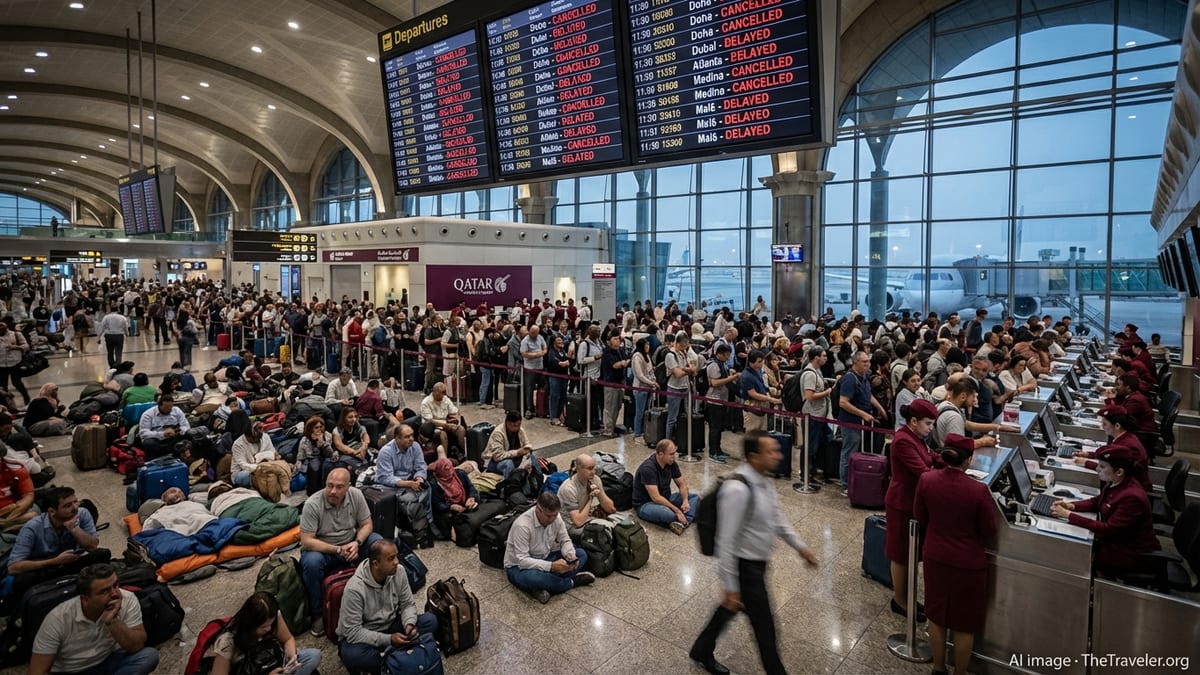
Regional Conflict Triggers Worldwide Flight Disruptions
The latest wave of cancellations comes after authorities across the Gulf moved to close or severely restrict airspace in response to intensified military action involving Iran, the United States and Israel. Aviation regulators in Qatar and neighboring states have curtailed civilian overflights, forcing airlines to ground aircraft or attempt lengthy diversions around the region.
Qatar Airways, one of the world’s largest long-haul carriers, has been hit particularly hard because its hub at Hamad International Airport in Doha sits at the center of east–west traffic flows. With Qatari airspace effectively sealed, the airline has frozen large parts of its schedule, cancelling 423 services across its network and pushing back many others as dispatchers struggle to rework routes on short notice.
Industry data compiled from major tracking platforms and airport operations logs show more than 4,600 combined cancellations and delays across Asia and the Middle East in the past 48 hours, with Qatar Airways among the most affected carriers. Regional rivals including Emirates, Etihad and flydubai have also halted or sharply cut operations, compounding the disruption at key transit hubs.
The resulting bottleneck has rippled far beyond the Gulf. Aircraft and crews stranded out of position have led to secondary cancellations across Europe, North America and Africa, as airlines temporarily abandon multi-leg itineraries that rely on Doha and Dubai as connective nodes.
Major Airports From Atlanta to Malé Feel the Strain
While much of the immediate focus is on shuttered Gulf gateways, the knock-on effects are increasingly visible at distant airports where Qatar Airways normally operates nonstop services. In the United States, passengers at Atlanta’s Hartsfield–Jackson airport have faced abrupt cancellations on routes to Doha, leaving long-haul travelers without clear alternatives as partner airlines grapple with their own capacity limits.
At Saudi Arabia’s Medina and Jeddah airports, large numbers of religious travelers connecting to and from South and Southeast Asia have been left in transit limbo. With onward services through Doha suspended, many have been forced to queue at crowded transfer desks, seeking rerouting via what limited capacity remains through airports in Turkey, Egypt or Oman.
Farther east, Malé’s Velana International Airport in the Maldives has become another pressure point. The island nation depends heavily on Gulf carriers for its tourism lifeline, and cancelled Qatar Airways and Emirates flights have stranded holidaymakers in resort atolls and in the capital’s small terminal, where departure boards show columns of scrubbed services to Doha, Dubai and Abu Dhabi.
Dubai International, normally the world’s busiest hub for international traffic, remains largely quiet by comparison to its usual frenetic pace. With both Emirates and Qatar Airways cutting or suspending operations through the city and much of the surrounding airspace under restrictions, long-haul services that would typically connect via Dubai have been taken off sale or left in “indefinite delay” status.
Passengers Face Long Queues, Patchy Information and Rising Costs
For many affected travelers, the most immediate challenge has been securing clear information. Airport terminals from Atlanta to Malé and Algiers have seen long lines at Qatar Airways customer service counters, as passengers attempt to understand whether their flights are cancelled outright or merely delayed pending airspace assessments.
Several airports have reported overwhelmed help desks and limited staffing relative to demand. With automated rebooking tools at capacity, frontline agents have been forced to process changes manually, often one booking at a time. Travelers report waiting hours just to receive meal vouchers or overnight hotel confirmations as operations teams race to reconfigure schedules.
Accommodation and replacement tickets have also become more expensive as the disruption drags on. With hotels near major hubs filling quickly, some stranded passengers have turned to distant suburbs or budget properties, while others have opted to sleep in terminal seating areas in hopes of securing early-morning departure slots should a window to operate reopen.
In markets where Qatar Airways is a dominant player, alternative options remain limited. Routes linking secondary cities in the United States, North Africa and South Asia to the Gulf often have only one or two daily services, leaving travelers little choice but to accept lengthy detours or significant delays. For some, particularly those traveling for medical treatment or family emergencies, the uncertainty has added a heavy emotional toll.
Airline and Government Responses Evolve by the Hour
Qatar Airways has described the sweeping cancellations as an unavoidable consequence of regulatory action and stated that safety remains its overriding priority. The airline is coordinating with the Qatar Civil Aviation Authority and other regulators, with internal bulletins suggesting that decisions on resuming limited services will be reviewed in tightly scheduled windows as the security picture evolves.
Airports across Saudi Arabia, the United Arab Emirates, the Maldives and Algeria have activated crisis-management protocols, setting up additional information booths, deploying multilingual staff and coordinating with local tourism authorities to arrange temporary lodging where possible. Some civil aviation authorities have issued travel advisories urging passengers not to travel to airports until they have confirmed flight status directly with their airlines.
Governments in affected countries are also monitoring the situation for citizens stranded abroad. Consular officials in the United States and Europe have begun working with Gulf-based carriers to prioritize vulnerable travelers, including unaccompanied minors and those with urgent medical needs, for the first available flights once corridors reopen or safe diversion routes are established.
Despite these efforts, officials privately acknowledge that the scale of the disruption makes a rapid normalization unlikely. With airspace closures spanning multiple jurisdictions and ongoing military activity in and around key transit corridors, planners are preparing for the possibility that schedules could remain heavily curtailed for several days.
Uncertain Outlook for Spring Travel and Global Connectivity
The disruption arrives at a busy period for global tourism and corporate travel, amplifying its impact. March typically marks the start of a strong spring and early summer booking window, particularly for travelers from Europe and North America heading to Asia and the Indian Ocean via Gulf hubs. Travel agents report a spike in requests to reroute itineraries through alternative hubs in Istanbul, Doha’s regional competitors on the Arabian Peninsula, and major European gateways.
Analysts warn that even once airspace begins to reopen, it could take days for airlines such as Qatar Airways to fully restore their complex long-haul networks. Aircraft and crews are scattered across continents, and maintenance cycles, crew rest rules and airport slot constraints will all limit how quickly normal timetables can return. Some lightly traveled routes may see prolonged reductions or temporary suspensions as carriers concentrate scarce capacity on trunk services.
For passengers with upcoming travel in March and April, industry experts recommend building in additional buffer time, avoiding tight connections, and staying alert for schedule changes that could come with little notice. Even travelers not booked on Qatar Airways may feel the downstream effects if rival airlines absorb displaced demand or adjust timings to skirt closed air corridors.
What began as a regional security crisis has therefore morphed into a global test of aviation resilience. With 423 Qatar Airways flights cancelled and many more delayed, and thousands of passengers stuck in airports from Atlanta and Medina to Malé, Dubai and beyond, the coming days will determine how quickly the world’s air transport system can adapt to yet another profound shock.