

More news on this day
Thousands of travelers across the United States, the Gulf, North Africa, and the Indian Ocean were left stranded this weekend after Qatar Airways scrapped hundreds of services and delayed many more, as the sudden closure of Qatari and wider Middle Eastern airspace rippled through major hubs from Atlanta and Dubai to Medina and Malé.
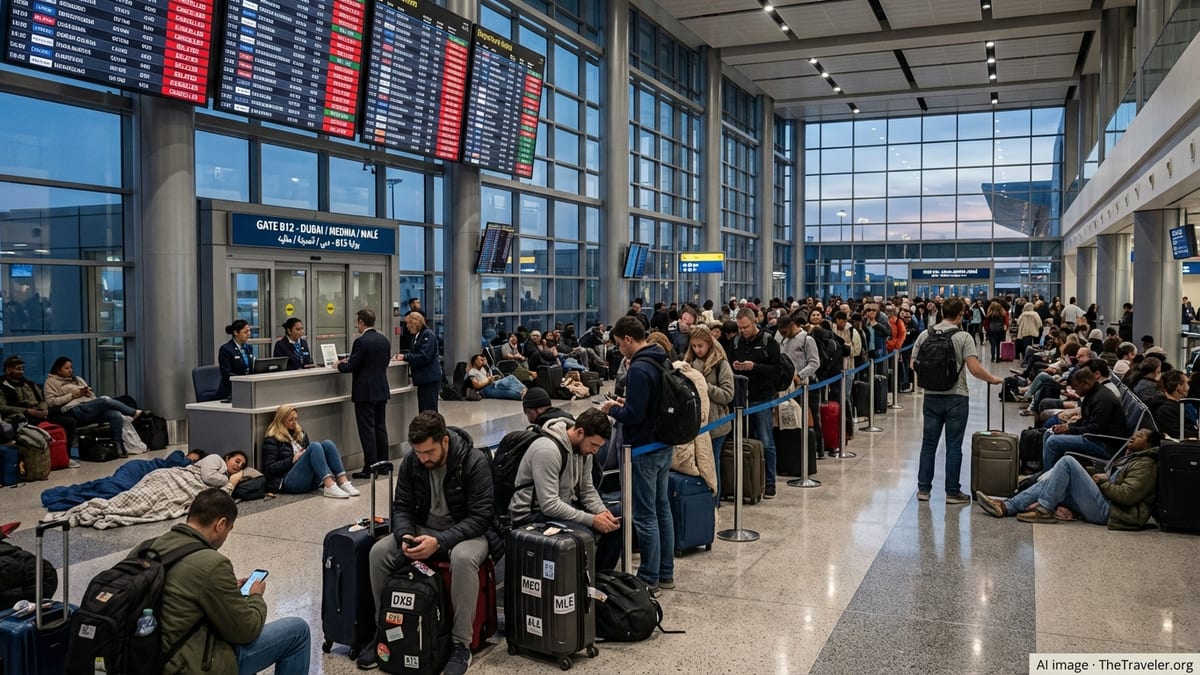
Middle East Airspace Crisis Ripples Across Global Networks
The disruption began on February 28 after U.S. and Israeli strikes on Iran triggered retaliatory missile attacks and prompted multiple countries, including Qatar, the United Arab Emirates, Bahrain, Kuwait, and others, to close or severely restrict their airspace. What started as mid-flight diversions quickly escalated into a systemic aviation shock, with flight-tracking data showing thousands of cancellations and diversions across the region and beyond.
Qatar’s Civil Aviation Authority ordered a complete halt to traffic in Qatari airspace on February 28, effectively freezing Qatar Airways’ hub at Doha’s Hamad International Airport. The airline confirmed that all flights to and from Doha would remain temporarily suspended until regulators declared the skies safe, stressing that safety of passengers and crew would take precedence over schedule recovery.
By March 2, operational data compiled by industry analysts and passenger-rights platforms indicated that Qatar Airways alone had cancelled at least 423 flights since the airspace shutdown began, with dozens more heavily delayed as aircraft and crew fell out of position around the world. Aviation observers warned that even once limited services resume, the carrier faces days of rolling disruptions while it rebuilds its long-haul network.
The closures have also compounded strain at neighboring Gulf hubs. Dubai and Abu Dhabi, primary bases for Emirates and Etihad Airways, remained shut or tightly constrained into March 2, further restricting routing options for travelers who typically rely on the Gulf as a bridge between continents.
Atlanta, New York and Other U.S. Gateways See Long-Haul Chaos
In the United States, the shutdown of Doha as a connecting hub has produced visible knock-on effects at major international gateways. At Hartsfield–Jackson Atlanta International Airport, where Qatar Airways normally operates long-haul services into its Middle East network, departure boards over the weekend filled with notices of cancellations and indefinite delays to Doha-bound flights and onward connections.
Passengers booked from Atlanta, New York, Chicago and other U.S. cities onto Qatar Airways itineraries bound for India, Southeast Asia and Africa reported being told to expect multi-day waits for rebooking as capacity through alternative hubs quickly filled. Many travelers were rerouted at short notice via European carriers or asked to accept itineraries that bypassed the Gulf entirely, adding hours and, in some cases, extra overnight stays to journeys.
Long queues formed at check-in counters and transfer desks as travelers sought clarity on whether their tickets could be refunded or changed without penalty. Qatar Airways has issued a temporary waiver policy allowing affected passengers to refund or rebook journeys scheduled between February 28 and early March, but implementation on the ground has varied by airport and partner airline.
Consumer advocates in the U.S. urged passengers to document all communications with airlines and to check whether they might be entitled to compensation or accommodation under local or foreign regulations, noting that protections differ markedly depending on where a flight originates and which carrier operates the segment.
Regional Turmoil Hits Medina, Malé, Dubai and Beyond
Across the broader network, the sudden loss of Doha as a functioning hub has been felt most acutely in cities heavily dependent on Gulf connectivity. In Saudi Arabia, pilgrims and workers traveling through Medina and Jeddah on Qatar Airways and partner itineraries saw flights abruptly cancelled as aircraft scheduled to arrive from Doha never left the ground.
In the Maldives, where Malé’s Velana International Airport relies on Gulf carriers to deliver tourists from Europe, Asia and North America, hotel operators reported waves of last-minute cancellations and unplanned extra nights for guests who found themselves unable to depart. Some resorts arranged emergency boat transfers and late check-outs to cope with guests whose homebound Qatar Airways or codeshare flights vanished from schedules overnight.
Dubai International Airport, one of the world’s busiest hubs, has itself been operating under heavy constraints, with Emirates suspending flights to and from the city and departure boards dominated by cancellations. With both Dubai and Doha largely out of action, city pairs that normally enjoy near-seamless connectivity through the Gulf have been left with few immediate alternatives.
The effects have stretched to North Africa as well. In Algeria, passengers flying to and from Algiers on itineraries routed through Doha reported being stranded in third-country airports when onward Qatar Airways sectors were scrubbed. Local authorities have coordinated with airlines to arrange limited charter and extra sections, but capacity has lagged far behind demand.
Stranded Passengers Navigate Uncertainty and Limited Options
For travelers caught mid-journey, the crisis has often unfolded in confusing bursts of notifications and gate changes. At Doha’s Hamad International Airport, thousands of passengers spent long hours stretched out on terminal floors and in crowded waiting areas as departures first slipped into rolling delays and then disappeared from screens altogether once the full closure of Qatari airspace was confirmed.
Similar scenes played out in Atlanta, Dubai, Malé and other affected airports, where local staff attempted to rebook passengers with limited tools as their own airline systems struggled to keep up with the pace of cancellations. Some travelers with flexible tickets managed to secure alternative routings via Europe, East Asia or Africa, while others on nonrefundable fares or complex multi-airline itineraries found themselves with few practical options beyond waiting.
Travel agents and corporate travel managers reported a surge in emergency calls from clients seeking to reroute staff away from the Middle East entirely. Many companies temporarily suspended travel that required transiting the Gulf, pivoting to routings through Istanbul, European hubs or direct services where available, even at significantly higher fares.
With airspace closures driven by an evolving security situation rather than a technical fault or weather system, airlines have been cautious about forecasting when full operations might resume. Analysts say the lack of a clear timeline has made it difficult for carriers like Qatar Airways to schedule recovery flights, contributing to the unusually high volume of outright cancellations rather than short rolling delays.
What Travelers Can Expect in the Coming Days
Aviation experts expect Qatar Airways to slowly rebuild its timetable once Qatari airspace reopens, initially focusing on key trunk routes to major hubs in Europe, Asia, North America and Australasia. However, with at least 423 flights already cancelled and many aircraft and crews out of position, the airline is likely to prioritize operational stability over a rapid return to full capacity.
Passengers scheduled to travel to or through Doha, Dubai or Abu Dhabi in the first week of March are being advised to monitor flight status closely and to consider rebooking via alternative hubs if their journeys are time-sensitive. Flexible rebooking and refund policies introduced by Qatar Airways and partner carriers may ease some of the financial burden, but availability on alternative routes is expected to remain tight until networks normalize.
Industry observers note that the disruption underscores the vulnerability of global aviation to sudden geopolitical shocks, particularly when they affect concentrated transit hubs that funnel traffic between regions. For travelers flying between the United States, Europe, Asia and Africa, reliance on a small number of Gulf gateways has delivered efficiency in normal times but has magnified the impact of this week’s crisis.
With no firm end date yet for the airspace restrictions, travelers are being urged to factor in greater time buffers, maintain up-to-date contact details with airlines, and keep essential items such as medication, chargers and a change of clothes in carry-on bags in case extended layovers or unexpected overnight stays become unavoidable.