

More news on this day
Travel across the Gulf and wider Middle East has been thrown into fresh turmoil as Qatar Airways and Gulf Air cancel more than 20 flights serving Iraqi cities including Baghdad, Basrah and Najaf, sharply disrupting passenger links to Doha, Bahrain, Amman and beyond.
Get the latest news straight to your inbox!
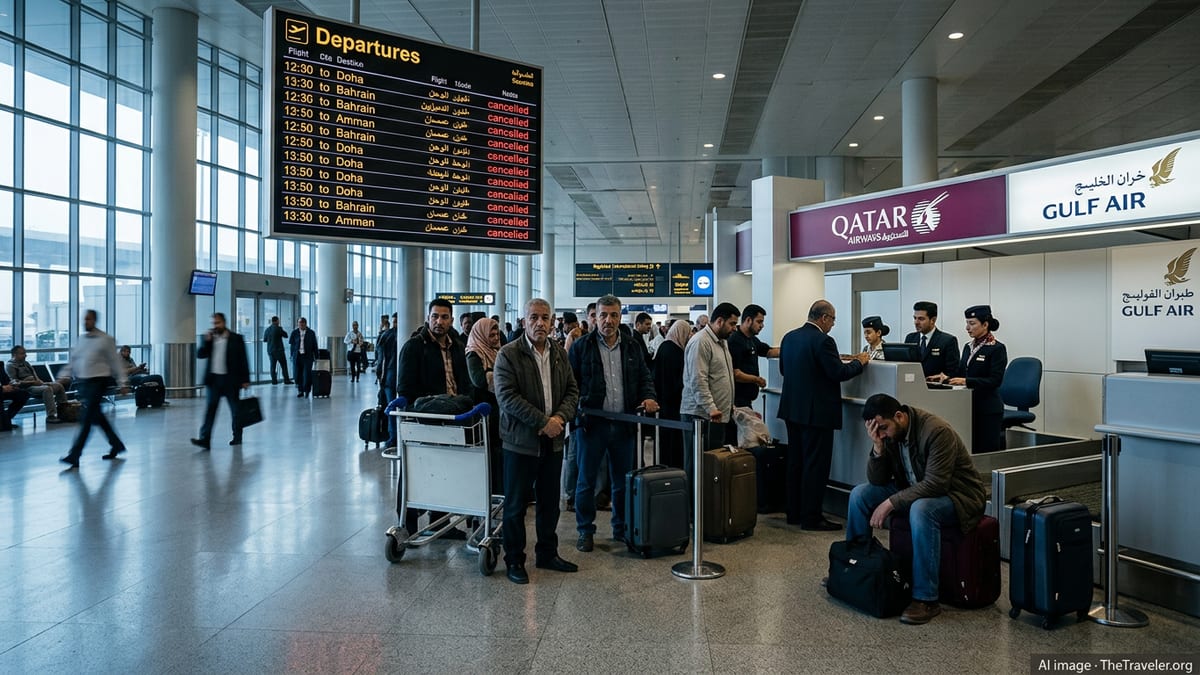
Latest Wave of Cancellations Hits Key Iraq–Gulf Routes
The newest disruption follows weeks of rolling airspace closures across Iran, Iraq, Jordan, Qatar, Bahrain and several neighboring states after a sharp escalation in regional tensions. Authorities in Qatar and Bahrain have kept significant restrictions in place, forcing airlines to repeatedly trim or suspend services in and out of the Gulf hubs.
Qatar Airways has reduced its previously busy Iraq schedule to a bare minimum, with multiple rotations between Doha and Baghdad, Basrah and Najaf pulled from the timetable over the coming days. Industry trackers and passenger reports point to at least a dozen Qatar Airways cancellations on Iraq routes alone, with Baghdad and Najaf among the hardest hit as schedules for March 12 and 13 are thinned out pending clearer guidance on airspace access.
Gulf Air, Bahrain’s national carrier, has mirrored these moves on its own Iraq network. Services that normally link Bahrain with Baghdad and Najaf have been repeatedly scrubbed since late February as Bahrain’s airspace remains effectively closed to routine commercial traffic. Operational updates from Manama confirm that only select relief and repositioning flights are operating while regular passenger services on many regional routes stay suspended.
Combined, the latest Qatar Airways and Gulf Air schedule changes amount to more than 20 cancelled flights touching Iraq in the current wave alone, on top of hundreds of wider regional cancellations since airspace restrictions began. Aviation observers warn that the numbers could rise further if conflict-related advisories to avoid large parts of Gulf and Iraqi airspace are extended.
Doha, Bahrain and Amman Connectivity Severely Restricted
The immediate consequence for travelers is a sharp reduction in nonstop options between Iraq and three of the region’s most important connecting hubs: Doha, Bahrain and Amman. Qatar Airways, a major transit carrier for Iraq-based passengers heading to Europe, Asia and North America, has been forced to suspend or reroute many services to and from Doha while Qatari airspace operates only through limited emergency corridors.
Gulf Air’s continued suspension of routine operations at Bahrain International Airport has compounded the squeeze on capacity. With Bahrain’s airspace still under closure orders from its civil aviation authority, the airline cannot run its usual shuttle of narrow-body aircraft that feed Iraqi passengers into its Bahrain hub for onward connections to the Gulf, Indian subcontinent and Europe.
Jordan’s capital Amman has also seen disrupted connectivity. Although Queen Alia International Airport remains open, many of the regional flights that typically link Iraqi cities to Amman pass through or near restricted airspace, leading to a mix of cancellations and re-routings. Travelers accustomed to using multi-leg itineraries such as Najaf–Doha–Amman or Basrah–Bahrain–Amman are finding those options either unavailable or subject to last-minute changes.
The knock-on impact is felt well beyond point-to-point traffic. Transit passengers who would usually rely on seamless same-day connections through Doha or Bahrain are being rebooked on longer routings via alternative hubs or asked to delay trips entirely, increasing crowding and wait times at already stretched airports in the region.
Baghdad, Basrah and Najaf Passengers Face Tough Choices
For travelers in Iraq’s main air gateways, the situation is particularly challenging. Baghdad International Airport, normally served by multiple daily links to Doha and Bahrain, is seeing large gaps in its departure boards as regional carriers pare back or suspend flights while they await more stable security assessments of overflight routes. Basrah, an important commercial center in the south, has similarly lost a significant share of its Gulf-bound capacity.
Najaf, a key religious destination that typically relies heavily on Gulf carriers to move pilgrims and expatriate workers, has been especially impacted by the Qatar Airways and Gulf Air cancellations. Local agents report rising demand for remaining seats on other airlines and routes, sometimes at sharply higher fares, as passengers scramble to find alternatives for time-sensitive trips.
With schedules changing daily, many Iraq-based passengers face a stark choice: accept significantly longer and more expensive detours via less affected hubs, or postpone travel in the hope that airspace closures will ease in the coming days. In some cases, travelers are choosing to route over Istanbul, Cairo or European gateways, adding many hours to journeys that would normally involve short hops to Doha or Bahrain.
Airport authorities in Iraq are urging passengers to confirm flight status with airlines before traveling to the airport and to allow extra time for check-in and rebooking, as ground staff juggle mounting queues of disrupted travelers across Baghdad, Basrah, Najaf and other affected cities.
Airlines Offer Flexible Policies but Capacity Remains Tight
In response to the turbulence, both Qatar Airways and Gulf Air have expanded flexible booking policies for affected customers. Qatar Airways has announced that passengers with confirmed bookings covering late February through March 22 can generally rebook, reroute or request refunds without standard change penalties when their flights are cancelled or significantly altered.
Gulf Air is applying similar waivers for itineraries touching Bahrain while its airspace remains effectively closed, offering date changes and in many cases fee-free refunds for flights that cannot operate. The carrier has also organized limited special flights on select regional routes where conditions and regulatory approvals allow, though these remain the exception rather than the rule.
Despite these measures, the core issue for passengers is not flexibility but availability. With large swathes of regional airspace still restricted, airlines across the Gulf are operating reduced networks and smaller schedules, leaving far fewer seats than normal to accommodate both newly booked travelers and those displaced from cancelled services.
Travel agents in Iraq and the wider region report that alternative routings on unaffected airlines are filling quickly, especially for peak travel dates. Many advise clients to secure any viable replacement itinerary as soon as possible, even if it involves longer travel times or less convenient connection points.
What Travelers Need to Do Now
For anyone holding tickets on Qatar Airways or Gulf Air to or from Baghdad, Basrah, Najaf or other Iraqi cities, experts stress the importance of proactive monitoring. Flight statuses are shifting frequently as airspace advisories evolve, and an itinerary that appears confirmed one day may be modified or cancelled the next.
Passengers are being urged to check airline apps and official communication channels several times a day, particularly in the 48 hours before scheduled departure. Those already en route or in transit should stay close to departure gates and information desks, where last-minute gate changes, delays or rebookings are being handled in real time by airline staff.
Travelers whose journeys are not essential in the coming days may wish to consider postponement, especially if their itineraries depend on tight connections through Doha, Bahrain or Amman. While flexible rebooking policies provide some financial protection, repeatedly attempting to travel during an unstable period can lead to extended airport stays, unexpected overnights and considerable stress.
For now, the restoration of normal flight patterns between Iraq and the Gulf’s major hubs hinges on when regional aviation regulators deem it safe to reopen more of the affected airspace. Until then, passengers planning to move between Baghdad, Basrah, Najaf and destinations such as Doha, Bahrain and Amman should expect continued disruption, limited capacity and the need for contingency plans.