

More news on this day
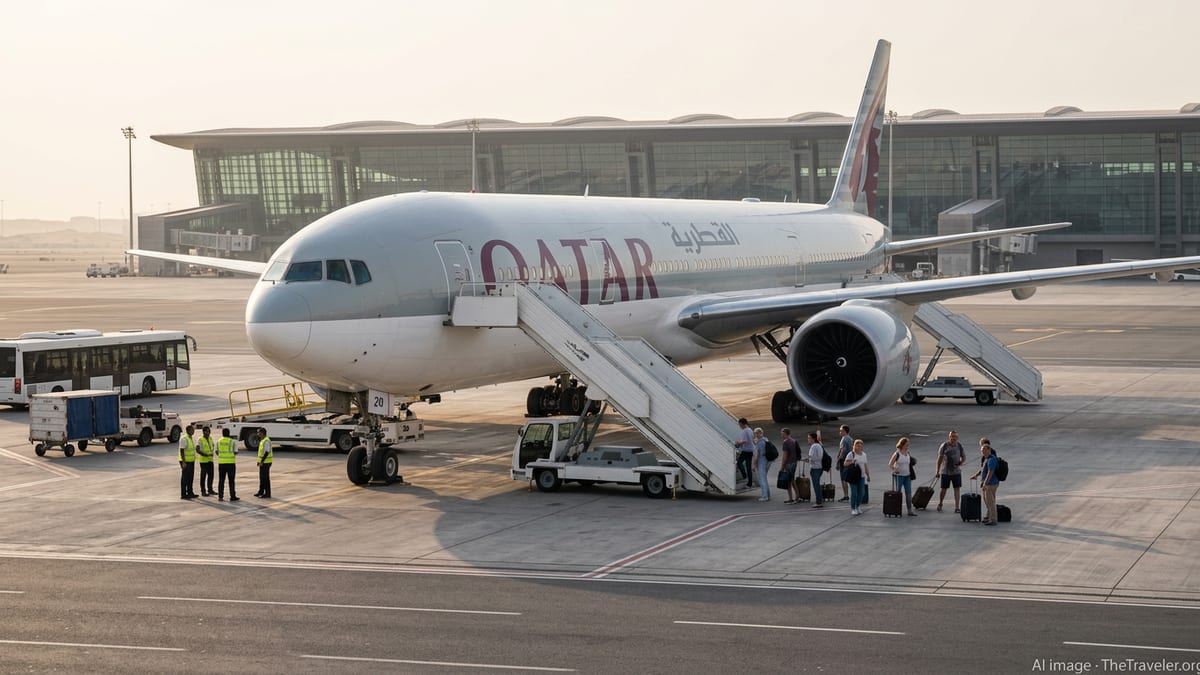
Qatar Airways has begun operating a limited emergency relief corridor from Doha to major European cities, offering a lifeline to stranded passengers while regular flight operations remain suspended following the closure of Qatari airspace.
What Is the New Doha–Europe Relief Corridor?
Qatar Airways confirmed that, following temporary authorisation from the Qatar Civil Aviation Authority, it is operating a small number of repatriation flights from Hamad International Airport on 7 March to five key European hubs: London Heathrow, Paris Charles de Gaulle, Madrid, Rome Fiumicino and Frankfurt. These services are being operated under special safety clearances while the wider national airspace remains closed to normal commercial traffic.
The airline stresses that these are not a resumption of its regular network but an emergency measure to move priority passengers out of Doha and onward to Europe. Schedules are extremely limited compared with the carrier’s usual operations, and there is no public inventory for sale through normal booking channels.
The relief flights complement earlier emergency services that began on 5 March from Muscat and Riyadh to several European destinations, arranged after Qatar Airways grounded most services in response to the regional security situation and subsequent airspace restrictions. Together, these corridors are designed to relieve the most urgent cases of stranded travelers across the Gulf and beyond.
Authorities and industry observers describe the corridor as a controlled, short-term bridge rather than a full reopening. A further regulatory update has been signalled for 8 March, after which the scope of flying to and from Doha may be reassessed.
Who Gets Priority on the Emergency Flights?
Seats on the Doha departure flights are being pre-assigned by Qatar Airways rather than released for general sale. According to the airline, priority is being given to passengers with families, elderly travelers and those with urgent medical or compassionate travel needs who were previously booked to travel and became stranded when flights were suspended.
This means that even travelers with valid tickets will not be able to choose dates or destinations freely. Instead, the carrier is reviewing existing bookings and passenger profiles, then matching individuals to whatever limited capacity becomes available on these specially authorised services.
Qatar Airways has made clear that it is directly contacting selected passengers by phone, email or app notifications to offer seats, provide itineraries and set out next steps. Those who are not contacted are unlikely to be able to board the relief flights, even if they can physically reach the airport or a departure city such as Muscat or Riyadh.
Travel specialists note that this kind of triage is typical of humanitarian-style air operations, which aim to move the most vulnerable first, rather than operate on a simple first-come, first-served basis. For many passengers, that means uncertainty will continue until broader airspace restrictions ease.
Which European Cities Are Being Served, and When?
For the Doha-origin services, Qatar Airways has listed London Heathrow, Paris Charles de Gaulle, Madrid, Rome Fiumicino and Frankfurt as the initial European destinations served on 7 March. These airports are among the airline’s largest hubs on the continent and offer extensive onward connections once passengers arrive.
Earlier in the week, a separate programme of relief flights was launched from Muscat and Riyadh to London Heathrow, Berlin, Copenhagen, Madrid, Rome, Amsterdam and Frankfurt. These flights are designed for passengers who were diverted or advised to relocate to Oman or Saudi Arabia when Doha operations first came to a halt.
At this stage, the carrier has not announced a sustained timetable or a published schedule for the Doha corridor beyond the initial cluster of flights. Officials have instead committed to issuing further operational updates, with the next significant communication expected by the morning of 8 March Doha time.
Travel analysts caution that capacity will remain far below normal for at least several days. Even if additional corridors are approved, aircraft and crew will need to be repositioned and maintenance checks completed before anything resembling a regular network can resume.
How Can Affected Passengers Secure a Seat?
For travelers hoping to use the emergency corridor, the single most important step is to ensure their contact details in existing bookings are accurate and up to date. Qatar Airways has repeatedly urged customers to verify email addresses and phone numbers through its website or mobile app so they can be reached quickly if space becomes available.
The airline has asked passengers not to go to the airport in Doha, Muscat or Riyadh unless they have received a specific notification confirming a place on a named relief flight. Airport access and check in for these operations are being tightly controlled, and those who arrive without an official confirmation are likely to be turned away.
Customer communications indicate that rebooking, refunds and rerouting via partner airlines remain possible in some cases under special disruption policies, particularly for passengers ticketed to travel through Doha in the coming days. However, call centres and sales offices are experiencing heavy demand, and processing times can be lengthy.
Consumer advocates advise passengers to keep records of all correspondence and to monitor official airline channels frequently. Given the fluid security environment, options that are unavailable one day may become possible the next as regulators adjust operating permissions and airlines reposition capacity.
What This Means for Travel Planning in the Region
The launch of relief flights from Doha signals a modest easing in an otherwise severe disruption to Gulf aviation. For thousands of passengers, it offers the first concrete pathway home since the sudden airspace closure led to mass cancellations and diversions. Yet travel across the region remains highly uncertain, with most regular services still grounded.
Travel planners say the situation underscores how quickly geopolitical tensions can affect even the most established aviation hubs. Hamad International Airport, usually one of the busiest and most efficient transfer points between Europe, Asia and Africa, has been reduced almost overnight to handling only narrowly defined emergency operations.
Prospective travelers are being advised to avoid nonessential trips that would normally route through Doha in the short term, and to consider alternative carriers and hubs where possible. Those who must travel are urged to build extra flexibility into itineraries and to anticipate last-minute changes or overnight stays if routes are altered.
For now, the key message from both regulators and Qatar Airways is that the emergency corridor is a temporary humanitarian measure rather than a signal of full reopening. Until authorities declare Qatari airspace safe for regular operations, the limited relief flights from Doha to Europe will remain a scarce and tightly controlled resource.