

More news on this day
Thousands of travelers across Egypt and the wider Middle East are facing cancellations, rolling delays and mounting uncertainty as EgyptAir extends the suspension of key regional routes and Cairo’s main gateway records one of its most disrupted days in years.
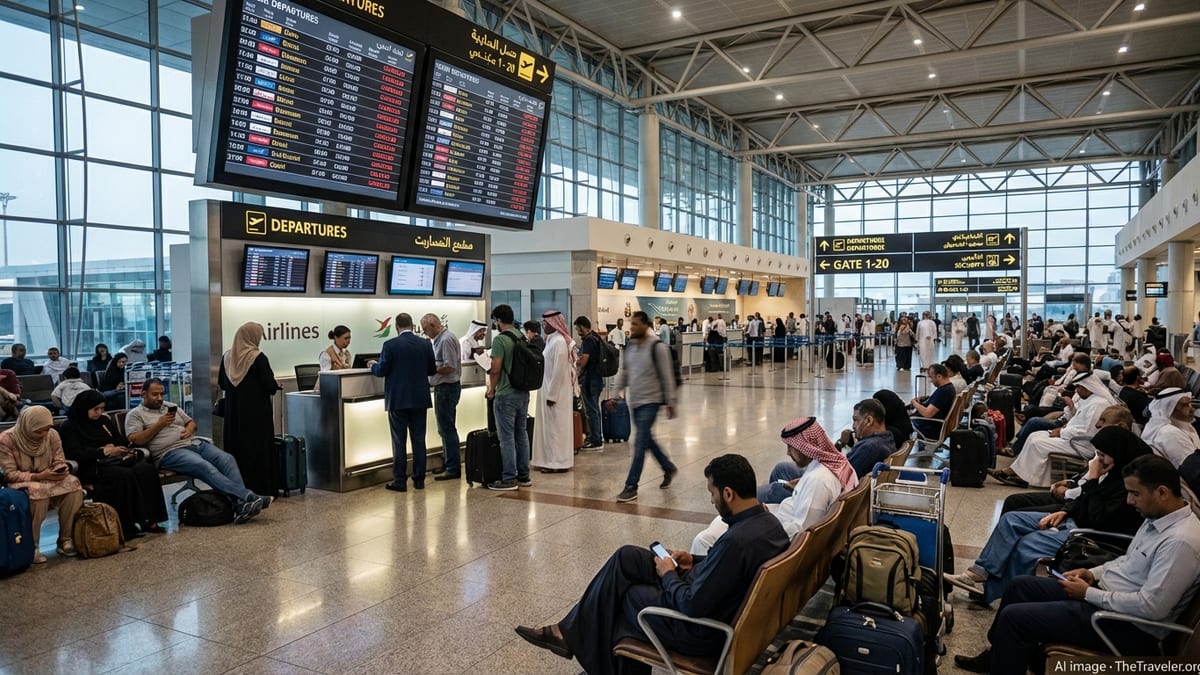
EgyptAir Keeps 11–13 Regional Routes Offline Amid Escalating Tensions
EgyptAir has confirmed that flights from Cairo to a swath of major regional hubs will remain suspended until further notice, as airspace closures ripple across the Middle East following a sharp escalation in conflict involving the United States, Israel and Iran. The state-owned carrier first halted services on February 28, cutting links to more than a dozen cities including Dubai, Abu Dhabi, Sharjah, Beirut, Doha, Amman, Dammam, Bahrain, Baghdad, Erbil, Kuwait, Qassim and Muscat.
In updated notices issued over the weekend, the airline said it is continuing to suspend flights on 11 of these routes, with services to Dubai, Abu Dhabi, Sharjah, Beirut, Doha, Amman, Dammam, Bahrain, Baghdad, Erbil and Kuwait all remaining grounded. EgyptAir described the move as a necessary safety measure in light of “rapid developments” and the closure or restriction of airspace in multiple neighboring countries, even as Egyptian airspace itself remains open.
The carrier’s Integrated Operations Control Center in Cairo is operating in emergency mode, tracking regional military and aviation developments and coordinating with civil aviation authorities and the airline’s overseas stations. Officials have not offered a firm timeline for resuming normal operations, leaving passengers booked on near-term departures with few guarantees beyond the offer of rebooking or refunds.
While EgyptAir has not published a comprehensive tally of affected services since the crisis began, regional aviation analysts estimate that dozens of its flights to the Gulf and Levant have been scrubbed each day, effectively severing some of Cairo’s busiest short-haul corridors at the height of the winter and spring travel season.
Ground Disruptions Mount in Cairo and Across Egyptian Holiday Hubs
The pressure on Egypt’s aviation system intensified on March 2, when four of the country’s airports reported a combined 227 flight cancellations and delays, according to industry data compiled by travel trade outlets. Cairo International Airport alone recorded 67 cancellations and 81 delays, making it the single largest disruption hotspot in the region that day by volume.
National carrier EgyptAir bore the brunt at its home hub, with reports of at least 34 cancellations and 29 delays on its Cairo operations. Other airlines serving Egypt’s capital, including Emirates, Qatar Airways and Air Arabia, also scrubbed multiple flights as they struggled with airspace closures around the Gulf and the need to reroute or suspend services into key markets such as Dubai and Doha.
The turmoil spread beyond Cairo to Egypt’s major Red Sea and Mediterranean gateways. Sharm El Sheikh registered three cancellations and 36 delays, Hurghada reported one cancellation and 36 delays, and Alexandria’s main international airport saw two cancellations and one delay, a small number in absolute terms but still disruptive to travelers relying on limited frequencies. Carriers such as Air Cairo, Pegasus Airlines, easyJet, Neos, TUI Airways, Etihad Airways, Gulf Air and Kuwait Airways all reported schedule impacts.
For passengers, the operational statistics have translated into long queues at check-in and transfer desks, overnight stays in terminal waiting areas and hastily rearranged travel plans. With many flights officially “delayed” rather than outright canceled while airlines wait for updated airspace guidance, travelers have reported uncertainty stretching for hours before eventually being told their services would not depart.
Ripple Effects in Beirut, Dammam, Dubai and Other Gulf Gateways
The shock to the regional network extends well beyond Egypt’s borders. In Lebanon, Middle East Airlines canceled and reshuffled multiple flights to Gulf destinations for March 2 and beyond, citing the impact of the conflict and related airspace restrictions. Scheduled services between Beirut and Dubai, Amman and Kuwait were among those pulled from the board, tightening an already constrained set of options for travelers moving between the Levant and the Gulf.
Across the Gulf, authorities in the United Arab Emirates, Qatar, Bahrain, Kuwait and Oman have temporarily closed or heavily restricted their airspace at various points since the strikes began, leading to suspensions and mass rerouting for both local and foreign carriers. Dubai International Airport, historically one of the world’s busiest international hubs, halted all flights for periods over the weekend as its home carrier Emirates suspended operations to and from the emirate while regional skies remained uncertain.
Saudi airports have also been affected as routes touching Iranian and Iraqi airspace were curtailed, while cities such as Dammam and Qassim saw services from EgyptAir and other carriers suspended. With many Gulf states hosting large expatriate populations from Egypt, Lebanon and other Arab countries, the interruption of these short-haul links has immediate social and economic consequences for workers, families and businesses that rely on frequent, relatively low-cost flights.
International carriers from Europe and Asia have likewise pared back operations into the affected zone. Airlines including Lufthansa, Air France, KLM, British Airways, Virgin Atlantic and several Indian and Russian carriers have either canceled flights to cities such as Tel Aviv, Beirut, Amman, Dubai and Abu Dhabi or rerouted services to avoid Iranian, Iraqi, Jordanian and Lebanese airspace, adding time, fuel and complexity to long-haul journeys.
Airspace Closures Reshape Regional and Long-Haul Routes
Behind the immediate wave of cancellations and delays lies a deeper structural challenge: the temporary loss of key air corridors that ordinarily funnel traffic between Europe, Asia and Africa through the Middle East. Aviation regulators and safety agencies have issued strong warnings about the risks of operating in contested skies, prompting airlines and insurers to move cautiously even in areas not formally closed.
The closure of multiple national airspaces across the Gulf and Levant has forced carriers to design longer, less efficient routings for flights that would typically overfly Iran, Iraq, Jordan or the Gulf states. For some operators, especially those already avoiding Russian airspace because of the war in Ukraine, options for safe, commercially viable flight paths have narrowed significantly, contributing to cascading delays and last-minute aircraft and crew rotations.
Industry consultants note that while a short, sharply defined disruption can be managed through temporary schedule reductions, rolling closures pose a greater financial and operational threat. Higher fuel burn, increased insurance premiums, congested alternative routes and aircraft stranded at outstations all erode margins, particularly for airlines with thinner balance sheets or a heavy reliance on connecting traffic over Middle Eastern hubs.
For EgyptAir, the extended standstill on regional routes and the spike in disruptions at Cairo and resort airports could complicate its broader recovery plans, which rely on strengthening its role as a connector between Africa, the Middle East and Europe. Other regional players, from Emirates and Qatar Airways to smaller point-to-point carriers, face similar questions about how long they can sustain extensive schedule adjustments without deeper cuts.
Passengers Navigate Rebookings, Refunds and Uncertain Timelines
As airlines and regulators focus on safety and airspace management, passengers are left to navigate the practical consequences: missed connections, additional accommodation costs and uncertainty around when suspended routes will reopen. EgyptAir has urged customers booked on affected flights to contact its call centers, website or ticketing offices to review reservations, while many foreign carriers are offering free rebooking, vouchers or refunds within specific travel windows.
Travel agents in Cairo, Beirut and Dubai report heavy demand for alternative routings that avoid the most affected hubs, including via North African, Turkish or European gateways that still have open and stable airspace. Fares on some of these alternatives have climbed as capacity tightens, particularly on dates close to public holidays and school breaks when demand would already be high.
Consumer advocates are encouraging travelers to document all disruption-related expenses, such as hotel nights or meals incurred during long delays, in case some costs can be reclaimed under airline policies or travel insurance. They also advise closely monitoring flight status on the day of travel, arriving early at airports and remaining flexible about routings and dates, as schedules continue to shift with limited warning.
For now, with EgyptAir keeping dozens of regional flights grounded each day and Gulf and Levantine hubs only gradually adjusting to a new operational reality, passengers across Egypt, Lebanon, Saudi Arabia, the UAE and beyond face a travel landscape defined by uncertainty, extended journey times and a premium on up-to-the-minute information.