


More news on this day
An interim investigation into the recent Bedford rail collision, which killed a driver and injured more than 100 people, indicates the airport-bound service passed a red signal moments before striking a stationary train south of the town.
Get the latest news straight to your inbox!
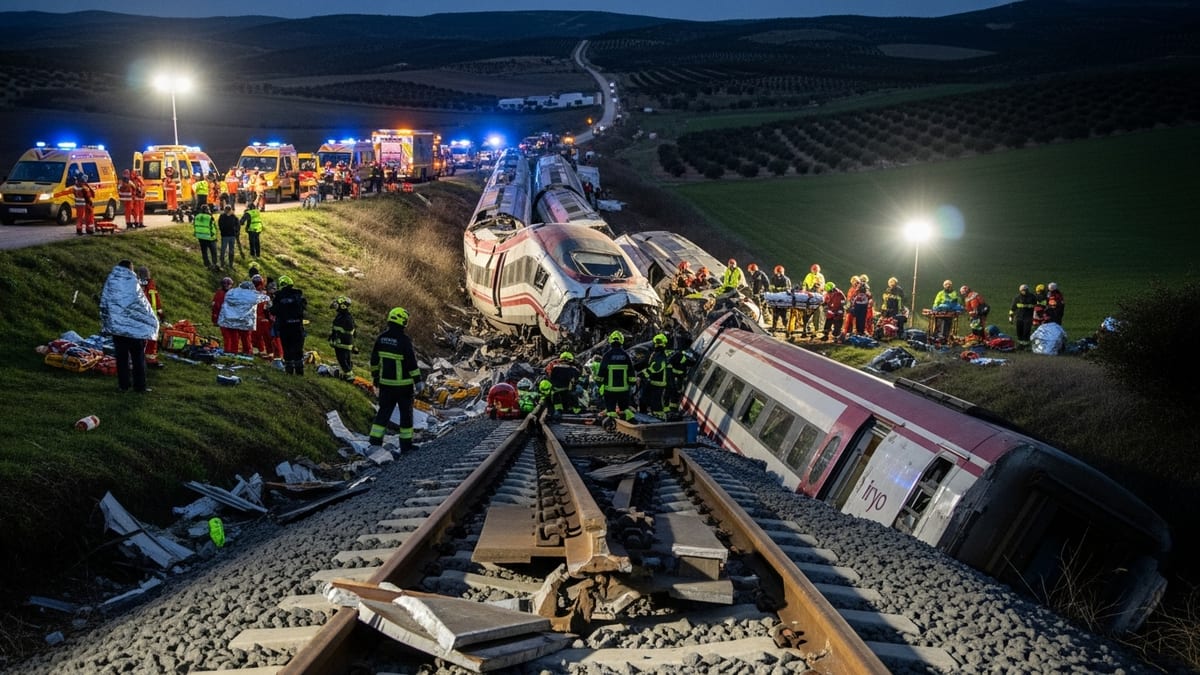
Interim findings shed light on Bedford collision
According to publicly available information from the Rail Accident Investigation Branch, data from the Bedford crash on June 19 suggests the southbound East Midlands Railway service towards Luton Airport Parkway continued past a red signal shortly before impact. The collision occurred on the Midland Main Line near Elstow, just outside Bedford, when the moving train struck the rear of another passenger service that had stopped on the line.
Initial reporting indicates the stationary northbound service had come to a halt after an onboard warning system intervened and applied the brakes. The investigating body has stated that this earlier intervention appears to have been triggered by an incorrect perception that the train had passed a red signal, leaving it stopped in a location where it would not normally be expected to stand.
The new update focuses on the movements of the southbound train driven by 60‑year‑old Shaun Burton, who died in the impact. Published coverage states that the train passed at least one cautionary yellow signal, then proceeded through a red “danger” signal that should have brought it to a stop before reaching the occupied section of track.
Analysis released so far suggests the brakes on the southbound train were applied only seconds before the collision. Investigators are using event recorder data and forward‑facing CCTV to reconstruct the final moments of the run and to determine exactly when the driver responded to the restrictive signals ahead.
How the sequence of signals is understood to have unfolded
Reports summarising the interim findings state that, as the southbound express departed Bedford, it encountered a pattern of increasingly restrictive signals. The train is understood to have passed at least one yellow aspect, indicating that the driver should be prepared to stop at the next signal if required.
The critical point in the sequence was the signal protecting the section where the stationary train was already present. That signal was showing red, meaning no train should enter the block. Publicly available information indicates that the express continued beyond this point without stopping, placing it on a collision course with the rear of the halted service ahead.
Event recorder data cited in news coverage indicates that the driver applied the brakes around nine seconds before impact. While this action reduced the speed, it was insufficient to prevent the collision. Investigators are studying whether the braking pattern is consistent with a late visual recognition of the stationary train, a delayed reaction to the signal sequence, or another factor such as distraction or misinterpretation.
The investigation update also notes that it is not yet clear what warnings were provided inside the cab as the train passed the cautionary and stop signals. The functioning of the Automatic Warning System, which typically alerts drivers to restrictive aspects, is a central focus of the technical analysis.
Focus on train protection systems and red‑signal risk
The Bedford crash has drawn fresh attention to the layered systems intended to prevent trains from passing red signals, commonly described as “signals passed at danger.” In the United Kingdom, lines carrying high‑speed passenger services are usually equipped with Automatic Warning System equipment and, in many locations, supplementary protections designed to trigger an emergency brake application if a train moves beyond a red signal.
Coverage of the interim findings notes that investigators are examining precisely which systems were active at the signal the express passed at danger, and whether any automatic intervention occurred. The report also highlights the earlier, apparently spurious activation of a protection system on the northbound train, which stopped it in an exposed position on the line and ultimately placed it in the path of the following service.
Specialists following the case point out that modern signalling and train protection systems are designed to provide multiple opportunities to avert a collision, from providing advance warning of restrictive aspects to enforcing a stop if a driver fails to respond. When two trains nonetheless collide, investigators typically look closely at the interaction between human decision‑making, system design and any local infrastructure constraints.
In this case, the combination of a train unexpectedly halted by its onboard protection equipment and a following service apparently failing to remain behind a red signal has become the central question for the ongoing inquiry. The interim document stresses that the findings released so far are provisional and may be revised as more technical evidence is examined.
Casualties, disruption and passenger accounts
The driver of the southbound service, named in published reports as experienced railway employee Shaun Burton, died at the scene. Around 100 passengers across the two trains sustained injuries, ranging from minor cuts and bruises to serious trauma requiring hospital treatment. Local emergency services, rail staff and bystanders worked together in the immediate aftermath to evacuate carriages and assist the injured.
Passengers have described being thrown from their seats, with luggage and debris scattered through carriages as the trains jolted to a stop. Some accounts mention smoke, dust and darkness in the moments after the collision, as lighting failed and passengers used mobile phones to navigate through the wreckage. Others recall long waits on embankments and in nearby fields as emergency responders assessed the stability of the trains and the condition of those on board.
The crash caused major disruption across a key north–south rail artery linking the East Midlands with London. Services were suspended for an extended period while investigators documented the scene, damaged rolling stock was recovered, and engineers inspected track and signalling equipment. Replacement buses and diversions were arranged, but passengers across a wide region experienced cancellations and delays.
In the days following the collision, flowers and messages appeared near Bedford station and along nearby public access points to the line, reflecting widespread shock at the death of the driver and gratitude for the efforts of those who assisted injured passengers.
Next steps in the investigation and wider safety context
The interim update from the Rail Accident Investigation Branch marks the first formal reconstruction of events since the crash, but the inquiry is expected to continue for many months. Investigators are now analysing onboard data recorders, signal logs, maintenance histories and training records to build a complete picture of the circumstances that led to the red signal being passed and the subsequent collision.
The final report is expected to consider whether additional infrastructure, such as further train protection equipment at key signals, could have reduced the likelihood or severity of the crash. It is also likely to examine working patterns, route familiarisation and cab ergonomics to assess any potential contributing factors on the human side of operations.
Rail safety commentators note that, while major train collisions in the United Kingdom have become less frequent over recent decades, incidents involving signals passed at danger continue to be treated as a high‑priority risk. Previous investigations into similar events have led to changes in driver training, technical standards for protection systems and the way risk is managed on intensively used main lines.
The Bedford crash has therefore become a focal point in the ongoing effort to minimise the consequences of any missed signal or equipment malfunction. As more information is released, the case is expected to inform discussion about how best to balance human and automated safeguards on a rail network that carries millions of passenger journeys every week.