


More news on this day
Ryanair is pressing the European Union to prolong temporary relief from full enforcement of the bloc’s Entry/Exit System at external borders, warning that the end of current flexibilities could trigger a fresh wave of passport queues and missed flights for millions of travelers across Europe.
Get the latest news straight to your inbox!
Airline Calls for Longer EES Derogation Window
Ryanair has renewed its campaign for more leeway in how the EU’s new biometric Entry/Exit System (EES) is implemented, arguing that the current derogation period is too short to avoid serious disruption at busy border crossings. A temporary regime introduced under Regulation (EU) 2025/1534 allows member states to phase in the system and rely on manual passport stamps while infrastructure and staffing are upgraded, but this flexibility is scheduled to phase out in line with the five year data-retention cycle built into the legislation.
According to publicly available information from the European Commission, the EES became fully operational at all external Schengen border points on 10 April 2026, replacing passport stamps for most non EU nationals with digital records that include biometric data such as fingerprints and facial images. The transition was designed to modernize border checks and tighten security, but regulators also acknowledged the need for a stepped rollout to give countries time to install kiosks, train officers and adapt airport layouts.
Industry-focused coverage indicates that Ryanair is now urging Brussels to extend that transition window, sometimes referred to as EES “relief” or derogation, at least until April 2027. The company argues that without an extension, border posts already struggling with equipment issues and staffing shortages could see processing times lengthen again just as traffic is forecast to grow.
In a statement reported by aviation trade media on 7 September 2026, Ryanair framed its request as a consumer protection measure, stressing that families and leisure travelers are still bearing the brunt of teething problems around the new checks. The carrier maintains that extending the derogation would give member states another full year to stabilize operations before stricter, automated use of EES data is required.
Summer 2026 Queues Highlight System Strains
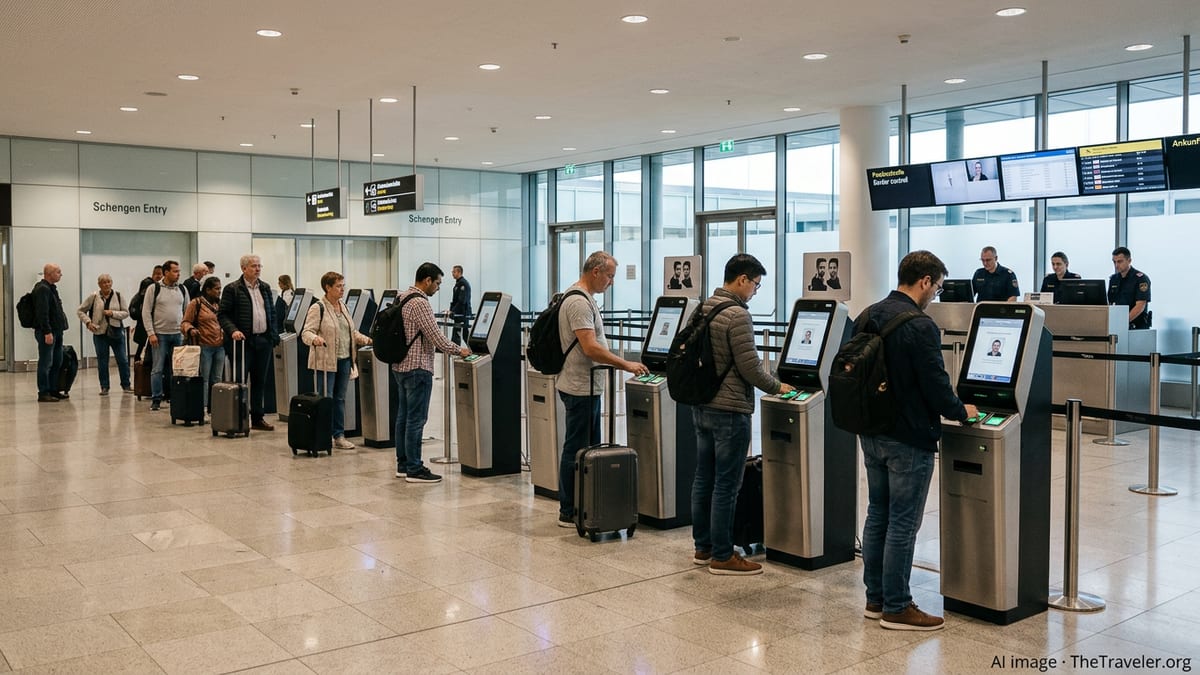
Border delays recorded since the system went live have given weight to calls for more time. Reports from airports in Spain, Italy and Germany during the spring and early summer pointed to hour long queues at passport control as passengers underwent first time EES registration and as malfunctioning kiosks were taken out of service. In several cases, local media noted that travelers missed flights after waiting in lines that stretched through terminal corridors during peak holiday weekends.
Ryanair has repeatedly drawn attention to those bottlenecks. In May and June the airline publicly criticized national preparations in some countries, highlighting what it described as insufficient staffing, incomplete installation of self service kiosks and limited contingency planning for system outages. Travel industry outlets covering the roll out documented similar issues, including airports temporarily reverting to manual checks when queues became unmanageable.
By July, press reports showed that some hubs and border authorities were selectively deactivating biometric kiosks during rush periods to keep passenger flows moving. A briefing note from the UK House of Commons Library in July also referenced “unsustainable pressure” at some Schengen border control facilities and noted that European aviation bodies were urging Brussels to allow member states to suspend EES whenever passenger volumes exceeded operational capacity, at least during the early years of the scheme.
The experience of the first full summer with EES in place has therefore become a key argument in Ryanair’s campaign. The carrier contends that if such issues persist while transitional flexibilities are still available, the risk of larger scale disruption will grow once those options formally expire.
Regulatory Framework Limits Flexibility
At the heart of the current debate is how far EU institutions are willing to stretch the temporary derogations embedded in the EES legal framework. Regulation (EU) 2017/2226 created the system as a central database to log entries, exits and refusals for non EU nationals at Schengen external borders, with a view to strengthening security, monitoring overstays and replacing the long standing practice of stamping passports.
A later measure, Regulation (EU) 2025/1534, introduced temporary derogations allowing a progressive start of operations, including continued use of manual stamping and the possibility to operate EES without full biometric functionality for a defined period. The law ties the end of this regime to the system’s official start of operations, stating that the derogation should cease five years and 180 days after that date. For now, this timeline sets a clear outer limit on how long member states can rely on the most generous flexibilities.
Travel policy analysts note that while national authorities have a degree of discretion in how they manage border flows in the short term, the Commission also has a mandate to ensure that EES is fully applied and interoperable with related systems such as the forthcoming ETIAS travel authorization platform. Any decision to extend or reinterpret the derogation period would therefore require careful balancing of operational concerns with the long term goals of the Schengen Borders Code.
Recent commentary from Brussels based think tanks and legal services underscores that the EU is wary of allowing prolonged partial implementation, which could undermine the effectiveness of automated checks across different border points. Nonetheless, the same analyses acknowledge mounting political pressure from member states and industry groups to use all available legal flexibilities to avoid visible disruption for travelers.
Member States and Aviation Sector Push for More Time
Ryanair is not alone in calling for extended EES relief. Over recent months, aviation and airport associations have urged the European Commission to give countries broader discretion to pause or scale back biometric processing during high traffic periods. According to a July 2026 research briefing from the UK Parliament’s Library, several European aviation bodies wrote collectively to the Commission asking for the power to “completely suspend EES” at individual border points when passenger flows exceed capacity, citing unsustainable pressure at some airports.
National governments have also been testing the limits of the current framework. Reports from European media outlets describe how at least nine Schengen countries have already argued for the derogations to run beyond their current deadline, particularly those that handle large volumes of non EU leisure travelers each summer. Some airports have deployed additional staff and reconfigured queuing areas, but industry representatives maintain that physical constraints and training requirements make rapid scale up difficult.
In parallel, the UK government has been working with EU partners and French authorities at cross Channel ports and rail terminals where EES applies to UK nationals. Official statements referenced in parliamentary briefings indicate that London is advocating what it calls “pragmatic use” of the flexibilities currently in EU law to minimize disruption for British travelers, even though the UK is now treated as a third country under Schengen border rules.
Within this wider lobbying effort, Ryanair’s latest intervention focuses specifically on extending the derogation timeline to at least April 2027. The airline argues that such a move would align better with airport infrastructure projects already underway and would ensure that the new procedures have been tested across multiple peak seasons before full enforcement is mandated.
What Travelers Can Expect in the Months Ahead
For passengers planning trips into and out of the Schengen area, the policy discussion in Brussels will translate into practical questions at border checkpoints over the coming months. Public guidance from the European Commission confirms that non EU travelers will continue to be enrolled in EES on arrival, with fingerprints and facial images taken at the first crossing and verified on subsequent trips. Many border posts now combine staffed booths with self service kiosks, and manual passport stamps may still be used in some locations during the transition.
Travel advisories issued by airlines and airports suggest that non EU nationals, including UK, US and other third country citizens, should allow extra time for border formalities, especially if they have not yet registered in EES. Families with young children and travelers connecting to onward flights are being encouraged to proceed directly to passport control after security and to pay close attention to on the day signage, as some airports are adjusting flows in real time.
The central question is whether EU institutions will agree with Ryanair and other industry voices that extended relief is needed to keep those queues manageable. If the Commission endorses a longer derogation or clarifies that member states may lean heavily on existing flexibilities through 2027, travelers could see a more gradual tightening of procedures. If not, border authorities may need to rely on short term operational fixes to prevent a recurrence of the long lines seen in the first EES summer.
For now, publicly available information points to a period of continued adjustment rather than an immediate return to pre EES norms. Travelers crossing into the Schengen zone in late 2026 and 2027 are likely to encounter a hybrid system, where biometric registration, manual checks and evolving queuing strategies coexist while airlines, airports and EU institutions negotiate the long term balance between security, automation and passenger experience.
European Commission: Entry/Exit System overview
Regulation (EU) 2025/1534 on EES derogations