

More news on this day
As the war involving Iran, the United States and Israel convulses air travel across the Middle East, Saudi Arabia has emerged as both a fragile transit lifeline and a high‑risk airspace where conditions for travelers can change by the hour.
Saudi Airspace: Open, But Under Heightened Restrictions
As of early March 2026, Saudi Arabia’s airspace remains technically open to commercial traffic, but it is subject to fast‑shifting restrictions, especially along the Gulf and northern borders. Aviation tracking data and industry notices show that Jeddah Flight Information Region, which covers much of Saudi airspace, is operating with partial closures affecting corridors near Iran, Iraq and the Persian Gulf, forcing airlines to reroute or reduce services.
Despite a wave of airspace shutdowns in neighboring countries, including full closures or severe curbs in Iran, Iraq, Qatar and the United Arab Emirates, Saudi skies have not gone completely dark. Major international airports in Riyadh, Jeddah and Dammam continue to process arrivals and departures, although schedules are being redrawn day by day and overnight cancellations have become common.
European and international aviation safety bulletins now classify the entire Saudi airspace as a conflict zone with elevated risk from missiles, drones and air defense activity. Carriers are urged to conduct their own risk assessments and, in some cases, to avoid certain sectors entirely or operate only at specified altitudes. For travelers, this translates into longer routes, last‑minute schedule changes and a higher chance that flights crossing the kingdom may be delayed, diverted or scrubbed at short notice.
Airport Operations in Riyadh, Jeddah and Dammam
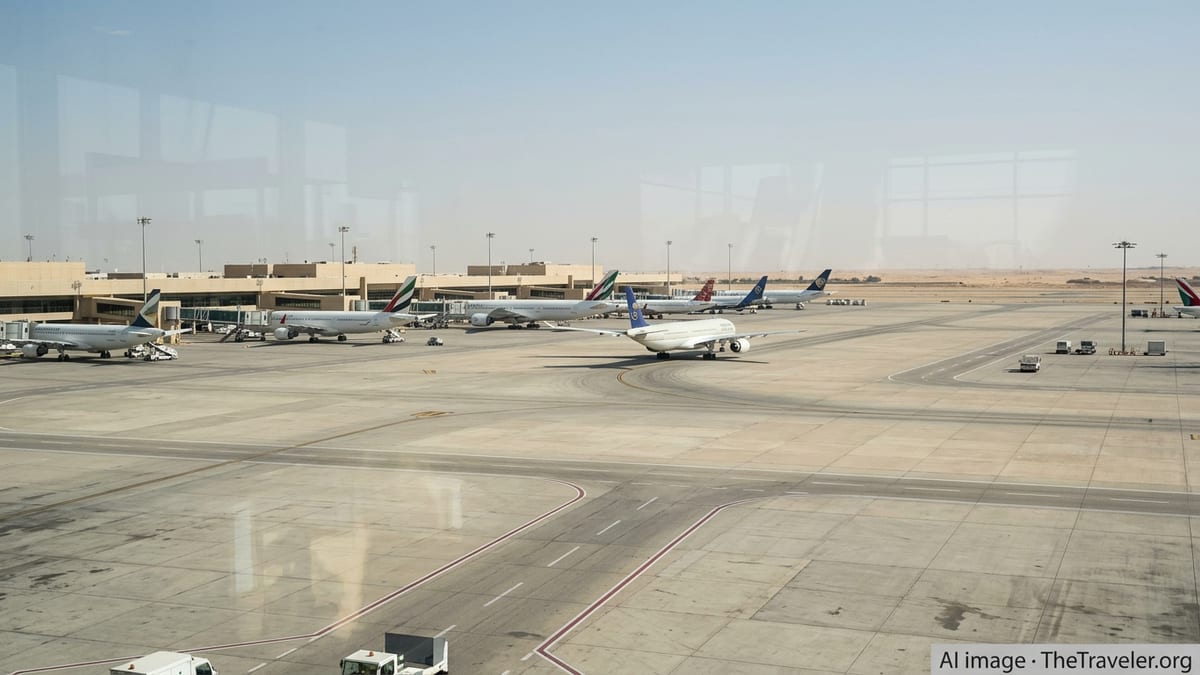
Saudi Arabia’s three main international gateways are feeling the strain in distinct ways. In Riyadh, staff at King Khalid International Airport report waves of cancellations and rolling delays as airlines react to new notices to air missions and security alerts. The airport remains open, but departure boards have turned patchy, with long‑haul flights to Europe and Asia particularly affected when regional routes are abruptly closed.
Jeddah’s King Abdulaziz International Airport, a critical hub for religious pilgrims, is also operating but with tighter control over overflight permissions and routing. Airlines serving Jeddah have begun favoring corridors that skirt the most sensitive airspace near Yemen and the Red Sea, adding time to journeys between Africa, Europe and Asia. This has created a knock‑on effect for connecting passengers, who may find minimum connection times no longer reliable.
Dammam’s King Fahd International Airport, closest to the Gulf and to several recent missile and drone alerts, is facing the heaviest disruption inside the kingdom. Travelers have reported short‑notice cancellations and diversions as airlines weigh the proximity of recent strikes on energy infrastructure and military sites along the eastern coast. While the airport is still receiving and dispatching flights, schedules there are more vulnerable to sudden security developments than in Riyadh or Jeddah.
Across all three airports, ground handling and security screening remain operational, and there have been no reports of sustained terminal closures. However, officials and airlines alike are urging passengers not to go to the airport without confirmed, same‑day flight status from their carrier, as outdated itineraries and generic app updates are proving unreliable in the current environment.
Missile Threats, Conflict Zones and Official Warnings
The airspace picture is being reshaped not only by closures but by the expanding conflict itself. Since late February, Iran has launched multiple missile and drone barrages across the Gulf, with several strikes and interceptions reported over or near Saudi territory, including attacks on energy facilities in the Eastern Province. Debris from intercepted projectiles has already fallen near civilian infrastructure in the wider region, underscoring the risk to overflying aircraft even when they are not direct targets.
Western governments and aviation regulators now advise extreme caution for any flights over Saudi Arabia and neighboring states. The United States has urged its citizens across the broader Middle East, including those in Saudi Arabia, to leave while commercial options remain available, citing serious safety risks tied to the war. European safety authorities, in turn, have issued conflict zone bulletins that effectively warn operators to avoid or carefully limit operations in Saudi and surrounding airspace.
Saudi Arabia’s own aviation regulator has emphasized its commitment to aviation security and coordination with regional and international partners, pointing to long‑standing investments in air defense integration and risk management. Nonetheless, a recent urgent alert from the United States mission in the kingdom highlighting an imminent threat of missile and drone attacks in the Eastern Province illustrates how quickly the local threat picture can escalate and how closely commercial routes overlap with potential strike zones.
How Airlines Are Rerouting and What Travelers Are Seeing
With swaths of Middle Eastern airspace closed outright, Saudi Arabia has become one of the few remaining land bridges linking Europe, Africa and Asia. Long‑haul carriers that once threaded dense corridors over the Gulf are now redrawing their maps, in some cases stretching routes north via Turkey and the Caucasus or south over Egypt and the Red Sea to reduce time spent near active conflict zones.
For passengers, these changes are visible in extended flight times, fuel stops that were not previously required and aircraft that appear to curve far from their usual tracks on in‑flight maps. Some airlines have suspended direct services to and from Saudi cities where alternate routings are impractical or uneconomical under current risk thresholds, while others are consolidating flights, operating fewer but fuller services on days when routing is viable.
The ripple effects reach well beyond the Gulf. Travelers connecting in Europe or South Asia frequently discover that flights into Saudi Arabia are operating, but onward legs over neighboring conflict states are not, stranding them mid‑journey. Aviation analysts warn that as long as missile and drone activity continues at current levels, temporary workarounds could become semi‑permanent, with higher operating costs feeding into ticket prices and reduced capacity on key trunk routes.
Practical Guidance for Travelers Heading to or Through Saudi Arabia
For travelers, the key message in March 2026 is to treat any flight involving Saudi airspace as high‑risk for disruption, even if it is still selling seats. Experts advise monitoring bookings daily, not just in the 24 hours before departure, as airlines push through rolling schedule changes in response to new military activity and regulatory guidance.
Authorities and industry groups are also stressing that travelers should rely on direct airline communications rather than third‑party booking platforms or generic flight‑tracking apps, which can lag behind real‑time airspace decisions. Many carriers serving Saudi Arabia are offering rebooking waivers or refunds on affected routes, but policies vary, and some options require proactive contact from passengers rather than automatic changes.
Travel safety agencies recommend that foreign visitors transiting Saudi Arabia review both their home government’s travel advisories and the latest security alerts issued for the kingdom, particularly for the Eastern Province and areas near the Yemeni border. Those who elect to travel despite warnings are urged to keep flexible itineraries, avoid tight connections and be prepared for extended layovers or unexpected overnight stays if regional corridors close mid‑flight.
Above all, the situation remains fluid. While Saudi Arabia continues to function as a partial aviation bridge across a region at war, the same factors that make its airspace essential to global connectivity also leave it exposed to the evolving conflict. Travelers in 2026 face an environment in which caution, flexibility and constant information‑checking are no longer optional extras but the basic requirements of flying to, from or through the kingdom.