

More news on this day
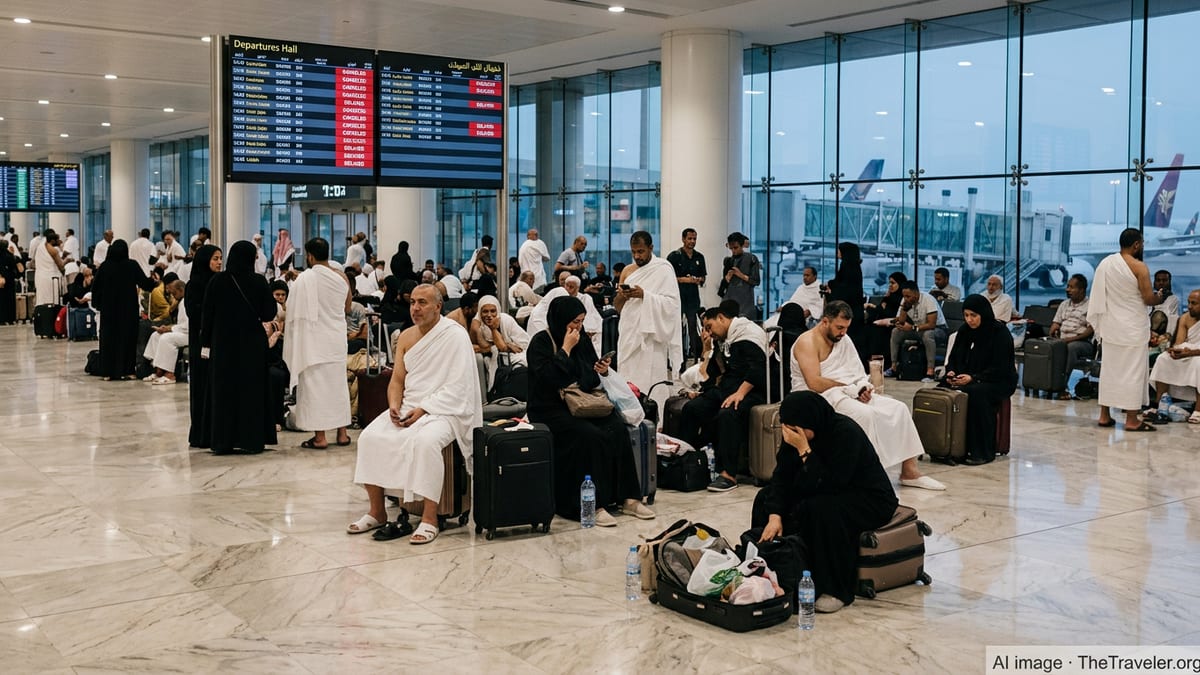
Thousands of travelers, including large numbers of Umrah pilgrims, have been left stranded across Saudi Arabia and the wider Gulf after a fresh wave of security-related flight cancellations disrupted routes operated by Qatar Airways, Saudia, Gulf Air and other regional carriers into key hubs such as Riyadh, Jeddah, Dammam, Medina and Abha.
Get the latest news straight to your inbox!
Regional Tensions Trigger New Wave of Cancellations
The latest disruption follows a sharp escalation in regional tensions that has rippled across Middle East airspace, forcing airlines to reroute or suspend services at short notice. Aviation authorities and airline operations centers have been working with constrained corridors, with some routes briefly reopening only to close again as security assessments change.
Qatar Airways has extended its rolling programme of cancellations and limited relief flights, focusing on repatriation from select hubs while curbing regular schedules. Saudia, Gulf Air and other Gulf carriers have also trimmed rotations or pulled entire routes out of the timetable, contributing to what regional travel analysts describe as one of the most volatile weeks for commercial aviation in years.
Industry tracking data and airline advisories indicate that more than 300 flights touching Saudi airports have been canceled or heavily delayed in recent days, as carriers attempt to navigate shifting no-fly zones and avoid areas of potential military activity. With Saudi Arabia remaining one of the few major east–west corridors still partially open, the knock-on effect has been severe congestion and mounting backlogs at key gateways.
Pilgrims and Families Stranded in Jeddah and Medina
The timing of the disruption, in the busy run-up to and early days of Ramadan, has intensified its impact on religious travel. Jeddah and Medina, the primary gateways for Umrah pilgrims, have reported large numbers of passengers stuck in hotels or airport terminals after return flights were pulled from the schedule or repeatedly rescheduled.
Consular officials from several predominantly Muslim countries have confirmed that thousands of their citizens are currently unable to depart Saudi Arabia as planned, many of them on tightly budgeted pilgrimage packages. Travelers describe spending hours on hold with call centers or queuing at airline desks, only to be offered itineraries days later or via distant third-country stopovers.
Some pilgrims have been reassigned to alternative flights at short notice, often with extended layovers in secondary hubs such as Muscat or Bahrain. Others report being told to await further updates by text message or email while hotel bills mount. Travel agents based in Jeddah say they are struggling to secure group seats for stranded clients amid intense competition for limited capacity.
Riyadh, Dammam and Abha Feel the Domestic Squeeze
While international routes have borne the brunt of the cancellations, domestic connectivity within Saudi Arabia has also been affected. Riyadh and Dammam, key business and transit hubs, have seen multiple short-haul sectors scrubbed as Saudia and low-cost operators reshuffle fleets to cover priority long-haul and repatriation services.
Travelers attempting to reposition between Saudi cities to catch alternative international flights report finding many services sold out or canceled at short notice. One common pattern is passengers being advised to route via Riyadh, only to discover that onward departures to Gulf or European destinations have themselves been withdrawn from sale or are operating with severe delays.
In the south, Abha and other regional airports have faced intermittent disruption as aircraft and crews are redeployed. Residents who normally rely on quick domestic hops to Jeddah or Riyadh to connect with global networks are instead facing overland journeys running to many hours, or are postponing trips altogether until the situation stabilizes.
Confusing Patchwork of Airline Policies and Waivers
For many passengers, the operational turmoil has been compounded by a complex and sometimes opaque set of rebooking and refund rules. Qatar Airways has issued special travel policies for customers with tickets during the current security situation, including options for free date changes, rerouting where space permits, or vouchers in lieu of travel, but implementation can vary depending on whether tickets were bought direct, via agents or using points.
Saudia and Gulf Air have similarly introduced limited-fee waivers and flexibility measures, though travelers report that available alternatives rarely match their original itineraries. Some passengers have successfully secured seats on other carriers after their original flights were canceled, but often at premium last-minute fares that may not be fully reimbursable.
Legal experts note that passenger compensation rules in the region differ significantly from those in the European Union, and that security-related disruptions are typically categorized as extraordinary circumstances. That means travelers may have rights to care, such as meals and accommodation in certain cases, but are unlikely to receive standard cash compensation for canceled flights linked to security decisions by states or regulators.
Governments and Airlines Race to Clear Backlog
Diplomatic missions in Riyadh and Jeddah say they are in close contact with Saudi authorities and airline representatives, prioritizing vulnerable travelers, including elderly pilgrims and families with young children. Some governments have urged citizens planning non-essential trips to Saudi Arabia and neighboring states to delay travel until after mid-March, when the security picture may be clearer.
Airlines, for their part, are working to add extra sections and larger aircraft where airspace approvals and crew duty limits allow, but warn that the backlog caused by several consecutive days of mass cancellations cannot be cleared overnight. Operations managers also stress that any further deterioration in the regional security environment could prompt another round of suspensions.
For now, industry and government officials are advising passengers with imminent travel to or from Saudi Arabia to monitor airline apps and official advisories closely, avoid traveling to the airport without a confirmed rebooked flight, and remain flexible about routings and dates. With uncertainty still high, the immediate focus remains on getting stranded travelers home safely, even if that means circuitous journeys and long delays.