


More news on this day
A derailment on SEPTA’s Manayunk-Norristown Regional Rail line in North Philadelphia early Wednesday, July 1, 2026, has triggered widespread service suspensions and delays across the network, affecting commuters throughout the Philadelphia region.
Get the latest news straight to your inbox!
Overnight derailment at key North Philadelphia junction
According to published coverage, the incident occurred shortly after midnight near 16th Street Interlocking, a busy junction north of North Broad Station where several Regional Rail tracks converge. Reports indicate that an outbound Manayunk-Norristown Line train left the tracks in this area, disrupting movements along one of SEPTA’s critical commuter corridors.
Initial information from local news outlets describes the derailment as taking place in a dense rail operations zone that connects central Philadelphia with neighborhoods such as East Falls and Manayunk before continuing to Norristown. The affected train was reportedly traveling away from Center City when cars derailed, forcing dispatchers to halt other traffic through the corridor.
Early-morning images shared in news coverage showed multiple railcars at angles along the right of way, with crews assessing track conditions and equipment damage. There were no immediate indications of life-threatening injuries in the initial reporting, but the incident significantly constrained the system’s capacity at the start of the weekday rush.
The location of the derailment is particularly sensitive for Regional Rail operations, as it functions as a funnel point for trains heading toward the northern and northwestern suburbs. Any blockage there can quickly ripple across the wider network, which is what riders encountered as the morning commute began.
Manayunk-Norristown, Fox Chase and Chestnut Hill East suspended
By early Wednesday, publicly available information from SEPTA alerts and multiple news reports showed that the Manayunk-Norristown, Fox Chase and Chestnut Hill East lines were fully suspended. Those three routes rely on access through the affected section of track, leaving trains unable to operate safely while inspections and recovery work continued.
Coverage from Philadelphia media indicated that other lines, including services through North Broad and Fern Rock, experienced residual delays as dispatchers rerouted equipment and attempted to maintain partial service elsewhere on the system. Trains that could still operate were often subject to crowded conditions and extended travel times as riders from suspended routes sought alternatives.
Some published accounts described riders being directed toward the Broad Street Line subway and other transit options as stand-ins for Regional Rail. However, because the Manayunk-Norristown Line in particular connects several riverfront neighborhoods with limited parallel rail options, many commuters faced longer walks, bus transfers or car trips to reach their destinations.
Regional Rail disruptions also had knock-on effects for passengers making longer journeys, including those planning to connect to intercity services at 30th Street Station. With three lines suspended and others delayed, morning travel planning across the region became considerably more complicated.
Network-wide delays and crowded alternative services
Reports from the scene and across the network indicated that the derailment immediately reduced capacity on key inbound and outbound tracks, forcing dispatchers to prioritize certain movements and hold others. As a result, trains on multiple lines experienced cascading delays, with some services running significantly behind schedule.
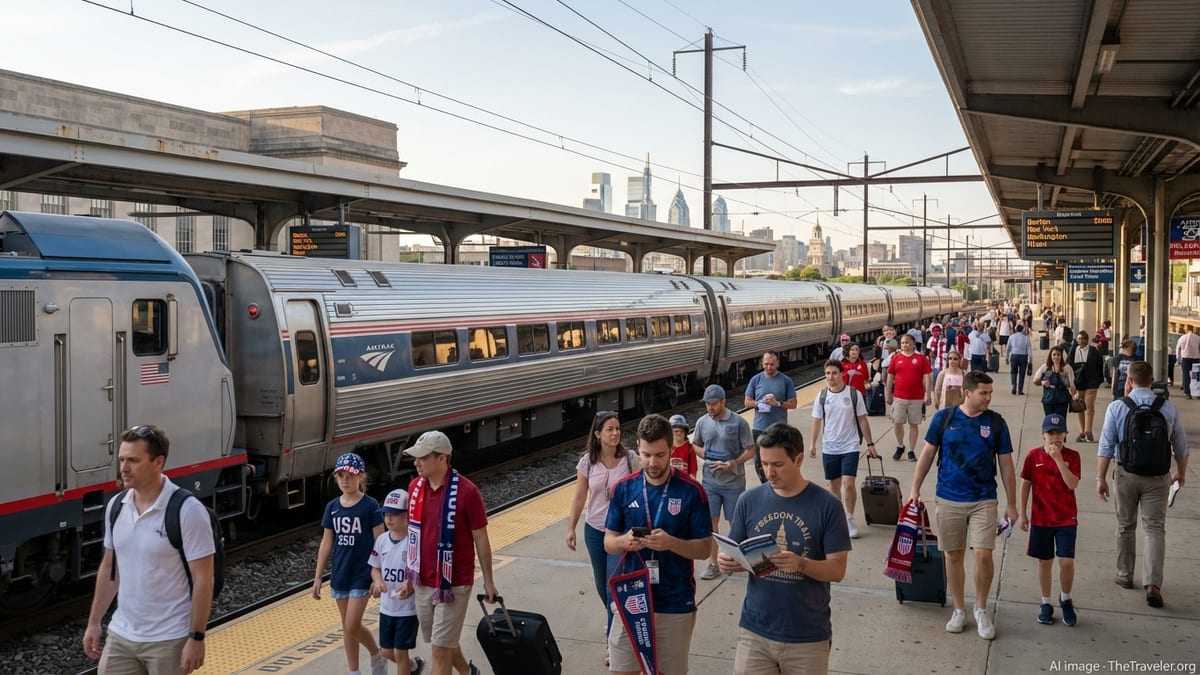
Riders arriving at Regional Rail stations Wednesday morning encountered electronic message boards and public address announcements reflecting the rapidly evolving situation. According to coverage from local outlets, several early-morning trains were canceled outright, while others operated with modified stopping patterns or turned back short of their usual termini.
In response, many commuters shifted to SEPTA’s Market-Frankford Line, Broad Street Line and city and suburban bus services. Those modes experienced heavier-than-usual passenger loads, particularly at key transfer points such as Fern Rock Transportation Center and Temple University Station, where Regional Rail typically interfaces with rapid transit and bus routes.
Travel times into Center City lengthened for many riders who would normally rely on a direct Regional Rail connection from Manayunk, Roxborough, Fox Chase or Chestnut Hill. For some, the trip required combining car travel to outlying stations that still had service, followed by rail or subway connections downtown, adding both time and uncertainty to the morning routine.
Safety checks and recovery operations under way
As of midmorning Wednesday, publicly available information showed that crews were focused on stabilizing the derailed cars, inspecting the tracks and overhead power infrastructure, and beginning the process of clearing the right of way. The complexity of the interlocking area, where switches and crossovers allow trains to move between tracks, means that inspections are expected to be detailed and time-consuming.
Media reports noted that the investigation into the cause of the derailment is in its early stages. Factors that are typically reviewed in similar incidents include track condition, train speed, signaling and switching operations, and any recent maintenance activities in the area. No timetable for completion of the investigation had been made public in initial coverage.
SEPTA has highlighted infrastructure investment on its Regional Rail system in recent years, including signal upgrades and positive train control on several lines. The incident on the Manayunk-Norristown route is likely to draw renewed focus to the condition and configuration of busy junctions such as 16th Street Interlocking, which handle high volumes of trains during peak periods.
Until the derailed equipment is removed and infrastructure is verified for safe operation, suspensions on the three most directly affected lines are expected to remain in place. Local reports midmorning indicated that the agency was preparing for an extended disruption that could carry into the afternoon and possibly the evening commute, depending on how quickly recovery work progresses.
Advice for travelers across the Philadelphia region
For travelers and visitors relying on SEPTA to reach destinations in Manayunk, Norristown or the northern neighborhoods served by Fox Chase and Chestnut Hill East, the derailment significantly reshapes routing options for at least part of the day. News outlets urged riders to check real-time alerts and consider alternative modes before leaving home or hotels.
Practical alternatives reported in early coverage include using the Broad Street Line to reach North Philadelphia and Fern Rock, then transferring to bus routes that parallel portions of the suspended rail lines. For trips to Manayunk, riders may also consider using buses that follow Ridge Avenue or Main Street corridors, though travel times are likely to be longer than typical rail journeys.
Those heading to Norristown and nearby Montgomery County communities face particular challenges, as the Manayunk-Norristown Line is a primary rail connection between Center City and the Schuylkill River corridor. Some travelers may opt to use intercity rail or long-distance buses to 30th Street Station and then continue by car share, taxi or local buses, depending on evolving congestion and availability.
Travel planners note that disruptions of this scale often ripple beyond the immediate service area, affecting airport-bound passengers, business travelers and visitors connecting between Philadelphia and other East Coast cities. Until full Regional Rail service is restored, riders are encouraged to allow extra time, prepare backup options and stay alert for additional schedule changes as recovery work continues.