


More news on this day
Türkiye is pushing ahead with one of the world’s most ambitious rail programs, expanding its high-speed and rapid network by thousands of kilometers in a strategy that aims to redraw national travel patterns by 2028 and transform connectivity by 2053.
Get the latest news straight to your inbox!
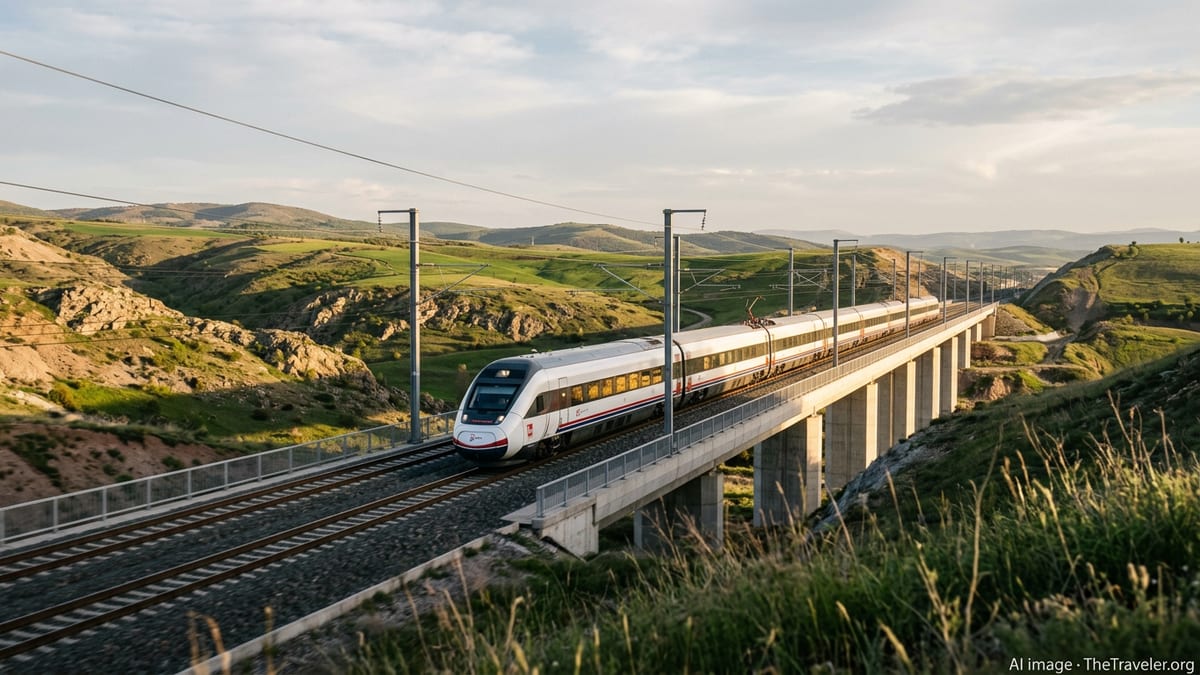
Ambitious 2053 Vision Puts Rail at the Core of Mobility
Publicly available planning documents place rail at the center of Türkiye’s long-term transport strategy, with a focus on dense, electrified corridors that can shift both passengers and freight away from roads and aviation. The country’s Transport and Logistics Master Plan to 2053 outlines the construction of 8,554 kilometers of additional railway, combining rapid, conventional, high-speed and very high-speed segments.
Within that total, the plan assigns the largest share to rapid lines, at more than 6,400 kilometers, supported by around 1,500 kilometers of new conventional routes and several hundred kilometers categorized as high-speed and very high-speed. These categories, which reflect differing design speeds and operating patterns, are intended to create a layered network in which premium express services share a national backbone with regional and freight operations.
Separate climate and infrastructure strategy documents indicate that authorities intend to increase the overall length of the national rail network from roughly 14,000 kilometers today to close to 29,000 kilometers by 2053. The expansion is framed as part of a wider net-zero pathway for the transport sector, with rail positioned as a lower-emission alternative to domestic flights and long-distance highway traffic.
Investment data released in recent months show that rail has already risen to more than half of total transport infrastructure spending, underlining a clear shift in priorities compared with earlier decades when highways dominated. Officials present this as both an economic and environmental move, designed to lower logistics costs while curbing emissions growth.
High-Speed Network Already Spans Key Anatolian Corridors
Türkiye’s first high-speed passenger services, marketed as Yüksek Hızlı Tren, began operating between Ankara and Eskişehir in 2009 and were gradually extended to Istanbul, Konya and Karaman. Industry compilations and operator data show that four high-speed axes are now in service, with Ankara linked to both Istanbul and Sivas, and Konya acting as a southern hub feeding into the wider system.
The opening of the 400-kilometer-class Ankara to Sivas line in April 2023 significantly extended high-speed operations deep into central and eastern Anatolia. The new route has cut journey times between the capital and Sivas and brought intermediate cities such as Kırıkkale and Yozgat into the fast rail network for the first time, illustrating how each project adds multiple regional markets, not just new endpoints.
Updated figures from international rail databases place Türkiye among the more substantial high-speed markets globally, with over 1,200 kilometers of lines categorized as in operation and more than 1,700 kilometers under construction. Planned and long-term schemes take the total high-speed portfolio to more than 5,000 kilometers, placing the country in the same league as several larger European and Asian systems in terms of development pipeline.
Passenger uptake has followed infrastructure growth. Recent statements and statistical releases indicate that the country’s high-speed lines have carried in the order of 100 million passengers since the first services were introduced, providing a growing base of demand for future extensions. The government’s medium-term targets include bringing dozens of additional provinces into direct high-speed connectivity by the end of this decade.
Flagship Ankara–Izmir Link Set To Reshape West Coast Travel
One of the most closely watched projects in the current construction wave is the Ankara–Izmir high-speed railway, a corridor of around 500 kilometers that will connect the capital with Türkiye’s Aegean metropolis. Non-technical project summaries and subsequent updates describe a route running from the Ankara region via Afyonkarahisar before turning west to reach Izmir’s metropolitan area.
According to recent public statements and regional government briefings, work along the Afyonkarahisar section is advancing, with teams targeting completion of key civil engineering stages by the end of this year. National transport authorities have outlined a timetable that foresees phased openings from 2026, with full service across the entire route envisaged in 2027 if progress continues as planned.
Once operational, journey times between Ankara and Izmir are projected to fall to around three and a half hours, positioning rail as a strong competitor to air and intercity coach travel on one of the country’s most heavily used domestic corridors. The line is expected to handle both business and leisure flows, linking governmental, industrial and tourism centers along a single high-speed spine.
The project also sits within a broader effort to consolidate Izmir’s role as a western gateway. In parallel with the high-speed scheme, other rail and highway projects are being developed to connect the Aegean region to Mediterranean ports and industrial zones, indicating that planners view the Ankara–Izmir line as a core element of a multimodal west coast corridor.
From National Spine to Regional Hub in the Middle East and Beyond
Sector analyses suggest that Türkiye’s rail build-out is not only about domestic cohesion but also about strengthening its position as a regional hub between Europe, the Middle East and the Caucasus. The 2053 master plan references new and upgraded corridors towards major border crossings, connecting with transnational rail initiatives that aim to shorten freight routes between Asia and European markets.
International rail organizations highlight Türkiye in their latest high-speed rail atlases as a key node along emerging east–west and north–south land bridges. With upgraded connections towards Bulgaria and Greece in the northwest and planned links eastward from Sivas and Erzincan, the expanding network is expected to dovetail with cross-border projects such as Rail Baltica and Middle Corridor initiatives, even though technical standards and speeds vary.
The combination of rapid and high-speed lines is particularly significant for freight. While top passenger speeds attract attention, policy papers emphasize the importance of providing high-capacity electrified tracks that can carry both container trains and passenger services, especially on routes to ports, industrial zones and logistics centers. This is reflected in program documents that list hundreds of kilometers of new or improved lines designed specifically to reach mines, organized industrial areas and harbors.
As these corridors mature, sector observers anticipate that Türkiye could capture a larger share of Eurasian rail freight, while also expanding night-train and intercity services for passengers. The gradual convergence of technical standards with European networks may further ease the movement of rolling stock and goods across borders.
Short-Term Targets Signal Pace of Construction to 2028
While the 2053 horizon provides the headline vision, interim benchmarks for 2028 indicate that the current decade is intended to be a period of rapid construction. Official targets compiled by international data providers point to the addition of more than 3,000 kilometers of high-speed track and over 200 kilometers of conventional lines by 2028, on top of projects already delivered.
Recent ministry updates state that civil works are under way on more than 4,000 kilometers of railway, including roughly 2,000 kilometers of high-speed lines and nearly 1,800 kilometers of rapid routes. Plans also call for the total rail network to reach around 17,300 kilometers by the end of 2028, with the number of provinces directly connected to high-speed services rising from just over 10 today to the high twenties.
Beyond new tracks, investment is being directed into rolling stock and signaling. Publicly available procurement information shows continued orders for domestically produced electric multiple-unit train sets, alongside modernization of control systems to support higher speeds, shorter headways and improved safety. Upgrades to existing corridors are designed to allow more services to be slotted into already busy approaches to major cities.
Taken together, these developments suggest that Türkiye’s rail transformation is entering a decisive phase. If construction milestones are met, travelers over the next decade could see journey times shrink across multiple regions, with high-speed and rapid trains emerging as a default option on many of the country’s most important intercity routes.