

Staying connected in India in 2026 is easier than ever, but visiting travelers still face a maze of choices: physical SIM or eSIM, airport kiosk or city store, unlimited 5G or budget 4G. India now ranks among the world’s largest and fastest growing mobile markets, with more than a billion subscribers and widespread 4G and 5G coverage. For short term visitors, however, small details like documentation rules, activation delays and patchy rural signals can make the difference between a smooth trip and days spent hunting for a signal. This guide walks you through exactly how to get connected, which networks to trust and how to avoid the most common mistakes.
India’s Mobile Landscape in 2026: What Tourists Should Expect
India’s telecom market is now the second largest in the world by number of users, with roughly 1.2 billion mobile subscribers on a mix of 4G and rapidly expanding 5G services. Industry and regulator data for late 2025 and early 2026 show that almost all districts have at least one 4G network and a growing share also offer 5G, especially in and around major cities and transport hubs. Mobile data consumption is among the highest globally, driven by video streaming and social apps, which means that even budget plans tend to include comparatively generous data allowances.
For visitors, the most important takeaway is that coverage is generally excellent in big cities and along popular travel routes, but can still be inconsistent in remote hill regions, deep rural areas and some national parks. 4G remains the foundation of connectivity across most of the country, while 5G is becoming common in metros and larger towns. Travelers who plan to spend most of their time in cities will find fast speeds and dense networks. Those heading off the beaten path should prioritize coverage and reliability over headline 5G speeds when choosing a provider.
India’s major private operators are Reliance Jio, Bharti Airtel and Vodafone Idea, with the state owned Bharat Sanchar Nigam Limited primarily serving certain regional and rural niches. Jio and Airtel have been adding subscribers and rolling out 5G at pace, while Vodafone Idea and BSNL have struggled to keep up in many areas. Independent drive tests and performance reports from 2024 and 2025 consistently rank Jio and Airtel ahead on a blend of coverage, call quality and data performance, reinforcing their status as the default choices for visitors.
From a pricing perspective, India remains a budget friendly destination for mobile data. Even with recent tariff increases, prepaid plans tend to be much cheaper than roaming packages from foreign providers. That said, rules for identity verification, SIM registration and eKYC are tightly enforced, partly to combat fraud. Tourists should therefore expect to present passports and visa details and sometimes wait a few hours for full activation, especially when buying in smaller stores.
SIM Card vs eSIM in India: Key Pros and Cons for Travelers
Most recent smartphones now support eSIM, and India’s major private operators have begun to embrace the technology, particularly for postpaid and higher value plans. For tourists, however, the picture is still mixed. In many cities, Jio and Airtel offer prepaid eSIM options through their apps or select stores, but the process can be less straightforward for foreign passport holders compared with simply buying a physical SIM. Availability also varies across outlets, so you should not assume that every kiosk can issue an eSIM on the spot.
A physical SIM remains the most universally available option for short term visitors. Airport counters and city retail stores routinely sell tourist friendly prepaid packs, and staff are familiar with activating them for foreign travelers. Physical SIMs are also more forgiving if something goes wrong during activation, because swapping to a new card is usually quick and cheap. The main disadvantage is the need to physically access the SIM tray and possibly carry a SIM eject tool, which can be awkward but is rarely a major barrier.
By contrast, an eSIM can be extremely convenient if you want to keep your home number active while using an Indian data plan on the same device. Once activated, there is no risk of losing a tiny plastic card, and switching plans or topping up can be done entirely in app. The downsides for tourists are the patchy retail readiness, occasional limitations on which foreign IDs are accepted for eSIM onboarding, and the possibility that some staff are still less familiar with the process than with traditional SIMs.
Some travelers prefer to arrive in India with an international roaming eSIM purchased from a global provider, which connects to Indian networks through roaming agreements rather than a local Indian SIM. This can work well for very short stays or if you want to minimize administrative friction, but costs are typically higher and speeds or network priority may be lower than for local subscribers. For stays longer than a few days, most visitors find that a locally issued SIM or eSIM from an Indian operator offers far better value and performance.
Tourist Eligibility, Documents and Activation Rules
India’s mobile operators are required to verify the identity and address of all customers, including tourists, before activating a new connection. In practice, most providers rely on a mix of digital and manual checks that can vary slightly from one city or store to another. As of early 2026, foreign visitors buying a prepaid SIM generally need to present a valid passport, a valid Indian visa where applicable, and in some cases details of a local contact or hotel address. Copies of passport and visa pages are often scanned or photographed at the point of sale.
At airports and large branded stores in major cities, the process is usually streamlined for tourists. Staff are accustomed to handling foreign documents, and many operators use electronic forms to capture details and photos. Activation can be near instant for some connections, though tourists should still expect it to take anywhere from 30 minutes to several hours, especially if the purchase is made late in the evening or in a smaller shop. In some cases, outgoing calls and data work first, with incoming calls or SMS enabled only after full verification is processed.
Tourist SIMs are generally issued on prepaid terms and tied to your identity. Most operators enforce a limit on how many active prepaid SIMs a person can hold, which is unlikely to affect casual travelers but may matter if you try to open multiple lines in quick succession. Regulators and operators have, in recent years, tightened re verification procedures to curb misuse, so you should be prepared to respond promptly if you receive automated calls or messages asking you to confirm that you initiated the SIM purchase.
For eSIM activation, the requirements are similar but the process may involve additional steps such as scanning a QR code, completing digital know your customer forms within the operator’s app, and sometimes attending a video verification. These extra layers can be more cumbersome for visitors using foreign cards or numbers during registration. To avoid surprises, it is wise to ask at the store whether tourist eSIM activation is supported for your specific passport and whether network staff can assist if the digital onboarding gets stuck.
Comparing India’s Main Networks for Coverage and Speed
Reliance Jio and Bharti Airtel dominate India’s mobile landscape and are generally the safest bets for visitors concerned with coverage and performance. Jio is widely regarded as having the broadest population coverage, particularly for 4G and now for 5G as well, including strong presence in smaller towns and many rural areas. Airtel often scores highly on independent speed tests, especially for 5G in dense urban zones, and has a long standing reputation for stable voice quality in many metro circles.
Reports from 2024 and 2025, including regulator drive tests, show both Jio and Airtel delivering relatively low call drop rates and strong data throughput, with 5G tests routinely demonstrating far higher speeds than legacy 4G in cities where the technology has matured. While exact numbers vary from state to state, Jio tends to edge ahead on availability, meaning that users have a better chance of finding at least a 4G signal even in smaller towns, whereas Airtel often leads in peak speed benchmarks where 5G is live and uncongested.
Vodafone Idea, once a top tier player, has in recent years struggled with network investment and subscriber churn. Its coverage can still be solid in pockets such as parts of major metros and certain states where it maintains legacy strength, but visitors increasingly report inconsistent data performance and weaker rural coverage compared with Jio and Airtel. The state run BSNL, meanwhile, has been rolling out 4G upgrades and planning 5G, but its footprint and speeds still lag in many parts of the country. For most short term travelers, these networks are better treated as secondary options unless you have a specific local reason to choose them.
In remote regions like parts of the Himalayas, northeastern states or deep rural interiors, even the best networks can become patchy. It is not uncommon to find that one operator performs noticeably better than another in a particular town or valley. If you plan to spend extended time in such areas, consider asking local hotels or guides which network works best on the ground. Some adventure travelers carry two SIMs, typically one Jio and one Airtel, to maximize the chance of staying connected where coverage is marginal.
How and Where to Buy a Tourist SIM or eSIM in India
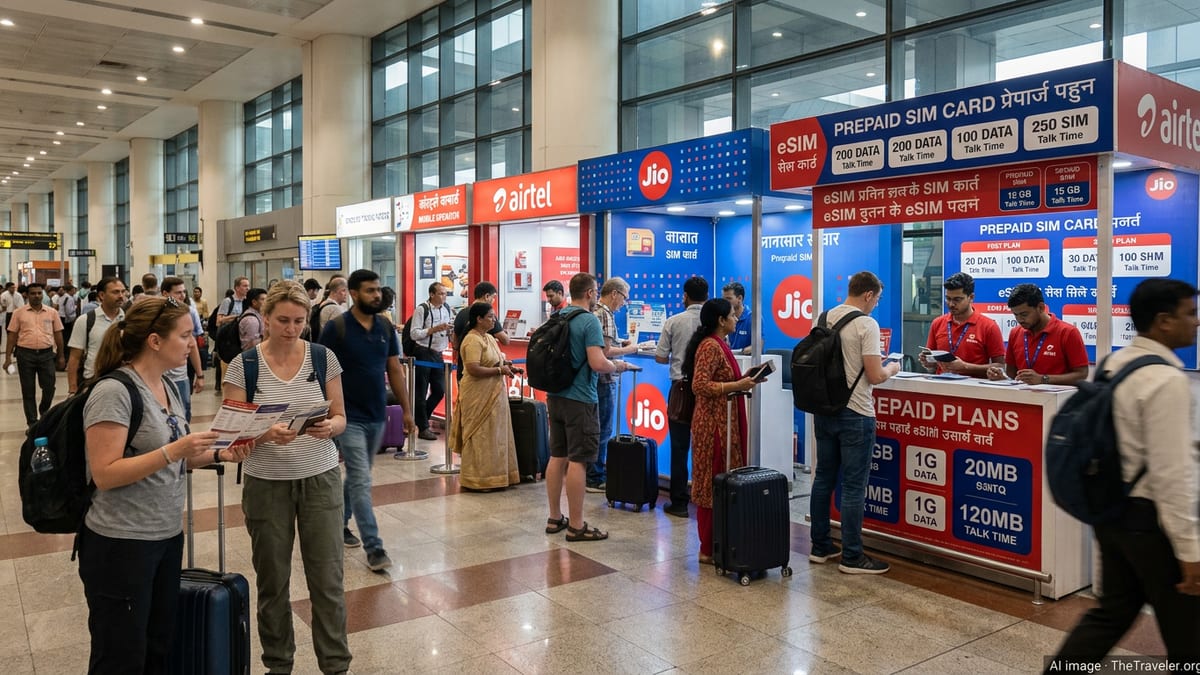
For most visitors, the simplest way to get connected is to buy a prepaid SIM on arrival at a major international airport. In hubs such as Delhi, Mumbai, Bengaluru, Chennai and others, you will usually find official counters for at least one of the big private operators in the arrivals hall. Staff there are accustomed to dealing with foreign travelers, can explain plan options in English and often handle the paperwork in a more streamlined way than smaller shops. Prices at airport counters can be slightly higher than in the city, but many travelers find the convenience well worth the small premium.
If you prefer to shop around, or if your flight arrives when airport counters are closed, you can buy a SIM from official branded stores and authorized resellers in town. Look for clearly marked outlets for Jio, Airtel or Vodafone Idea rather than generic mobile stalls, which may not always follow best practice around documentation or may lack the ability to troubleshoot complex activation issues. Branded stores are also more likely to support tourist friendly eSIM onboarding and to have staff familiar with foreign passports and visas.
When choosing a plan, pay attention not only to the total data allowance but also to daily caps, validity period and any restrictions on hotspot usage. Many Indian plans advertise large headline data limits that are actually spread across daily quotas. For a visitor who expects to rely heavily on maps, ride hailing apps and streaming, a plan with a predictable daily allowance can be attractive, but only if the validity covers your full stay. Be sure to ask whether incoming calls and SMS are free, which is usually the case, and whether international calls are included or must be added as a separate pack.
For eSIMs, the key step is to confirm whether the outlet is equipped to issue and activate them for foreign passport holders. You will typically need a compatible device, an email address and the ability to receive SMS or email while on Wi Fi during activation. In some cases, operators may insist on installing their app and completing the process within it. If you encounter difficulties, it can be helpful to have screenshots of your phone’s eSIM settings ready, and to make sure you are connected to a reliable Wi Fi network during the QR code scan and initial profile download.
Typical Costs, Validity and Plan Types for Tourists
India’s mobile tariffs are among the most affordable in the world when measured on a per gigabyte basis. While exact prices change periodically, recent hikes have still left prepaid plans comparatively budget friendly for most international visitors. Short term prepaid packs targeted at tourists and heavy data users commonly bundle local calls, SMS and generous data over periods ranging from a few days to a month or more. Many such packs are marketed for domestic customers but are fully accessible to foreign visitors as long as documentation requirements are met.
Most prepaid offers are structured either as unlimited daily data with a high speed allowance followed by reduced speeds, or as a fixed data pool usable any time during the validity period. Daily unlimited style plans are popular because they make budgeting simple and align well with routine usage patterns like navigation, messaging and social media. However, travelers who anticipate large one off downloads, such as backing up photos to cloud storage, may prefer a plan with a chunky one time data allocation and fewer daily caps.
For very short visits or transit stays, some travelers choose to rely on roaming packs sold by their home carriers or by global eSIM providers that partner with Indian networks. These options are convenient because they avoid the need for local paperwork, but they are almost always more expensive than a local SIM on a per day or per gigabyte basis. They can still make sense for business travelers on expense accounts or those who value simplicity above all else, but budget oriented tourists and long stay visitors generally benefit by switching to a local plan.
It is important to remember that tariffs, fair use policies and bundle structures evolve regularly as operators respond to regulator guidelines and competitive pressure. Before traveling, it can be helpful to roughly calculate your expected daily data needs based on past trips and then compare them with current public offers from Jio and Airtel. Once in India, staff at official stores can walk you through the latest promotions and, in many cases, help you activate add on data packs or extensions if you find your initial choice too small.
Practical Tips to Avoid Common SIM and eSIM Pitfalls
Despite India’s mature mobile ecosystem, tourists still encounter avoidable problems when buying or using SIM cards. One of the most common is a mismatch between the name on the passport and the information entered during registration. Even minor spelling errors can cause verification delays or temporary service suspensions. To minimize this risk, review the digital or paper forms the salesperson fills out, and insist that your name and passport number are copied exactly as shown. If you do not receive expected activation SMS within a few hours, return to the same outlet or contact the operator’s customer support promptly.
Another frequent issue arises when travelers misplace their SIM card or change phones without properly transferring or reconfiguring the eSIM. Since your Indian number may be linked to app based services such as ride hailing, banking or messaging, losing access at a critical moment can be stressful. If you choose an eSIM, make a note of the operator account details and any recovery options they offer. With physical SIMs, consider storing the small plastic holder with the SIM number in a safe place, such as with your passport photocopies, so that you have the necessary details if you need to request a replacement.
Network selection can also trip up visitors. Some phones, particularly those bought in certain markets, may not support all of the spectrum bands used by Indian 5G networks, which can result in devices falling back to 4G even in nominally 5G covered areas. Before traveling, it is wise to check your device specifications and confirm that it supports the main Indian 4G and 5G bands used by Jio and Airtel. In practice, most recent mid range and flagship phones work well, but very old or extremely budget models may struggle.
Finally, pay attention to SIM validity and recharging deadlines. Prepaid accounts that are left unused can be deactivated after a period of inactivity, and numbers may eventually be recycled. If you plan to return to India within a few months and wish to keep the same number, ask the operator about low cost extension packs or minimum recharge options that preserve incoming call ability. If you are nearing the end of your stay, avoid buying large add on packs that will outlast your trip, since refunds for unused balances are generally not available.
The Takeaway
For most tourists visiting India in 2026, a locally issued prepaid SIM from Jio or Airtel is the most practical, cost effective and reliable way to stay connected. Physical SIMs are still easier to obtain and troubleshoot than eSIMs, especially outside major cities, and they work seamlessly with the country’s broad 4G footprint and expanding 5G networks. Travelers who prioritize convenience and dual SIM flexibility can consider eSIM options where available, but should be prepared for slightly more complex onboarding steps and varied staff familiarity.
Successful connectivity in India hinges on a few core habits: carry your passport and visa details when buying a SIM, choose a provider known for strong local coverage, double check that registration data is accurate, and select a plan that realistically matches your data needs and length of stay. Whether you are crisscrossing megacities by metro, working remotely from a beach town or trekking in the mountains, the right SIM or eSIM setup will keep maps, messages and memories flowing with minimal friction.
With tariffs that remain low by global standards and infrastructure that now blankets the vast majority of the country, India offers visiting travelers a high value mobile experience. A bit of planning before you land, combined with informed choices at the point of purchase, will ensure that staying online enhances rather than complicates your journey.
FAQ
Q1. Is it better for tourists in India to buy a physical SIM or use an eSIM?
For most visitors, a physical prepaid SIM from Jio or Airtel is still the simplest and most widely supported option, while eSIM works best in major cities and for tech confident travelers.
Q2. What documents do foreign tourists need to buy a SIM card in India?
You will usually need your original passport, a valid Indian visa if required for your nationality, and a local address such as your hotel details for registration.
Q3. How long does it take for a new tourist SIM to activate in India?
Activation can be almost instant at major airport counters but often takes a few hours; in some cases full services, including incoming calls, may only start later the same day.
Q4. Which mobile network is best for coverage across most of India?
Reliance Jio generally offers the widest overall 4G and 5G coverage, while Airtel is also very strong; many travelers choose one of these two depending on local feedback.
Q5. Can tourists easily get an eSIM from Indian operators?
eSIM availability for prepaid tourists is improving but not universal. Some Jio and Airtel outlets in big cities can issue eSIMs, but smaller shops may only offer physical SIMs.
Q6. Are Indian prepaid plans really cheaper than international roaming?
In most cases yes. Local prepaid packs provide far more data at a lower cost than typical international roaming packages sold by foreign carriers or global eSIM providers.
Q7. Will my foreign smartphone work on Indian 4G and 5G networks?
Most modern unlocked smartphones from major brands work well, but very old or niche models may not support all local bands, which can limit 5G availability or reduce speeds.
Q8. Where is the best place to buy a SIM on arrival in India?
International airport counters and official branded stores in major cities are usually the most reliable places to buy and activate a SIM, especially for first time visitors.
Q9. What should I do if my new SIM does not start working?
First restart your phone and ensure mobile data and network selection are enabled, then contact the operator’s helpline or return to the store to check registration details.
Q10. Can I keep my Indian number for future trips?
You can often keep the number if you maintain minimal recharges to keep the SIM active, but inactive prepaid numbers may eventually be deactivated and reassigned after a period of non use.