

More news on this day
Airlines based in Singapore and Hong Kong are stepping up nonstop services to Europe and rerouting existing flights as war and airspace closures across the Middle East disrupt long-established transit corridors between Asia and the continent.
Get the latest news straight to your inbox!
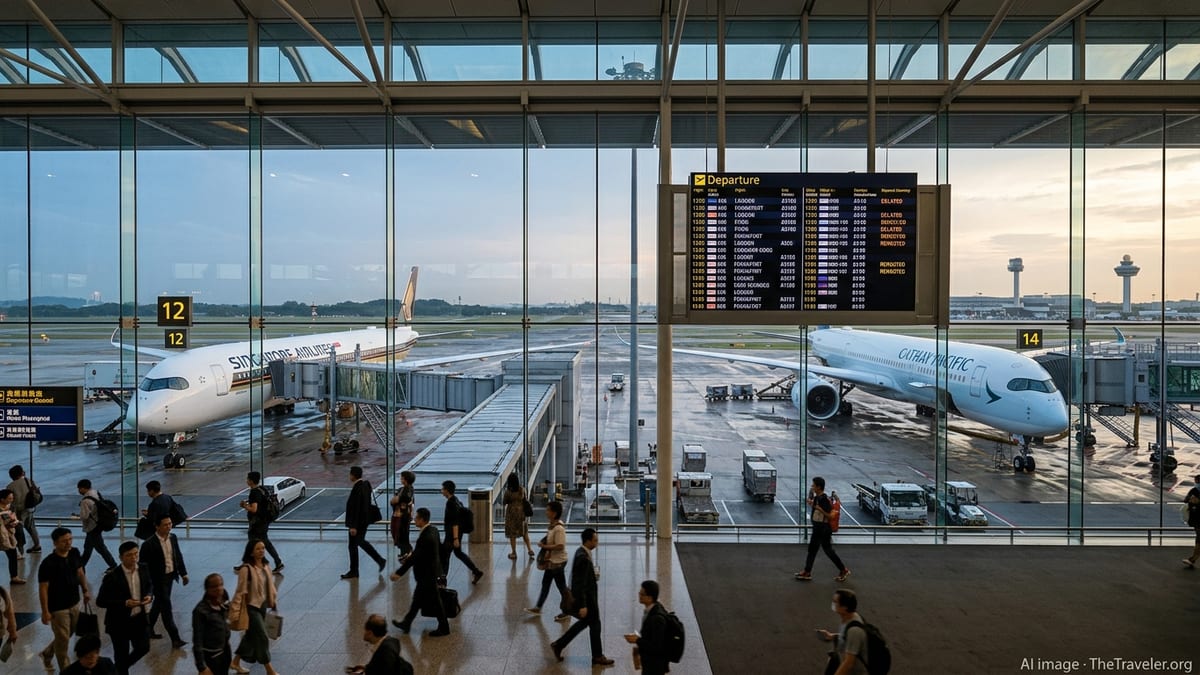
Middle East Conflict Redraws Asia–Europe Flight Map
The latest escalation of conflict involving Iran and its neighbors has triggered widespread airspace closures across the Gulf and Levant, affecting some of the world’s busiest long-haul corridors. Publicly available information shows that Bahrain, Iraq, Israel, Kuwait, Qatar, Syria and the United Arab Emirates have all restricted or closed portions of their skies since late February 2026, forcing mass diversions and cancellations on routes linking Europe, the Middle East and Asia.
Gulf hubs such as Dubai, Abu Dhabi and Doha, which normally handle thousands of daily flights and serve as key waypoints between Asia and Europe, have seen large parts of their operations suspended or severely curtailed on several days. Aviation data and industry coverage indicate that on March 1 alone, around 19,000 flights worldwide were scheduled to cross affected Middle Eastern airspace, with roughly 3,400 ultimately cancelled as airlines adjusted or abandoned planned routings.
These disruptions come on top of existing detours around Russian and Ukrainian airspace, which have already added up to two hours to some Europe–Asia journeys. As a result, major carriers are now navigating a complex patchwork of no-go zones stretching from Eastern Europe through the Middle East, concentrating traffic into narrower corridors over Turkey, the Caucasus, Central Asia and North Africa.
For travelers, the immediate impact has been longer flight times, missed connections and rising fares, particularly on itineraries that previously relied on one-stop connections via Gulf super-hubs. For airlines, the combination of extra fuel burn, higher crew costs and surging jet fuel prices linked to the conflict is putting particular pressure on ultra-long-haul and intercontinental routes.
Singapore Airlines Shifts Europe Capacity Away from Gulf Routings
Singapore Airlines, one of Asia’s largest long-haul carriers, has been among the first to lean more heavily into nonstop Europe services as instability spreads across the Middle East. According to published schedules and airline updates, the company has already restructured parts of its 2025 and 2026 northern summer timetables to favor direct connections between Singapore and key European cities, including London, Paris, Frankfurt, Zurich and Rome.
Industry analyses indicate that Singapore Airlines has temporarily halted services to certain Middle Eastern destinations such as Dubai and Jeddah during periods of peak airspace disruption, redeploying aircraft instead to Europe-bound routes. Some of these flights are now operating on southerly or central Asian tracks that skirt conflict zones, adding around 60 to 120 minutes to flight times compared with pre-crisis routings through the Gulf.
At the same time, capacity on selected Southeast Asia–Europe city pairs has been increased through larger aircraft or higher weekly frequencies. Aviation consultancies report that Singapore–London and Singapore–Frankfurt in particular have seen strong demand from travelers who would once have transited via Dubai or Doha. The airline’s move reinforces Changi Airport’s position as a long-haul hub capable of bypassing Middle Eastern bottlenecks entirely on many Europe-bound itineraries.
Publicly available commentary from route planners suggests that, while the shift raises operating costs, it also strengthens Singapore Airlines’ competitive position against Gulf rivals whose networks are more exposed to sudden airspace closures. The carrier is expected to keep a flexible approach to its schedules into the 2026 summer season, balancing direct Europe services with a gradual return to Middle East destinations as and when conditions allow.
Hong Kong’s Cathay Pacific Leans on Nonstop Links to London and Europe
In Hong Kong, Cathay Pacific and other local operators are also capturing demand from travelers seeking to avoid Gulf stopovers. Published booking and pricing data show that economy seats on Cathay Pacific’s flagship Hong Kong–London route were effectively sold out for days at a time in early March, with the lowest one-way fares multiple times higher than typical off-peak prices later in the month.
Aviation reports attribute the surge partly to passengers switching away from itineraries routed via Dubai, Doha or Abu Dhabi, instead choosing nonstops from North Asia. Hong Kong’s geographic position allows airlines to operate Europe services via northerly corridors over Central Asia or the Arctic, avoiding both Russian and Middle Eastern no-fly areas by using complex but workable alternative tracks.
Cathay Pacific has responded by optimizing widebody deployment on its Europe network, focusing on trunk routes to London, Manchester and continental European gateways such as Frankfurt and Paris. While the airline has not been immune to diversions and longer routings, its limited reliance on Gulf hubs gives it room to absorb displaced demand from both Southeast Asia and Australia that would previously have flowed almost automatically through Middle Eastern megahubs.
Industry observers note that Hong Kong’s recovery as an international hub after extended pandemic restrictions is being accelerated by this redirection of traffic. Strong premium demand on long-haul sectors, including corporate travel between Europe and Asia’s major financial centers, is helping support the economics of operating more nonstop services at a time when jet fuel prices and track mileage are both elevated.
Detours Drive Fares Higher and Lengthen Flight Times
The combined effect of airspace closures and precautionary no-fly advisories has materially increased the distance flown on many Asia–Europe services. Reports summarizing radar and flight plan data show that some aircraft are now routed south via Egypt, Saudi Arabia and Oman, or north over Turkey, Georgia and Central Asia, depending on the day-to-day risk picture and available corridors.
These detours typically add between 15 minutes and two hours to individual flights, although in extreme cases the extension can be even greater. The longer routes are particularly costly at a time when jet fuel prices have risen in response to the Middle East conflict’s impact on global oil supplies. Industry forecasts suggest that airlines will have limited ability to fully absorb these additional costs on long-haul routes, with higher ticket prices likely during the upcoming northern summer travel season.
For passengers, the most visible signs of stress are rapidly changing schedules, extended journey times and volatile fares. Travel industry briefings highlight that one-stop tickets between Asia and Europe, often via the Gulf, can be significantly more expensive than just months earlier, while nonstop flights from hubs such as Singapore and Hong Kong sell out quickly at premium prices.
Network managers at major carriers are also juggling knock-on effects within Europe itself. Data from European air traffic management authorities points to a rise in complexity and limited delays on south-east axis traffic as more long-haul flights are funneled along narrower corridors that avoid both Russian and Middle Eastern airspace. While this has so far been managed without large-scale disruption inside Europe, it adds another layer of risk to already busy summer schedules.
Competition Intensifies Among Non-Gulf Hubs
As Gulf megahubs face sustained operational uncertainty, a new competitive dynamic is emerging among alternative transit points. Airports in Singapore, Hong Kong, Istanbul and selected European cities are positioning themselves as reliable bridges between Asia and Europe, precisely because their key long-haul links can bypass contested Middle Eastern skies.
According to airline schedule data and analyst assessments, Istanbul Airport has picked up rerouted traffic on southern and central corridors, while European hubs such as Frankfurt and Paris are handling more direct Asian services that once funneled through the Gulf. In Asia, Singapore Changi and Hong Kong International are benefiting from their ability to offer both point-to-point nonstops and connections that skirt conflict zones without relying on multiple regional overflights.
For Singapore Airlines and Hong Kong-based carriers, this environment presents both opportunity and risk. On one hand, strengthened nonstop Europe networks can attract premium travelers and build long-term loyalty among customers who value reliability and fewer intermediate stops. On the other, the shift demands careful capacity management, higher fuel budgets and contingency planning for any further spread of conflict that could affect current alternative corridors.
Analysts caution that the situation remains fluid, with ceasefires and new flare-ups capable of changing the operational picture in a matter of hours. For now, however, the balance of evidence suggests that airlines from Singapore and Hong Kong are playing an increasingly central role in keeping Europe–Asia air links open, even as Middle Eastern skies become more difficult and costly to navigate.