

More news on this day
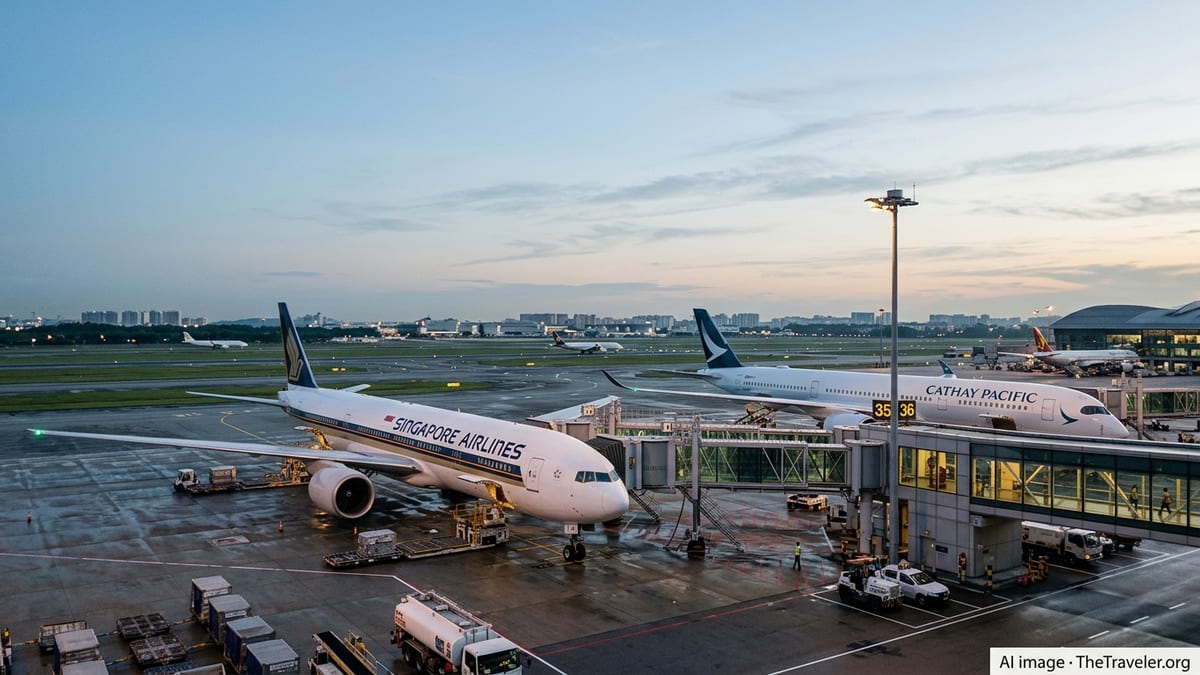
Airlines based in Singapore and Hong Kong are accelerating plans to add and upgauge Europe services as the war in Iran shuts swathes of Middle East airspace, forcing Asia–Europe traffic away from Gulf hubs and onto more northerly and southerly routes.
Get the latest news straight to your inbox!
Middle East Conflict Forces Rethink of Asia–Europe Corridors
The latest escalation of the Iran war and coordinated strikes by the United States and Israel at the end of February 2026 have triggered widespread airspace closures across the Middle East, according to multiple aviation trackers and news reports. Countries including Iran, Iraq, Israel, Kuwait, Bahrain and Qatar have imposed extensive restrictions, while major hubs in the United Arab Emirates and Qatar have seen sharply reduced operations.
Industry analysis indicates that these closures have cut off one of the world’s most important aviation corridors linking Europe with South and Southeast Asia. Research cited by specialist travel sites and international media suggests that as much as 15 percent of global air traffic is typically routed through Middle Eastern hubs, a share that has been abruptly curtailed as airlines divert or cancel services.
Rerouting has immediate operational consequences. Travel data providers report that many Europe–Asia flights now detour north via Turkey and the Caucasus or skirt further south over Egypt and the Arabian Sea, adding two to five hours to some journeys and significantly increasing fuel burn and crew costs. Analysts note that these adjustments come on top of existing detours around Russian and Ukrainian airspace that have been in place since 2022.
With Gulf super-connectors cutting schedules and focusing on core trunk routes, airlines in East and Southeast Asia are reassessing how best to maintain access to Europe. Publicly available flight schedules and airline statements show that Singapore and Hong Kong carriers are among those moving fastest to plug gaps in capacity created by the disruption.
Singapore Airlines Shifts Capacity Toward Nonstop Europe Links
Singapore Airlines has long operated a network of nonstop routes to major European cities, and current timetables indicate that the carrier is leaning further into this model as Middle East detours lengthen. Capacity tracking services highlight additional frequencies and larger aircraft on key European destinations from Singapore, particularly on high-demand city pairs where travelers previously relied on one-stop options via Gulf hubs.
Aviation schedule data shows more widebody deployment on routes to cities such as London, Paris, Frankfurt and Zurich, aligning with reports that travelers and corporate buyers are favoring itineraries that avoid conflict-zone overflights and potential last-minute diversions. Industry commentators note that Singapore’s Changi Airport, already a major Asian hub, is now absorbing a portion of connecting traffic that might otherwise have transited Dubai, Doha or Abu Dhabi.
Network analysts also point to Singapore Airlines’ close collaboration with its low-cost and regional partners as an important factor. By tightening connections from secondary Southeast Asian and Australasian points into long-haul European departures, the group is able to offer alternative one-stop journeys that remain competitive in total travel time, even as detours elsewhere extend rival routings.
Travel management companies report that corporate clients in markets such as Australia, Indonesia and Malaysia are increasingly requesting routings via Singapore for Europe-bound staff. Publicly available booking and fare data suggests that this shift is supporting yield on non-stop Europe services out of Changi, even as operating costs rise due to longer skirting routes to avoid restricted Middle Eastern skies.
Hong Kong Carriers Target Secondary European Cities
Hong Kong-based airlines, led by Cathay Pacific, are also positioning themselves to capture displaced demand between Asia and Europe. Company financial disclosures and fleet plans published in 2025 show a renewed focus on rebuilding and expanding the carrier’s European footprint, including the resumption of services to cities such as Rome and Brussels and the launch of additional destinations on the continent.
By late 2025, Cathay Pacific’s scheduled network included a dozen European destinations, according to publicly available corporate reports, with plans to deepen frequencies in subsequent seasons. Aviation analysts say the Middle East airspace crisis has reinforced the strategic value of this diversified European portfolio, particularly secondary cities where Gulf carriers had built strong one-stop propositions.
As Hong Kong International Airport continues its post-pandemic recovery, schedule filings show more Europe-bound departures timed for convenient onward connections across North Asia. Industry observers note that this hub-and-spoke approach positions Hong Kong as an alternative to both Middle Eastern and northern European gateways for travelers originating in markets such as mainland China, Japan and South Korea who seek to avoid conflict-affected corridors.
Regional competitors from Hong Kong, including full-service and low-cost carriers operating under local or affiliate brands, are also increasing capacity on short-haul feeder routes. This supports a broader trend in which travelers piece together combinations of regional and long-haul flights that bypass traditional transit points now affected by closures or heightened security risks.
Longer Routes, Higher Fares and Changing Passenger Preferences
Independent forecasts from aviation and travel consultancies suggest that the combination of longer routings, higher fuel consumption and constrained capacity is likely to push up fares on many Asia–Europe city pairs in the coming months. Research cited in European media has already found that rerouting around conflict zones can increase airline costs on some intercontinental sectors by up to 40 percent, a burden that historically has been passed on partly through ticket prices.
As travelers confront these changes, booking patterns are shifting. Reports from online travel agencies and corporate travel managers indicate a growing preference for itineraries that use what are perceived as politically stable hubs, even if that requires longer connections or higher base fares. Airports in Singapore, Hong Kong and parts of Europe are among the beneficiaries of this rebalancing, while traffic through certain Gulf hubs remains volatile.
Consumer behavior is also being influenced by uncertainty around last-minute airspace closures. News coverage of flights forced to divert mid-journey or return to origin airports has heightened awareness of geopolitical risk along traditional routes. Analysts note that this visibility is encouraging some passengers to select routings that avoid the Middle East entirely, even when airlines continue to operate limited services through the region.
In parallel, travel insurers and booking platforms are adapting their products and messaging, with more emphasis on flexible tickets, rerouting options and coverage for disruption linked to geopolitical events. This environment further encourages travelers to favor carriers and hubs that appear less exposed to sudden shifts in regional security conditions.
Strategic Advantage for Non-Middle East Hubs
While the current pattern of airspace closures is closely tied to the Iran war and may evolve as diplomatic dynamics change, aviation strategists argue that the broader realignment of global air traffic could outlast the immediate conflict. With Russian and Ukrainian skies already heavily restricted, the effective closure of vast portions of the Middle East concentrates long-haul flows along a smaller number of safe corridors.
In this context, airlines based in Singapore and Hong Kong are widely viewed as being structurally well placed. Their home airports sit close to key great-circle routes between Europe and Asia that can be adjusted to avoid conflict zones without excessively lengthening journeys. They also benefit from large local and regional catchment areas, strong premium demand and well-established partnerships with European network carriers.
Observers caution, however, that the benefits are not cost-free. Even when avoiding the most heavily restricted areas, carriers still face higher fuel bills, complex flight-planning requirements and heightened operational risk. Any large-scale diversion of traffic away from Middle Eastern hubs also has knock-on effects for connectivity to Africa and parts of South Asia, where Gulf carriers traditionally act as intermediaries.
For now, publicly available schedules and booking data show that Singapore and Hong Kong airlines are using the disruption to consolidate and, in some cases, grow their presence on Europe routes. How durable this advantage proves to be will depend on the trajectory of the conflict, the pace at which Middle Eastern airspace can safely reopen, and whether travelers’ newfound caution about certain corridors becomes a permanent feature of long-haul demand.