

More news on this day
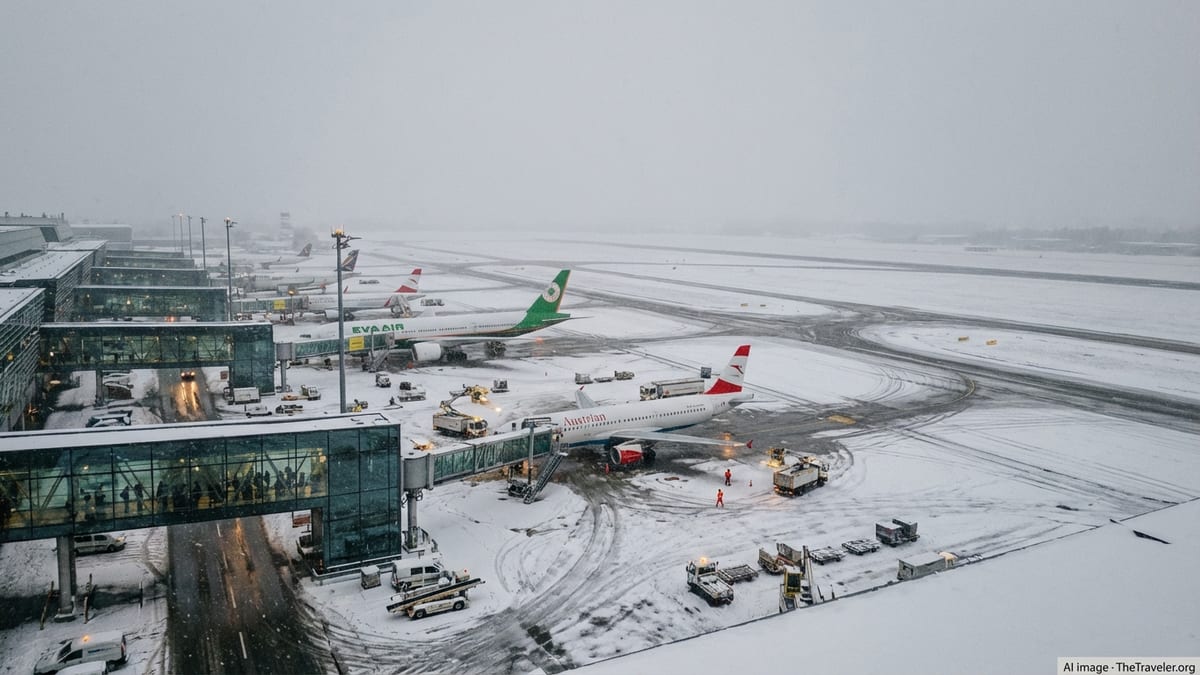
A powerful snowstorm that swept across eastern Austria on February 20 forced Vienna International Airport to halt operations for hours, triggering widespread cancellations, diversions and delays for airlines including EVA Air and Austrian Airlines and rippling through flight networks across Europe and beyond.
Historic Snowfall Brings Hub Airport to a Standstill
The winter storm, described by meteorologists as one of the heaviest single-day snowfalls around Vienna in two decades, dumped around 20 centimeters of wet, wind-driven snow across the capital region. By early morning, runways, taxiways and apron areas at Vienna International Airport were blanketed, leaving ground crews scrambling to keep pace with fast-accumulating drifts.
Airport management took the unusual step of suspending all flight operations early on February 20, initially for several hours as a precautionary ground stop. As conditions deteriorated and snow removal teams struggled against persistent bands of precipitation and gusty winds, the shutdown was extended, with the airport indicating that only limited departures would be possible around midday and arrivals not before early afternoon.
According to airport statements and aviation data, roughly two thirds of the 230-plus flights scheduled to operate into and out of Vienna by midday had been cancelled. Others were severely delayed or rerouted to alternative airports, turning the normally orderly winter operations at one of Central Europe’s key hubs into a patchwork of last-minute changes and emergency diversions.
EVA Air and Austrian Flights Forced to Divert
Among the most visible disruptions were long-haul services that found Vienna unreachable just as the storm peaked. EVA Air’s Flight BR61 from Bangkok to Vienna was diverted hundreds of kilometers away, with flight trackers showing the aircraft ultimately touching down in Munich after holding patterns made clear that conditions at its intended destination would not improve in time.
Austrian Airlines, Vienna’s home carrier and the largest operator at the airport, faced a particularly acute operational challenge. One of its long-haul services, Flight OS36 from Washington, bypassed Vienna entirely and diverted to Klagenfurt in southern Austria, a much smaller airport that suddenly found itself handling an unexpected influx of international passengers.
Other inbound aircraft were rerouted to airports across the region, including Linz and Graz within Austria, as well as Brno, Munich and Frankfurt, as carriers sought any available runway that remained open and within range. For passengers on affected flights, the diversions meant extended journey times, unfamiliar airports and complex rebooking efforts as airlines tried to reposition aircraft and crews.
Wave of Cancellations Ripples Across Airlines
While diversions captured public attention, the bulk of the snowstorm’s impact came through large-scale cancellations. Austrian Airlines cut dozens of rotations from its Friday schedule, including multiple European and regional services that typically shuttle business travelers and transfer passengers through Vienna’s hub. Aviation analysts estimate that more than 80 Austrian-operated flights were either cancelled outright or significantly delayed.
Foreign carriers were similarly hit. Airlines from the Middle East, Asia and across Europe reported schedule disruptions as Vienna’s ground stop took effect. Some services were scrubbed due to lack of available turnaround windows once the airport reopened, while others were delayed long enough to cause missed connections for onward journeys to Central and Eastern Europe.
Air cargo operators were not spared either. With limited runway access and tight safety margins on slippery aprons, several freight movements were postponed or rerouted. Logistics companies reported shifting high-value and time-sensitive consignments onto road and rail, or temporarily warehousing goods near alternative gateways in Germany and neighboring countries.
Long-Range Passengers Face Extended Journeys
For travelers on EVA Air’s Bangkok service and long-haul Austrian flights, the storm’s timing translated into long, uncertain journeys. Passengers who expected to arrive in Vienna in the early morning found themselves landing in Munich or Klagenfurt instead, where airline staff had to quickly arrange buses, hotel rooms and rebooked flights amid an unfolding operational crunch.
Those bound for Vienna as a final destination were in many cases bussed onward once roads were deemed safe, turning what should have been a single flight into a multi-leg odyssey across snowy central Europe. For transfer passengers using Vienna to connect onward to destinations from the Balkans to Western Europe, the picture was even more complicated, as missed connections cascaded through already crowded weekend services.
At Vienna Airport itself, the situation inside terminals remained relatively calm compared with other major weather events, largely because authorities explicitly urged passengers not to travel to the airport unless their flight was confirmed as operating. The measure helped prevent overcrowding but left many travelers stranded in hotels, homes and remote departure cities waiting for updates from their carriers.
Runway Crews Battle the Elements
Behind the scenes, Vienna’s winter service teams mounted a continuous effort to regain control of the airfield. Airport officials said ploughs and snow blowers had been in operation since Thursday evening, with convoys of specialized vehicles clearing runways, taxiways and parking stands in tightly choreographed sweeps. Deicing crews worked in parallel to ensure that aircraft which could depart did so with clean, ice-free wings and fuselages.
Estimates from local authorities indicated that as much as 15,000 tons of snow were removed from the wider Vienna transport network over the course of the storm, including airport grounds and major roadways. The heavy, wet nature of the snowfall compounded the challenge, refreezing quickly on exposed surfaces and requiring repeated clearing runs to keep even limited areas operational.
Although flight operations gradually resumed around midday, with individual takeoffs followed by restricted inbound traffic, the backlog proved impossible to clear in a single day. Airlines cautioned that residual delays, scattered cancellations and aircraft imbalances would continue into the weekend as planes and crews were returned to their intended rotations.
Regional Transport and Power Networks Under Strain
The chaos at Vienna Airport unfolded against a broader backdrop of weather-related disruption across eastern Austria. The main highways south of Vienna, including important freight and commuter routes, were periodically shut as snowdrifts, stranded trucks and multiple accidents rendered sections impassable. Drivers faced long delays as tow services and road crews worked to unclog affected stretches.
Farther afield, power utilities in southern and eastern regions reported outages affecting tens of thousands of households. In Styria alone, around 30,000 homes briefly lost electricity as heavy snow and ice weighed down trees and power lines. Repair crews were deployed throughout the day, often working in challenging conditions along rural roads and forested hillsides.
The severe weather also heightened avalanche risk in alpine areas, with authorities warning against off-piste skiing and issuing advisories for popular mountain resorts. The combination of deep new snow and unstable layers beneath increased the likelihood of slides, prompting tighter safety cordons and occasional temporary closures of high-altitude access roads.
Travel Industry Scrambles to Support Stranded Customers
With Vienna’s main hub constrained, airlines, tour operators and corporate travel departments moved quickly to manage stranded customers and minimize further disruption. Many carriers activated flexible rebooking policies, allowing passengers to push travel plans to later dates without penalty or to reroute through alternative European gateways such as Munich, Frankfurt or Zurich.
Travel management companies reported a surge in requests from corporate clients seeking to reroute staff via rail, particularly on Austria’s Westbahn and ÖBB high-speed services linking Vienna to key regional centers. For some journeys, trains became the most reliable option, especially once road conditions improved and airport capacity remained capped.
For leisure travelers, package operators and online travel agencies faced a complex task reconfiguring itineraries involving Vienna as a starting point for ski holidays, river cruises or city breaks. Customer service teams extended opening hours across multiple time zones, fielding calls from passengers delayed in Asia, North America and within Europe, all seeking clarity on next steps.
Questions Raised Over Resilience and Future Planning
Although winter weather is a regular feature of aviation in Central Europe, the scale of this particular disruption has prompted renewed debate over the resilience of Vienna’s air transport infrastructure. Industry observers noted that as Austria’s primary international gateway, Vienna handles around two thirds of the country’s passenger traffic, making it a single point of failure when extreme conditions strike.
Aviation analysts and some business groups suggested that the episode underscores the need for stronger contingency planning and diversified transport links. Proposals that have resurfaced include enhancing high-speed rail connectivity between Vienna and Bratislava’s airport to provide an alternative hub in exceptional circumstances, and investing in advanced navigation and landing technologies that allow more aircraft to approach safely in poor visibility.
Climate specialists also pointed out that while individual snow events cannot be solely attributed to long-term climate trends, greater variability in winter weather patterns can produce both milder periods and more intense storms. For airports, that creates a planning challenge: ensuring sufficient snow-clearing capacity and staff readiness for rare but high-impact events, without overinvesting in infrastructure that lies idle in more typical seasons.