

More news on this day
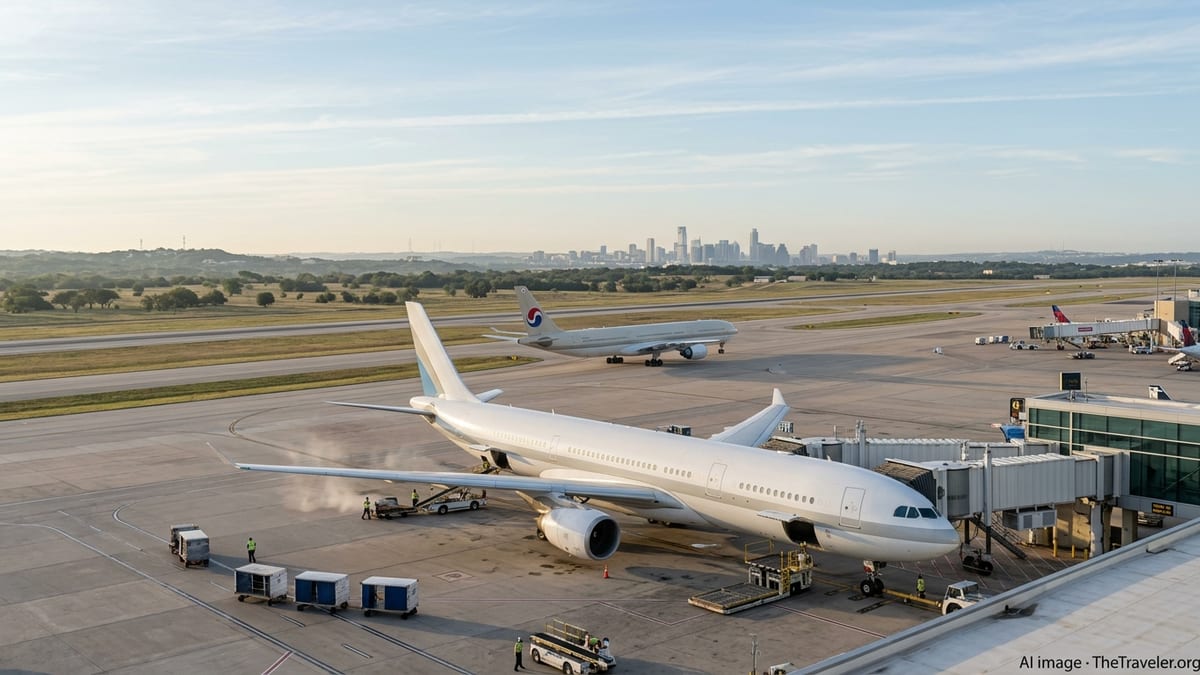
A potential nonstop flight between Seoul Incheon and Austin is emerging as a key topic in South Korea–United States aviation discussions, as Samsung’s multibillion-dollar semiconductor expansion in Central Texas accelerates business links between the two tech hubs.
Get the latest news straight to your inbox!
Talks Align With Samsung’s Expanding Texas Footprint
Publicly available information on recent policy and industry meetings indicates that South Korean and US aviation stakeholders are exploring options to add a direct Incheon–Austin service to support sharply rising traffic tied to Samsung’s investment in the region. The discussions are unfolding against the backdrop of Samsung’s plan to pour more than 37 billion dollars into a semiconductor cluster centered on Taylor, northeast of Austin, alongside upgrades to its long-established Austin fabrication site.
US government releases on semiconductor policy describe Samsung’s Texas program as a comprehensive ecosystem that includes new leading-edge logic fabs, advanced packaging capacity and research and development facilities. Those documents highlight expectations that Central Texas will attract thousands of highly skilled workers, suppliers and visiting executives over the next several years as the complex comes online in stages.
Industry coverage notes that the Taylor project has recently cleared important regulatory milestones, including temporary approvals that pave the way for limited operations while full-scale production is prepared. This steady progress is reinforcing aviation planners’ assumptions that business and technical travel between Korea and the Austin area will move from episodic to constant, underlining the case for a nonstop air link.
Local economic reports from Austin and surrounding counties already point to substantial indirect effects from Samsung’s earlier investments, ranging from specialized construction to logistics and engineering services. Analysts following the new 37 billion dollar buildout expect those ripple effects to intensify as more Korean suppliers establish a presence in Texas, further strengthening demand for direct connectivity with Seoul.
Austin’s Global Air Network Reaches Toward Asia
Austin-Bergstrom International Airport has spent the past decade transitioning from a primarily domestic facility into a secondary US gateway with a growing roster of long-haul services. Transatlantic routes to London and key European hubs established a template for how the fast-growing Texas capital can sustain intercontinental traffic, particularly when backed by strong business ties.
Aviation planners now see Asia as the next frontier for Austin’s network. Previous public statements from local economic development agencies have highlighted the role of Samsung and other Asia-based investors in driving international demand, with Korea often cited as a priority market. The scale of current semiconductor construction around Taylor appears to be turning that strategic aspiration into a more time-sensitive opportunity.
Unlike coastal giants such as Los Angeles or New York, Austin does not yet have a nonstop link to East Asia, leaving travelers to connect through Dallas, Houston or West Coast hubs. For semiconductor executives, engineers and technicians commuting between the Seoul metropolitan area and Central Texas, this can add hours to each trip, particularly when equipment schedules or project timelines are tight.
A nonstop Incheon–Austin service would shorten end-to-end travel times and simplify cargo handling for high-value, time-sensitive semiconductor components. Air service development specialists frequently note that once a single long-haul route to a new region proves viable, it often attracts additional capacity and competition, which can benefit both business and leisure travelers.
Potential Carriers and Partnership Structures
Industry observers point to several plausible airline candidates for an Incheon–Austin route, led by Korean Air as South Korea’s flag carrier and a major operator at Incheon International Airport. As a key member of the SkyTeam alliance, Korean Air already cooperates closely with US partner Delta Air Lines on trans-Pacific services and onward connections across North America.
Publicly available alliance information shows that Delta maintains a sizable presence in Austin, with a mix of domestic and regional flights that could feed an intercontinental service. A joint operation or codeshare arrangement on an Incheon–Austin flight would allow the two carriers to blend Korean-origin traffic with demand from Austin and secondary US markets, a model they already use on other long-haul routes.
Other South Korean and US carriers could also examine the opportunity, depending on fleet availability, network priorities and bilateral air service arrangements. Widebody aircraft capable of efficiently serving the roughly 7,000-mile sector from Incheon to Austin would likely be required, and operators would weigh the route against competing long-haul prospects in both trans-Pacific and Europe–Asia markets.
Analysts following airline strategy stress that any launch decision would depend on a detailed assessment of corporate travel contracts, cargo projections and slot availability at Incheon. They also note that early flights on new long-haul routes often rely heavily on anchor customers, such as major industrial investors, before broader market awareness develops.
Semiconductor Investment Reshapes Travel and Trade Flows
Samsung’s growing Texas footprint is one of the most visible examples of how semiconductor investment is reshaping global travel patterns. US policy documents on the semiconductor industry describe the Central Texas complex as part of a broader push to localize production of advanced chips, with targeted public funding intended to complement tens of billions of dollars in private capital.
Economic impact studies commissioned around Samsung’s existing Austin operations suggest that international business travel has already become a structural feature of the local economy, supporting hotels, meeting facilities and specialist service providers. Extension of this trend to the new Taylor cluster is expected to draw even more frequent movements by engineers, equipment suppliers and corporate leadership between Korea and Texas.
In this context, a direct Incheon–Austin air link is viewed by many analysts as an infrastructure response to industrial geography. Rather than creating demand on its own, such a route would formalize and streamline travel that is already taking place via circuitous connections, while also sending a signal to other Asia-based manufacturers about Austin’s accessibility.
On the cargo side, even limited belly capacity in passenger aircraft can be significant for semiconductors and related equipment, which tend to move in relatively small volumes but with high value and tight delivery windows. The presence of a nonstop option can also encourage logistics providers to design new time-definite products linking Korean tech clusters with Central Texas industrial parks.
Next Steps and Timelines Under Watch
For now, the Incheon–Austin route remains in the exploratory stage, with no carrier having publicly filed schedules or launch dates. However, aviation and economic development circles are closely tracking near-term milestones at Samsung’s Taylor complex, where full operations are expected to ramp up following recent approvals, as well as broader patterns in Korea–US trade and investment.
Travel industry analysts anticipate that any formal route announcement would likely be timed to coincide with clear signals from Samsung about production start dates and staffing levels, in order to highlight the link between manufacturing activity and connectivity. They also point to seasonal planning cycles in the airline industry, which typically lock in major long-haul changes several months before the start of the summer or winter schedules.
Observers also note that the experience of other mid-sized US cities suggests that once a major Asian carrier commits to a new gateway, local stakeholders often respond with marketing support, passenger awareness campaigns and infrastructure tweaks at the airport to accommodate cultural and operational needs. Similar steps in Austin could help an Incheon service mature more quickly if it is launched.
Until firm plans are disclosed, the proposed Incheon–Austin flight will remain a subject of speculation among travelers and aviation watchers. Even so, the scale of Samsung’s 37 billion dollar semiconductor expansion in Texas and the deepening Korea–US technology partnership are widely seen as powerful structural forces pushing both governments and airlines to take the idea increasingly seriously.