

More news on this day
Southwest Airlines is preparing to halt flights at Chicago O’Hare International Airport and Washington Dulles International Airport effective June 4, a network shift that is already rippling through competing airlines, airport hotels, and tourism organizations that rely on the carrier’s domestic feed.
Get the latest news straight to your inbox!
Network Retrenchment Targets O’Hare and Dulles
Booking displays, customer notifications, and industry discussion indicate that Southwest’s last day of scheduled service at Chicago O’Hare (ORD) and Washington Dulles (IAD) will fall on June 3, with no flights operating from June 4 onward. The change affects a relatively small but strategically important portfolio of routes that linked the two large hubs with Southwest’s national network.
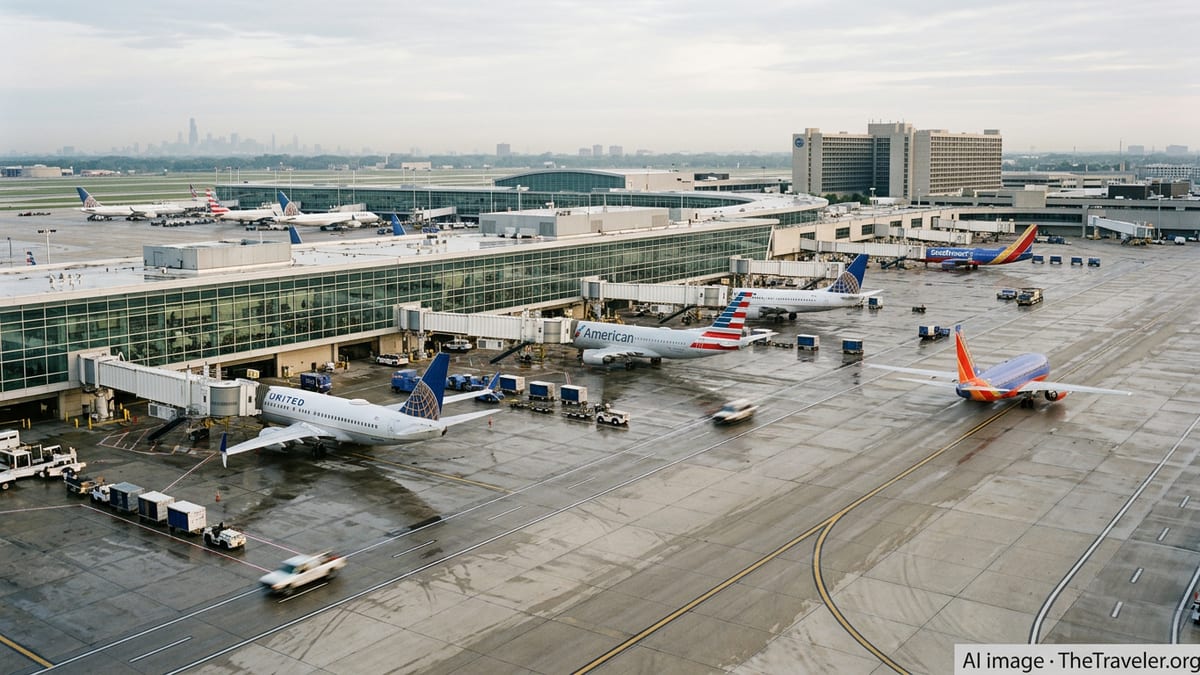
At O’Hare, Southwest has been operating from Terminal 5 with a handful of daily departures to core cities such as Denver and Phoenix, supplementing its much larger operation at Chicago Midway. At Washington Dulles, the airline has maintained a modest schedule alongside more robust offerings at nearby Baltimore/Washington and Washington National airports.
Publicly available filings and schedule data show that Southwest has been gradually consolidating around its strongest airports, particularly Midway in Chicago and Baltimore/Washington in the capital region. The move to cease operations at both O’Hare and Dulles on the same day marks a clear acceleration of that strategy, concentrating aircraft and crews where demand and cost structures are most favorable.
Travel forums, fare searches, and airline timetables reviewed in mid-March show no Southwest-operated flights listed from either ORD or IAD after the June 3 schedule, reinforcing expectations that June 4 will be the first full day without the carrier at the two airports.
Impacts for Travelers and Competing Airlines
For passengers, the immediate impact will be a loss of nonstop options from O’Hare and Dulles to several Southwest cities, along with the carrier’s familiar policies on baggage and ticket changes. Travelers holding tickets beyond June 3 are receiving rebooking notices and options to shift to Chicago Midway, Baltimore/Washington, or Washington National, or to request refunds depending on fare rules and airline policies at the time of change.
Competing carriers at both airports are watching closely. O’Hare is dominated by United and American, while Washington Dulles is a major hub for United. With Southwest stepping aside, competitors may adjust capacity, either by adding seats on overlapping routes or by rebalancing aircraft to markets where Southwest remains a strong presence, such as Midway and Baltimore.
Industry analysts note that Southwest’s relatively small footprint at O’Hare and Dulles made it difficult to compete with entrenched hub carriers on frequency and lounge access, especially for time-sensitive business travelers. By contrast, the airline retains a near-dominant presence at Midway, where it can offer dense schedules, quick connections, and lower airport costs.
Budget-conscious travelers using ORD or IAD may see fares drift higher on routes where Southwest exits and only one or two full-service competitors remain. However, low-cost and ultra-low-cost carriers operating at the two airports could step in to capture price-sensitive demand, particularly on leisure-heavy routes.
Airport Hotels and Tourism Boards Brace for Lower Traffic
Airport hotel operators around O’Hare and Dulles are preparing for a subtle but meaningful shift in booking patterns once Southwest flights disappear. Many midscale properties near the terminals depend on a mix of airline crew stays, short-notice overnight passengers, and weekend leisure travelers booking packages tied to specific carriers.
Revenue managers say that even a modest reduction in daily departures can translate into fewer distressed travelers seeking last-minute rooms during irregular operations. While O’Hare and Dulles will remain among the busiest airports in the country, the loss of a major domestic brand’s presence removes one stream of potential bookings, especially for hotels that have marketed heavily to Southwest’s customer base.
Tourism and convention organizations in both metropolitan areas are also monitoring the change. Chicago’s visitor economy relies on both O’Hare and Midway to deliver meeting attendees and weekend city-break travelers, while the Washington region leans on Dulles, National, and Baltimore/Washington to support business, government, and leisure trips.
Marketing teams focused on attracting domestic conferences and events may need to update travel guidance, highlighting alternative airports and advising attendees on new connection patterns. Package operators that previously funneled Southwest passengers through O’Hare or Dulles are evaluating whether to reroute traffic via Midway or Baltimore to maintain access to the airline’s network.
Shift in DC-Area Dynamics: Focus on Reagan and Baltimore
In the Washington region, Southwest’s exit from Dulles underscores the carrier’s preference for airports where it can sustain higher frequencies and lower costs. Baltimore/Washington International remains one of the airline’s largest bases, and schedule filings show a growing emphasis on Washington National, where access is constrained by federal slot rules but offers proximity to downtown.
Travel industry observers point out that long-term changes in demand have increasingly favored Baltimore and National over Dulles for domestic point-to-point flying, particularly on routes where short ground travel times and strong local catchment areas outweigh the benefits of long-haul connectivity. Southwest’s realignment reflects that shift, refocusing customers on airports where the airline can provide more robust schedules.
For Northern Virginia residents and companies that have used Dulles as their primary airport, the loss of Southwest means fewer choices and potentially higher prices on select domestic routes. Some travelers may pivot to Baltimore or National despite longer ground commutes, especially if they value Southwest’s fare structure and loyalty program.
Ground transportation providers serving Dulles, including shuttle operators and rideshare drivers, may see slight changes in demand patterns, with fewer Southwest-branded arrivals and departures feeding late-night and early-morning traffic.
What June 4 Means for Future Route Maps
The June 4 exit from Chicago O’Hare and Washington Dulles fits a broader pattern of Southwest pruning underperforming stations and redeploying capacity to stronger markets. In recent years, the airline has withdrawn from several airports where operations remained small compared with nearby focus cities, citing evolving demand, higher costs, and the need to simplify its network.
For travelers, the date serves as a reminder to check itineraries closely in the coming months, especially for summer trips involving Chicago or Washington. Those who prefer Southwest’s policies may opt to fly via Midway, Baltimore, or National, accepting extra ground travel time in exchange for familiar onboard experiences and loyalty benefits.
For airports and tourism boards, the development highlights the importance of diversifying airline partnerships and building resilience against individual carriers’ network decisions. While O’Hare and Dulles will continue to attract global traffic, the loss of even a modest schedule from a major domestic airline can nudge hotel bookings, meeting plans, and marketing strategies in new directions.
As the June 4 milestone approaches, travelers are encouraged to monitor airline communications and rebook options. Airlines, airport-area hotels, and tourism promoters across both regions are adjusting their plans in anticipation of a reshaped competitive landscape once Southwest’s aircraft and crews depart O’Hare and Dulles for the last time.