

More news on this day
Hundreds of travellers were left stranded across Spain today after a new wave of disruption hit key airports in Barcelona, Madrid, Valencia and Seville, with major carriers including Iberia, Vueling, Air Europa and easyJet together logging 241 flight delays and 33 cancellations.
Major Spanish Hubs Buckle Under Fresh Wave of Disruption
The latest figures from aviation monitoring services show Spanish airports once again at the centre of Europe’s travel turmoil, as operational bottlenecks and knock-on scheduling issues ripple through airline networks. Barcelona El Prat and Madrid Barajas recorded the highest concentration of affected services, but Valencia and Seville also saw mounting queues at check-in, security and rebooking desks as the day wore on.
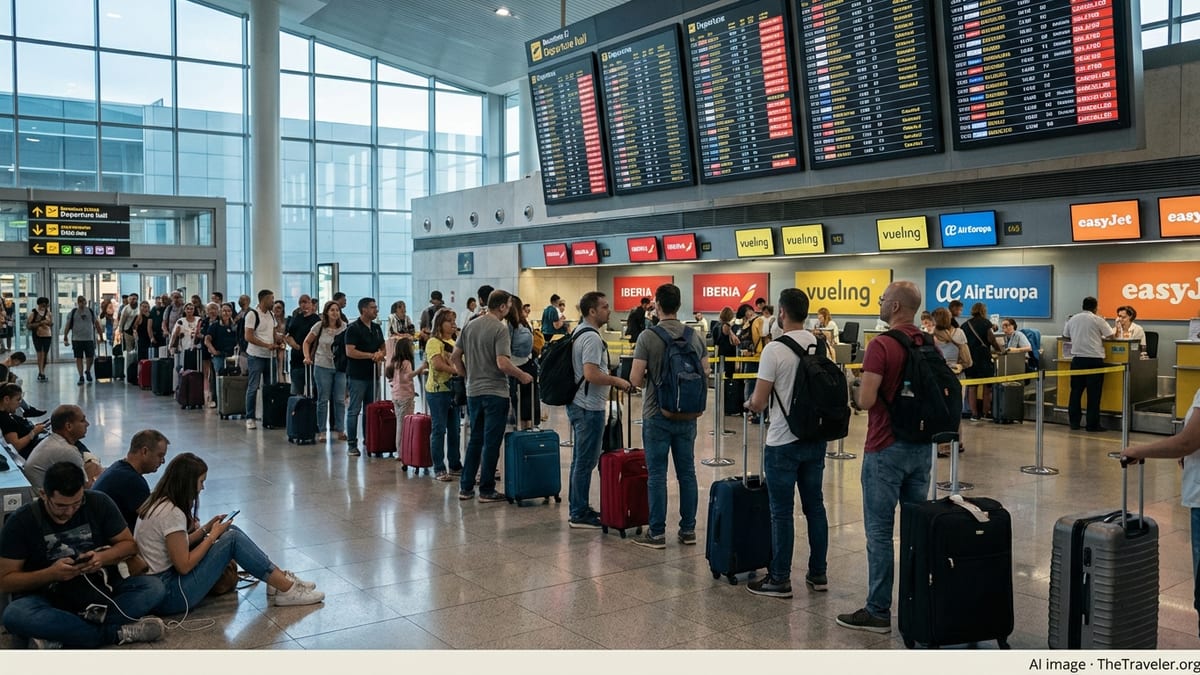
Passengers reported packed departure halls, long waits at customer service counters and departure boards filled with red and amber alerts as airlines battled to re-sequence aircraft and crews. While Spain’s main hubs have faced repeated bouts of disruption over the past year, today’s cluster of delays and cancellations underscores just how fragile punctuality remains across the continent’s busy short haul corridors.
The day’s 33 cancellations were spread across domestic and intra-European routes, affecting both business travellers and holidaymakers. Many more passengers were caught up in the 241 delayed departures and arrivals, with some short haul flights leaving more than three hours behind schedule and triggering compensation rights under European regulations.
Iberia, Vueling, Air Europa and easyJet Among Worst Hit
Flag carrier Iberia and low cost operator Vueling, both central to Spain’s domestic and European connectivity, were prominent on today’s disruption lists, particularly at Madrid and Barcelona. Their combined networks form the backbone of Spain’s internal air links and key routes to France, Italy, Germany and the United Kingdom, magnifying the impact whenever schedules slip.
Air Europa, another major player on domestic and regional services and an important connector to long haul destinations in Latin America, also logged a series of delayed rotations as aircraft returning late from earlier sectors knocked subsequent departures off track. At several points during the day, ground crews were forced to turn aircraft around in compressed timeframes to keep remaining flights as close to schedule as possible.
Pan-European low cost carrier easyJet, which has built a strong presence on routes linking Spanish cities with hubs in France, Italy and northern Europe, faced a mix of late arrivals and outbound delays. With aircraft and crews flying multi-leg sequences across several countries, a single late inbound from elsewhere in Europe often translated into a cascade of secondary delays in Barcelona and other Spanish stations.
Barcelona, Madrid, Valencia and Seville Feel the Strain
Barcelona El Prat once again emerged as one of the day’s most pressured hubs, reflecting its role as a primary base for Vueling and a key gateway for both leisure and business traffic. Crowded departure halls and extended waits at baggage drop were reported as passengers tried to navigate a constantly shifting departure board. Several morning delays spilled into the afternoon peak, complicating connections for travellers headed to other European cities.
Madrid Barajas, Spain’s busiest airport and Iberia’s main hub, also faced a heavy operational load as airlines worked to reroute customers off cancelled services and secure spare seats on remaining flights. The sheer scale of Madrid’s daily operation means even a relatively small proportion of delayed flights can translate into thousands of disrupted journeys, from domestic hops to long haul departures.
In Valencia and Seville, where traffic volumes are smaller but heavily concentrated at peak times, even modest numbers of delayed flights quickly led to bottlenecks at boarding gates and security checkpoints. Local tourism officials expressed concern about the cumulative effect of repeated travel disruption on city breaks and conference traffic during what is shaping up to be a competitive spring season for Mediterranean destinations.
Knock-on Effects Across Europe’s Congested Skies
Today’s problems in Spain did not occur in isolation. Airlines and analysts point to a tightly stretched European aviation system in which weather disruptions, air traffic control constraints or geopolitical tensions in one region rapidly cascade across national borders. Carriers that rely on complex multi-stop rotations frequently find themselves juggling aircraft and crew availability late into the operating day.
In practical terms, this means that a storm cell, an airspace restriction or a technical issue far from Spain can still cause a late inbound arrival in Madrid or Barcelona, which then delays the same aircraft’s next departure to Valencia, Seville or elsewhere in Europe. As airlines operate closer to capacity to meet strong demand, there is less slack in the system to absorb such shocks without passing them on to passengers in the form of delays or cancellations.
Industry observers note that while overall reliability has improved compared with the immediate post-pandemic years, episodic spikes like today’s Spanish disruption highlight continuing vulnerabilities. Staffing levels, maintenance cycles and air traffic control resources all remain under pressure, especially on busy Fridays and Sundays and at the start and end of school holidays.
Passengers Face Long Queues but Hold Strong Compensation Rights
For travellers caught up in today’s disruption, the immediate experience was dominated by long queues at airline counters, difficulty reaching call centres and the challenge of rebooking scarce seats on alternative departures. At several airports, passengers described waiting in line for more than an hour simply to receive updated information about revised departure times or overnight accommodation where cancellations had already been confirmed.
Yet consumer advocates stress that passengers flying from Spanish airports benefit from robust protections under European air passenger rights rules. Depending on the length of the delay, the distance of the flight and the cause of the disruption, travellers may be entitled to meal vouchers, hotel stays and financial compensation, as well as the choice between a refund or re-routing on the earliest available service.
With airlines across Spain and the wider region now bracing for another busy travel season, today’s wave of 241 delays and 33 cancellations will renew scrutiny of operational resilience at major hubs and the support offered to passengers when schedules fall apart. For many of those stranded in Barcelona, Madrid, Valencia and Seville, the hope is simply that their next trip through Spain’s airports will be smoother than this one.