

More news on this day
Indian Railways has abruptly postponed the planned March 1 launch of the Srinagar–Jammu Vande Bharat Express, delaying what was billed as a transformational high-speed link across the Himalayas and leaving passengers and tourism stakeholders awaiting a new date.
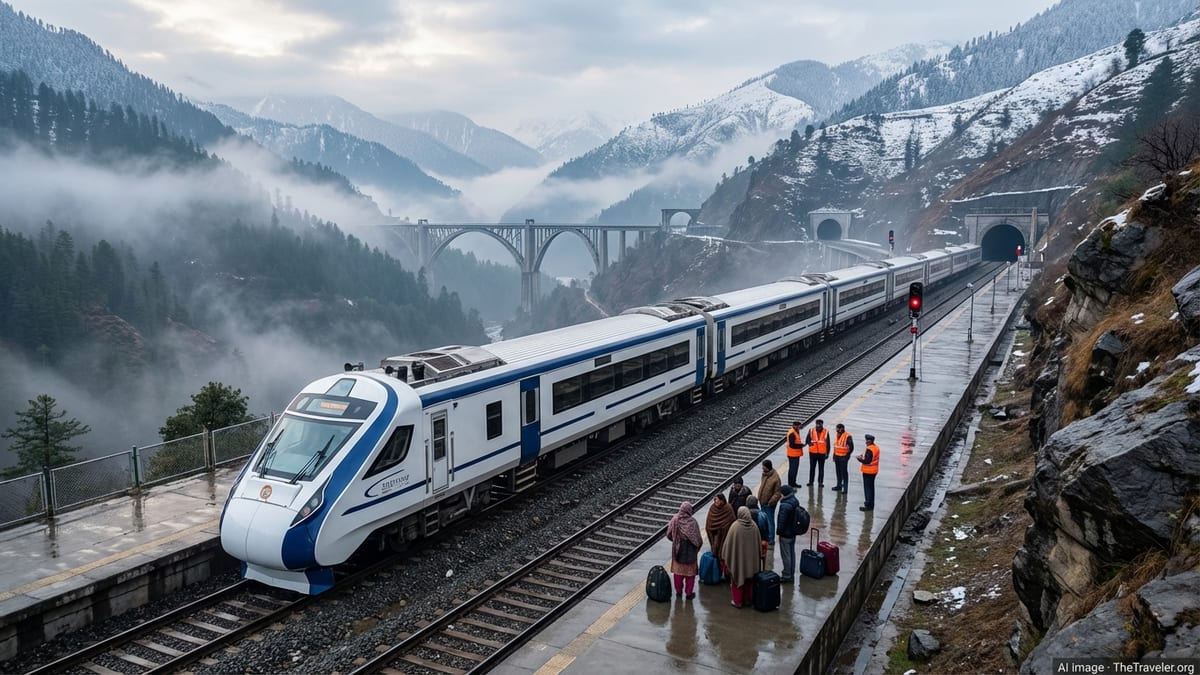
Railway Board’s Late-Night Reversal Stuns Passengers
The Railway Board ordered the extension of the semi-high-speed Vande Bharat Express from Srinagar to Jammu Tawi to be put on hold late on Tuesday, just hours after Northern Railway publicised the March 1 rollout. The premium service, which currently runs between Srinagar and Katra, was set to be extended to Jammu to create the first direct Vande Bharat connection between the twin capitals of Jammu and Kashmir.
Officials communicated the U-turn through a brief notice citing only “unavoidable circumstances,” without specifying whether the concerns were operational, security-related, or logistical. The lack of detail has fuelled speculation, especially given the strategic importance of the route and the long history of delays attached to Vande Bharat services in the region.
For many residents and regular commuters, the reversal felt particularly abrupt because ticketing preparations and local expectations were already in motion. Travel agents in both Jammu and Srinagar reported a surge in queries as soon as the March 1 date was announced, followed by confusion and cancellations once the postponement surfaced.
Railway officials have stressed that the project itself has not been scrapped, only deferred, and that a revised launch date will be communicated once the Board grants fresh approval. Until then, services will continue to terminate at Katra, requiring passengers to change trains or travel by road to cover the final leg to Jammu.
A Strategic Link in the Himalayan Rail Network
The Srinagar–Jammu Vande Bharat extension is widely regarded as a capstone in the newly completed Udhampur–Srinagar–Baramulla Rail Link, a 272-kilometre engineering undertaking through the Pir Panjal range that has taken more than four decades to finish. The project, made fully operational in mid-2025, stitched together some of the world’s most challenging mountain rail segments, including the towering Chenab arch bridge, the Anji cable-stayed bridge, and India’s longest transportation tunnel.
Once operational, the Vande Bharat service is expected to shrink the journey between Jammu and Srinagar to under five hours, compared with roughly eight hours by road in good weather. For much of the year, the Jammu–Srinagar National Highway is vulnerable to landslides, snow, and traffic closures, making a fast, all-weather rail alternative critical for residents, pilgrims, and tourists.
The planned service was to run with a 20-coach rake, an upgrade from the eight-coach formation currently serving the Srinagar–Katra section. This capacity boost is designed to handle peak-season flows of pilgrims bound for the Vaishno Devi shrine and holidaymakers heading to Kashmir’s ski slopes and summer resorts, while also improving connectivity for students, traders, and government employees shuttling between the two capitals.
For New Delhi, the Vande Bharat extension is not just a transport upgrade but a symbolic demonstration of seamless, high-speed connectivity from the national capital deep into the Himalayan valley. With the Jammu Tawi link in place, planners envision through services that would eventually allow passengers to travel from Delhi to Srinagar on a single premium train.
Unanswered Questions Over the Reasons for Delay
Officially, railway authorities continue to describe the postponement only as a consequence of “unavoidable circumstances,” a phrase that has been used in the past to cover a range of issues from incomplete safety clearances to last-minute schedule conflicts for high-profile inaugurations. This time, the opacity is more striking given that critical yard-remodelling and platform works at Jammu Tawi had already been completed for Vande Bharat operations.
Operational experts suggest that final safety audits, signalling integration, or rolling stock allocation for the longer 20-coach formation could still be pending. Others point to the unique mix of steep gradients, tunnels, and high bridges on the Jammu–Srinagar alignment, which demand rigorous testing of braking systems, evacuation protocols, and rescue plans before ramping up to full-capacity premium operations.
Security analysts in the region have also hinted that intelligence-based risk assessments may have factored into the timing decision. A high-profile inaugural service on brand-new Himalayan infrastructure is widely seen as a symbolic target, and officials may prefer to quietly stabilise regular services before staging any public ceremonies or media-heavy launches.
Without an official explanation, however, passengers are left to interpret the delay through the lens of previous postponements of Vande Bharat plans in the Kashmir corridor, some of which were linked to adverse weather forecasts and others to shifting political calendars. The latest deferment risks reinforcing perceptions that even completed projects in the valley remain subject to last-minute strategic recalibration.
Economic and Tourism Hopes Put on Hold
The postponement carries immediate implications for the region’s tourism and hospitality sectors, which had begun planning around the promised March 1 start date. Hoteliers in Srinagar and Gulmarg say the prospect of a reliable, under-five-hour train link from Jammu had encouraged them to target more weekend and short-break travellers from the plains, especially during shoulder seasons when road conditions are unpredictable.
Trade bodies in Jammu had similarly hoped that the faster connection would lower logistics costs for horticulture, handicrafts, and small manufacturing units supplying both local and outside markets. A morning departure from Jammu and afternoon return from Srinagar would have allowed same-day business trips that are currently impractical by road, particularly in winter.
Local residents, meanwhile, are balancing disappointment with a measure of pragmatism. Many say they would rather endure a short-term delay than ride a service launched before every safety and security box is ticked. The memory of frequent highway closures and landslide-related accidents has made the promise of a safe, dependable rail spine more important than an early inauguration date.
Still, the lack of a tentative new timeline complicates planning for the upcoming tourist season and for pilgrims expected to travel in large numbers during major festivals and the annual Amarnath Yatra. Stakeholders are now pressing railway officials not just for a fresh date, but for clearer communication about the milestones that must be met before the train can finally roll into Jammu Tawi.
A Pattern of High-Stakes Delays in the Valley
The latest deferment fits into a broader pattern of stop-start progress around high-visibility transport projects in Jammu and Kashmir. Earlier planned launches of the Katra–Srinagar Vande Bharat service were pushed back multiple times in 2025, with weather advisories and changes to top-level visit schedules cited informally as reasons. Even after the full Himalayan rail link became operational, officials adopted a phased approach to premium services.
This cautious sequencing reflects both the engineering complexity of the corridor and the political symbolism attached to making Kashmir accessible by fast, comfortable rail from the rest of India. Each new train, and particularly a flagship brand like Vande Bharat, carries stakes that extend well beyond passenger numbers, touching on questions of integration, security, and regional development.
Transport planners argue that the current pause could be used productively to fine-tune timetables, crew deployment, maintenance cycles, and passenger facilities at intermediate stations, so that the eventual launch delivers a smooth, reliable experience from day one. They also note that integrating a 20-coach premium service into an already busy northern rail grid requires careful calibration to avoid knock-on delays elsewhere.
For now, what is clear is that the Srinagar–Jammu Vande Bharat Express remains central to the vision of a modern, resilient Himalayan rail corridor. The strategic delay underscores how tightly safety, security, and symbolism are intertwined on this route, even as passengers on the ground wait for a straightforward piece of news: the day the train’s first service finally appears on the departure board.