

More news on this day
A fast-moving late-winter storm system sweeping across the central United States has triggered major disruption at John Glenn Columbus International Airport and Salt Lake City International Airport, where more than 70 flights have been cancelled and thousands of passengers are facing extensive delays, missed connections and overnight stays in crowded terminals.
Get the latest news straight to your inbox!
Weather System Hits Two Key Interior Hubs
Publicly available flight-tracking data on March 17 indicates that John Glenn Columbus International Airport in Ohio and Salt Lake City International Airport in Utah have emerged as two of the hardest-hit facilities as a sprawling storm complex disrupts air travel across multiple states. The cancellations are concentrated in the morning and early afternoon, when low clouds, strong winds and mixed precipitation combined to reduce visibility and complicate airport operations.
The weather-related problems are unfolding as a large extratropical system, currently affecting much of the central United States, delivers blizzard conditions to parts of the Upper Midwest, heavier snow to the Rockies and a band of rain, sleet and gusty winds farther south. Forecast discussions highlight rapidly shifting wind directions and occasional low ceilings as key issues for aviation, particularly for airports situated along the storm’s eastern and southwestern flanks.
At both Columbus and Salt Lake City, operational updates show that the majority of cancellations are tied to specific banks of departures and arrivals rather than a complete shutdown of operations. Some flights are still operating or being delayed instead of cancelled, suggesting that airfield conditions remain technically usable but are subject to tight safety margins and fast-changing weather conditions.
The disruption is being magnified by the role both airports play as connecting points for itineraries across the country. Columbus, which has recently reported strong year-over-year passenger growth, and Salt Lake City, a major western hub, are each seeing ripple effects from cancellations at other airports also impacted by the same storm system.
More Than 70 Flights Scrubbed as Cancellations Mount
Based on mid-day tallies from aviation data dashboards, over 70 combined arrivals and departures at John Glenn Columbus and Salt Lake City have been cancelled today, with additional flights posting significant delays. At Columbus, cancellations are spread across multiple carriers, with some airlines consolidating frequencies on key routes to large hubs in order to move as many passengers as possible once conditions improve.
Salt Lake City is experiencing a similar pattern, with early-arriving flights from the West and Mountain states cancelled or delayed, followed by secondary cancellations on outbound legs that depend on those inbound aircraft and crews. In several instances, aircraft that did reach Salt Lake City earlier in the morning are being held for later flights, an approach that allows airlines to preserve at least some connectivity once the worst of the weather passes.
While the total number of cancellations at each airport remains fluid through the afternoon, the operational picture points to a classic cascading effect. When one or two critical flights are scrubbed or heavily delayed, follow-on rotations for those aircraft and flight crews are affected in multiple cities, adding to the disruption even where local weather conditions appear relatively manageable.
Industry data on delay causes consistently shows that adverse weather is one of the leading drivers of major air travel disruption in the United States each year. The current storm is reinforcing that pattern, with cancellations at Columbus and Salt Lake City contributing to a broader national spike in grounded flights across the Midwest, Rockies and Great Lakes regions.
Thousands of Travelers Stranded in Terminal Gridlock
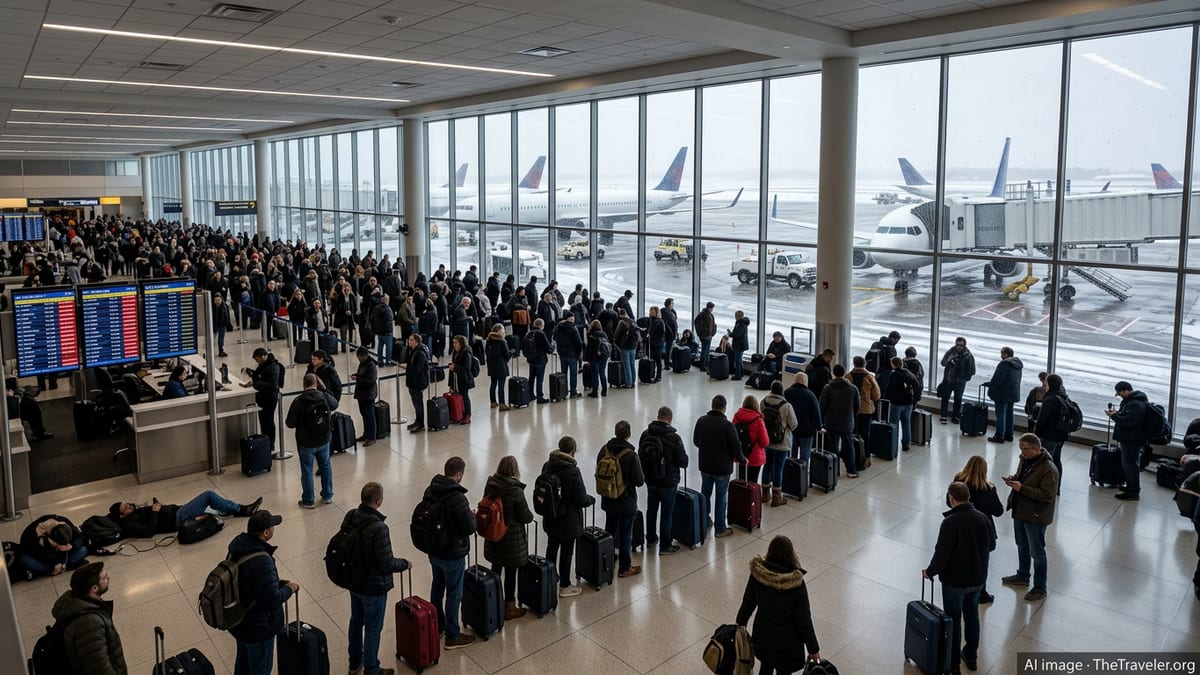
Scenes shared across social media platforms show packed concourses, long customer-service lines and families camped out on the floor near charging stations at both airports, as travelers attempt to rebook flights or piece together alternative routes. Many passengers are reporting missed connections to international flights or onward domestic legs, particularly through major coastal hubs that are already experiencing tight capacity due to the same weather pattern.
According to publicly available airline information, carriers are offering a mix of options, including complimentary rebooking onto later flights, waivers for change fees within defined travel windows and, in some cases, the ability to reroute through different hubs where capacity still exists. However, with the storm coinciding with a busy late-winter and early spring travel period, open seats are limited on many routes, increasing the likelihood that stranded travelers will remain on the ground overnight.
Airport operations pages and terminal advisories are encouraging passengers to check their flight status frequently and arrive early, noting that security checkpoints and baggage claim areas may be busier than usual as flights bunch together during short weather windows. Travelers are also being urged to use mobile apps and websites to make itinerary changes where possible, as in-person lines can stretch for hours when multiple banks of flights are cancelled simultaneously.
The disruption is underscoring the ongoing vulnerability of hub-and-spoke airline networks to strong storm systems. When a single weather event sweeps across a wide geographic swath, as is happening this week, it becomes more difficult for carriers to reposition aircraft and crews quickly enough to keep schedules intact, especially at interior hubs like Columbus and Salt Lake City that link multiple regions of the country.
Airlines Deploy Waivers and Recovery Schedules
In response to the cancellations and growing passenger backlog, several major carriers have issued or expanded weather-related travel waivers covering cities in the Midwest, Rockies and Great Lakes. Publicly posted advisories outline flexible rebooking policies for affected travelers, typically allowing changes to later dates without additional fees, provided the new flights fall within specific timeframes and use the same origin and destination.
Operational statements and scheduling data indicate that airlines are also adjusting aircraft utilization, prioritizing the deployment of larger jets on trunk routes into and out of Columbus and Salt Lake City once runway conditions and winds allow more stable operations. This strategy aims to move larger numbers of stranded passengers per flight, though it can lead to temporary gaps in service to smaller regional destinations.
At the same time, airlines are balancing the need for rapid recovery with regulatory limits on flight-crew duty times and mandatory rest periods. Delays related to crew availability are appearing in some of today’s status boards, reflecting the cumulative effect of several days of weather-driven disruptions across the broader network.
Industry analysts note that large-scale events like the current storm can take several days to unwind fully, even after skies clear. Passengers traveling through Columbus and Salt Lake City over the next 24 to 48 hours are being advised, in public-facing guidance, to prepare for ongoing schedule adjustments, including rolling delays and isolated cancellations as airlines work to restore normal operations.
What Travelers Can Expect in the Coming Days
Forecasts indicate that the core of the storm will gradually shift away from the central United States late today and into Wednesday, reducing the direct weather impacts on both airports. However, the backlog of displaced passengers and aircraft is likely to linger, especially for peak-time departures and arrivals.
Travel planning resources suggest that passengers with nonessential trips may wish to consider voluntary rebooking to later in the week, when operations are expected to be more stable and seat availability may improve. Those who must travel in the near term are being encouraged in public advisories to monitor their flights closely, keep contact information updated with airlines and allow extra time at the airport for security screening and customer-service interactions.
Airfield and airline operations teams at Columbus and Salt Lake City are expected to focus on clearing any remaining de-icing backlogs, repositioning aircraft and restoring typical departure banks as quickly as conditions and crew availability permit. While many travelers may ultimately reach their destinations only a few hours behind schedule, thousands more are likely to face overnight stays or multi-stop routings as the system-wide disruption continues to ripple outward.
For now, the wave of cancellations at John Glenn Columbus and Salt Lake City highlights how swiftly an already busy air travel system can tip into gridlock when a powerful weather system aligns with key connecting hubs, leaving passengers across the country waiting for skies and schedules to clear.