

More news on this day
A powerful late February winter storm has thrown operations at Barnstable Municipal Airport in Hyannis, Massachusetts into disarray, with at least 13 flights canceled, the airport temporarily closed, and passengers bound for Nantucket, Martha’s Vineyard, Boston and beyond left scrambling for scarce alternatives across Cape Cod and the islands.
Storm Shuts Cape Cod Gateway as Flight Cancellations Mount
The disruption hit Barnstable Municipal Airport, also known as Cape Cod Gateway Airport, on February 26 after days of severe weather across the Northeast. Federal aviation notices showed the airfield closed for much of Thursday as operators worked to keep runways safe and clear following the historic Blizzard of 2026 that hammered New England and crippled transport corridors along the East Coast.
For a relatively small regional facility, logging 13 cancellations in a short window effectively wiped out much of the day’s schedule. Regular shuttle links that tie Hyannis to Boston Logan, Nantucket Memorial and Martha’s Vineyard Airport were particularly affected, creating a knock-on effect throughout the local air network as aircraft and crews were left out of position.
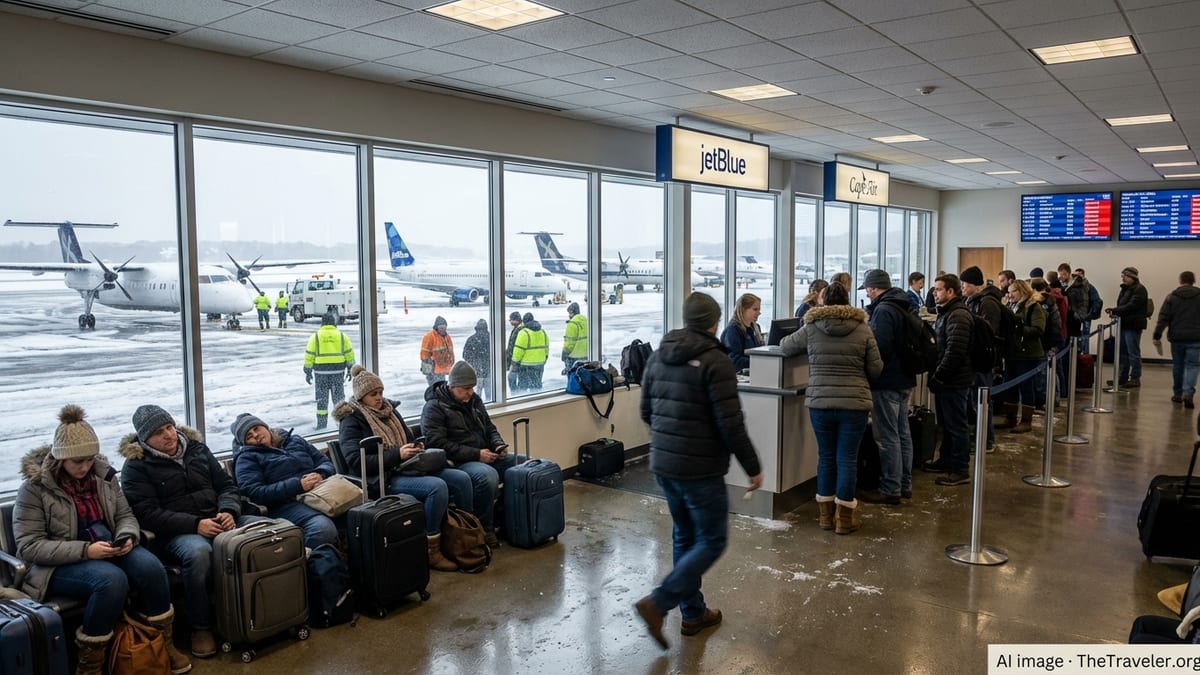
Inside the compact terminal, digital boards showed long stretches of red as Cape Air, JetBlue and other operators scrubbed departures and arrivals. Lounge seating quickly filled with stranded travelers, some camping out with luggage carts and winter coats as they weighed whether to wait for rebooked flights or attempt an overland escape off the Cape on still-slick highways.
Airport staff spent the morning redirecting confused passengers, making loudspeaker announcements about cancellations and urging customers to work directly with airlines for new itineraries. Ground teams also focused on keeping essential services running amid fluctuating power and intermittent communication issues caused by the broader regional storm.
Passengers Stranded Between Hyannis, Nantucket and Martha’s Vineyard
The cancellations rippled quickly across island routes that depend heavily on Hyannis as a lifeline connection. Early-morning and midday flights between Barnstable and Nantucket or Martha’s Vineyard were among those grounded, leaving residents, commuters and winter visitors suddenly stuck on one side of Nantucket Sound or the other.
Families returning from school vacation on the islands described arriving at check-in only to learn that their flights had been canceled with no firm estimate for when operations would resume. Some were handed lists of regional hotels, while others were advised to consider ferries when marine conditions allowed or to rebook through Boston once Logan’s schedule stabilized.
On the mainland, travelers who had expected a quick hop from Hyannis to Boston to catch onward connections found their broader plans collapsing. Several passengers faced the prospect of missing international departures out of Logan, while business travelers reported lost meetings and additional accommodation bills as they searched for any remaining seats out of New England later in the week.
At Nantucket Memorial and Martha’s Vineyard, terminal agents fielded lines of customers seeking same-day solutions. With ferry services also adjusting sailings around high winds and residual rough seas, many visitors found themselves in a holding pattern, monitoring updates from both air and sea carriers while watching the storm’s lingering bands move offshore.
JetBlue, Cape Air and Regional Carriers Scramble to Recover
The storm’s timing compounded existing pressures on the Northeast network, with JetBlue and Cape Air among the hardest-hit brands serving the Cape and islands corridor. JetBlue had already canceled a large share of its schedule earlier in the week as the blizzard peaked, focusing recovery efforts on major hubs including Boston and New York before feeding aircraft back into shorter regional segments.
Cape Air, which operates a dense schedule of turboprop flights linking Hyannis with Nantucket, Martha’s Vineyard and Boston, saw much of its Thursday portfolio disrupted as aircraft were parked on weather holds or temporarily repositioned. The regional carrier issued travel alerts offering fee-free changes for affected customers and encouraged passengers to confirm flight status before heading to any airport in the Cape and islands system.
Customer service lines for both airlines reported prolonged hold times as stranded travelers sought rebooking options, same-day standby lists or refunds. Agents prioritized passengers with critical onward connections and those who had already experienced multiple cancellations, but limited seat availability across the region meant that many travelers were rebooked one or even two days out.
Operationally, airlines balanced the push to restart service with mandatory safety protocols. Crews and aircraft needing to remain within regulated work and maintenance limits constrained how quickly schedules could be rebuilt once Barnstable reopened, leaving gaps in the timetable even after skies over Cape Cod began to clear.
Broader Northeast Meltdown and Boston Logan Gridlock
The troubles at Barnstable unfolded against a backdrop of widespread flight disruptions across the Northeast as the February 2026 blizzard, informally dubbed Winter Storm Hernando, shuttered or severely curtailed operations at major airports from Washington to Boston. In recent days, thousands of flights were canceled or delayed, with Boston Logan International among the hardest-hit hubs.
That congestion at Logan reverberated through the Cape’s air links. Multiple Cape Air flights between Hyannis, Nantucket, Martha’s Vineyard and Boston were canceled or delayed as Logan struggled to clear snow, de-ice aircraft and work through a backlog of previously stranded passengers. Regional commuter runs that usually serve as quick connections for Cape residents suddenly became some of the most difficult seats to secure in New England.
Travel agents across Massachusetts reported clients abandoning air travel altogether in favor of car rentals and intercity buses once roads reopened. Yet even those options were constrained by lingering coastal flooding, snow-clogged secondary routes and continued travel advisories in parts of the state.
Rail services in the wider region also saw delays and cancellations, limiting alternatives for those hoping to bypass airport gridlock. The combined effect was a patchwork recovery in which some corridors snapped back quickly while others, including Cape Cod’s thinly resourced air links, continued to feel the storm’s impact days after the heaviest snowfall ended.
Tourism, Local Economy and the Road to Normal Operations
The timing of the disruption dealt a particular blow to Cape Cod’s tourism and service economy, which relies on reliable air links even in the off-season. February is a quieter month than summer, but a growing number of second-home owners, remote workers and off-season visitors depend on quick flights to and from the islands and Boston. Hoteliers in Hyannis, Nantucket and Martha’s Vineyard reported a wave of unplanned overnight stays from passengers stuck mid-journey.
Local businesses near Barnstable Municipal Airport saw a short-term bump as stranded travelers sought meals, phone chargers and warm clothing, but many proprietors expressed concern that repeated winter disruptions could deter visitors from planning shoulder-season trips to the Cape and islands. Tourism officials stressed that the storm was exceptional in its scale, calling it a rare but vivid reminder of the region’s exposure to harsh coastal weather.
Airport management and airline partners are now focused on restoring a full schedule, clearing backlogs and reviewing how communication and contingency plans performed during the crisis. Early indications suggest that digital tools such as mobile apps, text alerts and flight-tracking platforms proved crucial in keeping many travelers informed, even as terminal signage and in-person queues lagged behind rapid operational changes.
As runways at Hyannis dry out and aircraft once again shuttle between Barnstable, Boston, Nantucket and Martha’s Vineyard, the immediate chaos is beginning to ease. Yet for passengers who spent hours in crowded waiting areas or watched carefully laid plans collapse with a single cancellation notice, this week’s turmoil will remain a sharp illustration of how quickly New England weather can upend even the shortest of journeys.