


Landing in Australia for the first time at Sydney Kingsford Smith Airport can feel overwhelming, especially if you have a tight domestic connection. With three separate terminals, mandatory immigration and customs checks, and multiple ways to transfer between buildings, it pays to know the process before your wheels touch down. This guide walks you through each stage of an international to domestic connection at Sydney Airport, with real-world examples, timing tips and clear advice on how to avoid missed flights.
Get the latest updates straight to your inbox!
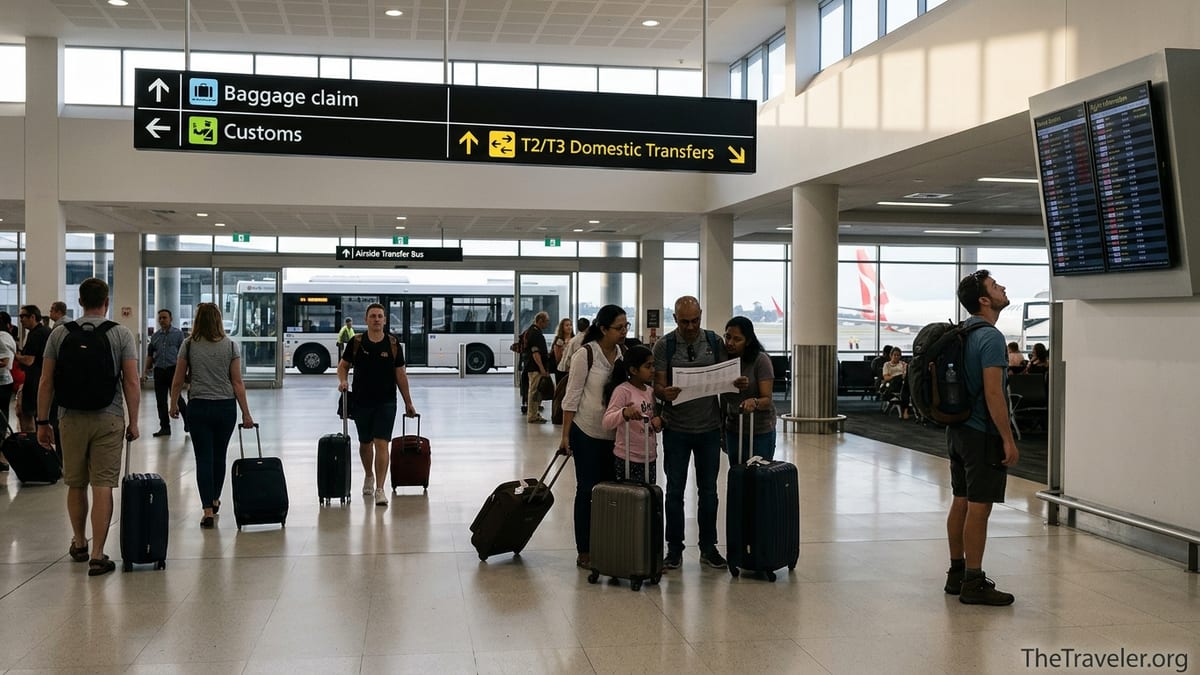
Understanding Sydney Airport’s Terminals and Layout
Sydney Airport has one international terminal and two domestic terminals. T1 handles almost all international flights, from long-haul services like Qantas and American Airlines from Los Angeles to regional links on carriers such as Air New Zealand and Singapore Airlines. T2 and T3 sit together on the other side of the runway and handle domestic flights. Virgin Australia, Jetstar and Rex generally use T2, while Qantas and QantasLink use T3 for domestic services.
For a first-time visitor, the most important point is that T1 is physically separated from T2 and T3 by a runway. You cannot walk between the international and domestic terminals. Even though the distance looks short on the airport map, you must transfer by bus, train, taxi, rideshare or a dedicated airline transfer service.
Most international arrivals connecting on to Qantas domestic will travel from T1 to T3, for example from a Qantas flight from Singapore to a Qantas flight to Melbourne. Many Virgin Australia connections will go from T1 to T2, such as arriving on Singapore Airlines or Qatar Airways and connecting to a Virgin Australia flight to Brisbane. Understanding which domestic terminal you are heading for will make following the signs and choosing transport much easier.
Because of this split layout, Sydney Airport is less forgiving of very tight connections than some hub airports with all terminals under one roof. If everything runs smoothly, you can move between terminals in under 30 minutes. If queues are long or your inbound flight is delayed, the separation between T1 and T2/T3 can quickly eat into your margin for error.
Step-by-Step: From Landing to Clearing Immigration, Baggage and Customs
When your international flight lands at T1, you will disembark into the arrivals level and follow the clearly marked signs to Immigration. Australia requires all arriving international passengers to pass through passport control, even if you are simply connecting onward the same day. You will either use the SmartGate system with your ePassport, where available, or queue for a staffed immigration counter. At busy times such as early morning bank arrivals from Asia and overnight flights from North America, it can take 20 to 40 minutes to clear this stage.
After immigration, you proceed into the baggage reclaim hall. Even if your luggage is tagged to your final domestic destination, Australian regulations normally require you to collect your checked bags on first arrival in the country. For example, if you fly London to Sydney to Cairns on one Qantas ticket, you must still pick up your bag at T1 Sydney, walk it through customs, and then either drop it at a transfer counter or check in again at the domestic terminal.
Once you have your bags, you head toward the exit, walking through the customs and biosecurity area. Australia has strict rules on food, plant material and animal products. First-time visitors are often surprised by the thoroughness of screening, including x-ray of all bags and occasional manual inspection. If you have declared items such as wooden souvenirs or packaged snacks, allow extra time here. On a typical mid-morning arrival without a bag search, you might be out of customs in 10 to 20 minutes. If your bags are selected for inspection, the process can stretch to 30 minutes or more.
Only after you clear customs do you officially enter Australia and reach the public arrivals hall at T1. From here, you can either head directly to a transfer counter if your airline offers one, or follow the signs to buses, trains, taxis and rideshares to reach T2 or T3. If you are on separate tickets with different airlines, this is the point where your risk increases because you are now responsible for making the onward flight on time.
Moving from T1 to T2/T3: Bus, Train, Taxi and Airline Transfers
Once you exit into the T1 arrivals hall, look for the signs marked “Transfers” and “T2/T3 Domestic.” Sydney Airport operates a complimentary Terminal Transfer Bus that runs between the international terminal and the domestic precinct. The airport advertises departures roughly every 15 minutes between early morning and late evening, typically from around 5:30 to approximately 22:30. In practice, during daytime hours you can expect to wait 5 to 15 minutes for the next bus, with the journey itself taking about 10 minutes depending on airside and road traffic.
The Terminal Transfer Bus is a convenient option for many passengers who have already cleared customs and simply need to change buildings. For example, a family arriving from Bangkok on Sydney-bound Thai Airways and connecting to a Jetstar flight to Hobart could take the free bus from outside T1 to the T2/T3 precinct, then walk into T2 for their domestic check-in. The bus drops you close to both domestic terminals, and the walk from the drop-off point into either T2 or T3 is usually less than five minutes.
Another popular option is the Airport Link train. Both T1 and T2/T3 have their own underground stations on the T8 Airport & South Line. The train journey between the two stations takes only a couple of minutes. At the time of writing, Sydney Airport promotes a special single transfer ticket costing around 7 Australian dollars per person for passengers travelling just between the terminals by train. This can be appealing if you are comfortable navigating public transport and want a predictable travel time even during heavy road traffic.
For travelers with large amounts of luggage, mobility challenges, or travelling outside the transfer bus operating hours, a taxi or rideshare can offer a door-to-door solution. In light traffic, the drive between T1 and T2/T3 might take less than 10 minutes, but during peak periods such as weekday mornings, you should allow 15 to 25 minutes to account for queues at the pick-up zones and congestion around the domestic drop-off areas. A typical taxi or rideshare fare between terminals is modest compared with a city transfer, but is still more expensive than the free shuttle or train transfer ticket, especially for solo travelers.
Airline-Managed Connections: Qantas, Virgin Australia and Partners
If your entire journey is booked on a single ticket with a major carrier, your transfer at Sydney Airport is usually smoother. Qantas, for instance, offers managed connections between T1 and T3, as well as between T1 and partner flights operated by Jetstar or other oneworld airlines. On many itineraries, your boarding passes for both the international and domestic sectors are issued at your original departure airport, and your luggage is tagged through to the final domestic city even though you still physically collect it at Sydney for customs inspection.
For Qantas international arrivals connecting to Qantas domestic, you often have access to a dedicated transfer channel at T1. After customs, you follow signs for “Domestic Transfers” and locate the Qantas transfer desk. Here, you can recheck your bag for the domestic flight without going to the main domestic check-in area. In some cases, especially when connecting to T3, Qantas uses its own transfer buses that operate on secured routes. This can save time compared with using public transport, and your bags are handled behind the scenes once you drop them at the transfer counter.
Virgin Australia and its partners also support through-checked connections, though the process can involve using the public-side transfer bus or train between T1 and T2. For example, if you arrive on Qatar Airways into T1 and continue on a Virgin Australia flight to the Gold Coast, your bags may be tagged to your final destination. You still collect them at Sydney for customs, but after clearing biosecurity you might be able to hand them back at a transfer counter in T1 rather than queuing again at the main Virgin Australia check-in in T2. Airline staff in the arrivals hall can direct you to the correct counter for your specific ticket.
The key benefit of having all flights on one ticket with the same airline group is protection on missed connections. If your inbound international flight is delayed and you miss your Qantas or Virgin domestic leg, the airline generally assumes responsibility for rebooking you on the next available service. This might mean a later flight that same day, a reroute via another city, or in rare cases an overnight hotel if the disruption is severe and no same-day connection is possible.
Self-Connecting on Separate Tickets: Extra Risks and How to Manage Them
More and more travelers piece together their own itineraries using separate tickets to save money or use frequent flyer points. For instance, you might arrive in Sydney on a low-cost carrier from Asia and then have a separate domestic booking on Jetstar or Rex. In this case, the airlines consider each ticket a separate contract. If your international flight is late and you miss the domestic one, you are normally treated as a no-show and may have to buy a new ticket at last-minute prices.
The main risk with self-connecting at Sydney Airport lies in the multiple steps required between T1 and T2/T3. You must clear immigration, collect your bags, pass customs and biosecurity, transfer to the domestic precinct, check in again, and clear security and reach the gate at the second terminal. Any delay at any step can cause the whole connection to unravel. Real-world accounts from travelers at Sydney suggest that a transfer can be easy in 90 minutes on a quiet day, but the same process can take more than two hours when immigration and security lines are long or if baggage delivery is slow.
If you are planning to self-connect, it is wise to build a generous buffer. For a daytime arrival, many experienced travelers aim for at least three hours between scheduled arrival at T1 and domestic departure from T2 or T3 when on separate tickets, and often four hours if travelling with children, carrying lots of luggage, or arriving in the early morning peak. That extra time allows for scenarios such as a 45-minute delay to your inbound flight, 30 minutes waiting at the carousel for bags, and another 30 minutes spent transferring and checking in again.
Consider also the onward consequences if you miss your domestic flight. If your domestic leg is feeding a separate international departure from another Australian city, such as Sydney to Melbourne to catch a long-haul flight to Europe, the domino effect of a missed connection can be expensive. In such cases, it is usually safer to fly into Sydney the day before and overnight near the airport or in the city rather than relying on a same-day self-connection through T1.
How Much Time Do You Really Need?
Officially, airlines that sell through-tickets in and out of Sydney use minimum connection times that are often around 90 minutes for international to domestic transfers. That means that if you are on one ticket and the airline offers you a 1 hour 30 minute connection, it is technically considered valid, and in normal conditions many passengers do make those flights successfully. Qantas, for example, routinely sells itineraries from North America to regional Australian cities with a 1.5 to 2 hour window at Sydney, and most days those connections work.
However, minimum connection times are not the same as comfortable or low-stress connection times. For first-time arrivals unfamiliar with Australian immigration forms, biosecurity rules and the Sydney terminal layout, something closer to two hours or more is advisable even on a single ticket. A traveler arriving from Vancouver on an overnight flight might need 20 minutes to disembark and walk to immigration, another 20 minutes to clear passport control, 20 to 30 minutes to wait for bags and exit customs, and 20 minutes to use the transfer bus and security screening at the domestic terminal. On a good day, that totals about 80 to 90 minutes, but any modest delay can push you to the edge.
If your connection involves separate tickets, most seasoned flyers treat three hours as an absolute minimum at Sydney, and four hours as a more practical target. This is particularly important during peak arrival waves, such as early mornings when flights from Asia, the Middle East and North America tend to land close together. Queues at SmartGate, immigration counters and customs inspection points are typically longest at those times. In the evening, after 19:00, flows can be smoother, but the number of later domestic departures is also smaller, so a missed connection can have more serious consequences.
It is also worth thinking about your own travel style. Confident solo travelers who can walk briskly, use eGates and carry light luggage may be comfortable aiming closer to the minimum connection time, especially on a through-ticket. Families with young children, anyone requiring assistance, or travelers carrying lots of duty-free shopping will benefit from a wider margin.
What Happens If You Miss Your Connection?
If all your flights are booked under one ticket and operated by the same airline group or alliance, a missed connection due to factors outside your control is usually handled by the airline. For example, if your Qantas flight from Tokyo arrives late and you miss your Qantas connection from Sydney to Adelaide, Qantas will normally rebook you on the next available service at no additional cost. If that means a long wait, staff might also provide meal vouchers. In a severe disruption, such as widespread weather delays where no same-day option exists, they may arrange hotel accommodation, though this depends on the circumstances and fare conditions.
The situation is quite different if you are travelling on separate tickets. Suppose you fly into Sydney on an ultra-low-cost carrier from Southeast Asia and have a separate Jetstar ticket to Perth, with a two-hour window between flights. If your first flight is 90 minutes late and you arrive at T1 only 30 minutes before your Jetstar departure from T2, you will almost certainly miss check-in and be classed as a no-show. In that scenario, Jetstar is under no obligation to rebook you for free, and on busy routes the next flight with seats may be much later or even sold out. You might end up buying a walk-up fare at several hundred dollars more than your original ticket.
Travel insurance can offer some protection for missed connections, but policies vary. Many insurers require you to allow a minimum connection time and to prove that the delay was beyond your control, such as a mechanical issue or weather disruption. Keeping boarding passes and any written confirmation of delays from the airline can support a later claim. However, insurance is generally a reimbursement mechanism rather than an automatic solution on the day, so you should still build your schedule to be resilient without needing to rely on a claim.
Regardless of ticket type, communication is crucial when things go wrong. As soon as it appears that you may miss your domestic connection, advise the cabin crew on your inbound flight, particularly if you are connecting on the same airline. Ground staff at Sydney can sometimes expedite transfers for a cluster of late-arriving passengers by fast-tracking them through security or holding a flight briefly, although this is never guaranteed. If you are on separate tickets, you will likely need to approach the check-in desk or customer service of your onward airline in the terminal and ask about standby options or same-day change fees.
The Takeaway
For first-time visitors, Sydney Airport is a busy but manageable gateway, provided you understand its three-terminal layout and allow realistic time to navigate immigration, customs and the transfer between T1 and T2/T3. Almost all international arrivals land at T1; practically all domestic flights depart from either T2 or T3, and you cannot walk between the international and domestic precincts. Factor in the mandatory baggage reclaim and biosecurity inspection on first entry to Australia, and it becomes clear why tight connections can quickly become stressful.
Using airline-managed connections with Qantas, Virgin Australia and their partners greatly reduces the risk of being stranded, as these carriers typically take responsibility for rebooking you when disruption occurs. Self-connecting on separate tickets can be done, and many travelers take advantage of it, but it demands generous buffers of three to four hours and a willingness to absorb costs if things go wrong. Whether you choose the free terminal transfer bus, the quick Airport Link train, or a taxi or rideshare, planning your route in advance and knowing which terminal you are heading to makes the transfer smoother.
Ultimately, the best strategy is to balance cost and convenience with a realistic assessment of your own tolerance for risk and stress. If you are arriving after a long-haul flight and connecting to a domestic sector that is important for a tour, cruise or separate international departure, give yourself more time, not less. A relaxed coffee in the domestic terminal before boarding is far preferable to sprinting through Sydney Airport while watching your connection slip away.
FAQ
Q1. How long do I need to transfer from international to domestic at Sydney Airport?
Most airlines sell 90-minute international to domestic connections on a single ticket, but first-time visitors are usually more comfortable with at least two hours, and three hours or more if travelling on separate tickets.
Q2. Do I have to collect my bags in Sydney if I am connecting to another Australian city?
Yes. On arrival at T1 you must collect all checked baggage, clear customs and biosecurity, and then either recheck your bags at a transfer desk or at the domestic terminal, even if they are tagged to your final domestic destination.
Q3. Can I walk between the international terminal and the domestic terminals at Sydney?
No. T1 and T2/T3 are separated by a runway and there is no pedestrian walkway between them. You must use a transfer bus, train, taxi, rideshare or airline-operated shuttle.
Q4. Is there a free shuttle between T1 and T2/T3?
Sydney Airport operates a complimentary Terminal Transfer Bus between T1 and the T2/T3 domestic precinct, generally every 15 minutes during operating hours from early morning to late evening.
Q5. How much does the train between Sydney’s international and domestic terminals cost?
The Airport Link train connects T1 and T2/T3 in a couple of minutes. A special single transfer ticket between the terminals typically costs around 7 Australian dollars per person.
Q6. What happens if I miss my domestic connection in Sydney on a single ticket?
If your flights are on one ticket with the same airline group, the airline usually rebooks you on the next available service at no extra charge, subject to seat availability and fare conditions.
Q7. What if I miss my domestic flight and I am on separate tickets?
If you self-connect using separate tickets, the onward airline generally has no obligation to assist. You may need to buy a new ticket or pay change fees, and travel insurance may or may not cover the cost.
Q8. Are there transfer desks at T1 for Qantas and Virgin Australia?
Yes. Major airlines typically have transfer counters in or near the T1 arrivals area where eligible passengers on through-tickets can recheck bags and receive guidance on moving to T2 or T3.
Q9. Is 90 minutes enough for a self-connection in Sydney?
For most travelers, 90 minutes is too tight for a self-connection because it leaves little room for delays at immigration, baggage reclaim, customs or security. A minimum of three hours is usually safer.
Q10. Are there hotels near Sydney Airport if I want to overnight before a connection?
Yes. Several hotels cluster around the international and domestic precincts, from business-style properties a short shuttle ride away to more budget-friendly options slightly farther out, which many travelers use to avoid relying on tight same-day connections.