


More news on this day
Rail passengers face cancellations, diversions and extended delays after a series of fires next to railway lines in Europe and North America forced operators to halt or sharply reduce services on key corridors.
Get the latest news straight to your inbox!
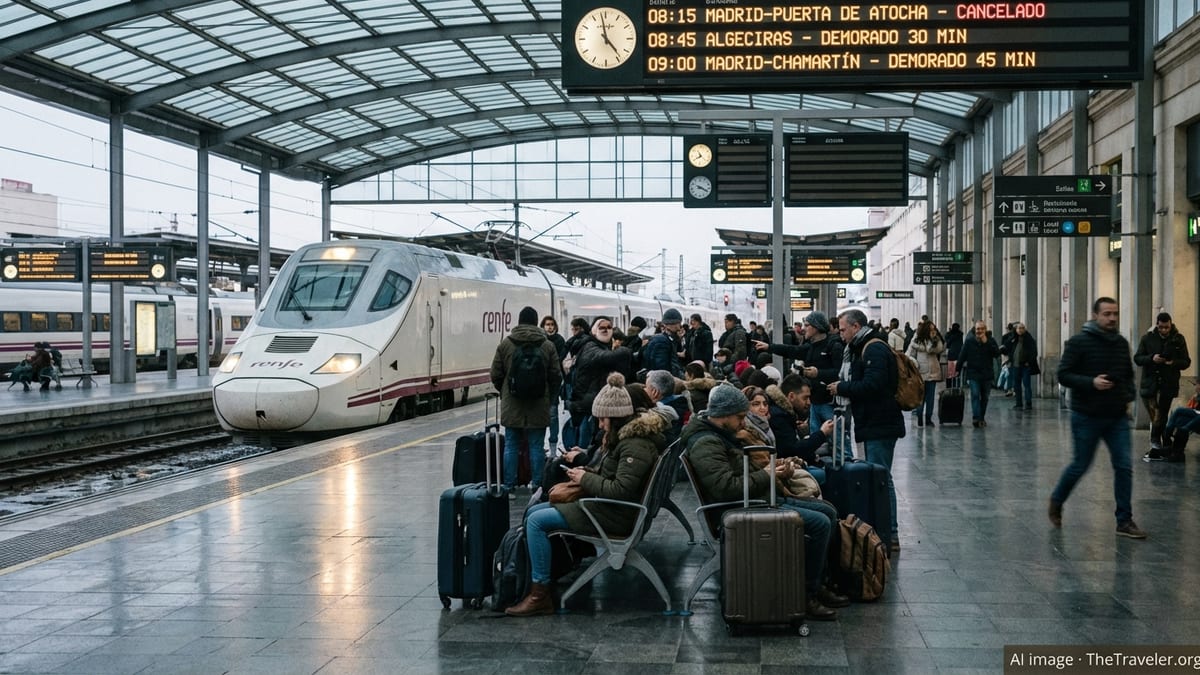
Lines blocked and trains cancelled after track-side fire
On July 14, a fire next to the tracks on Long Island in New York led to a partial suspension of Long Island Rail Road services on the busy Ronkonkoma Branch during the morning peak. Local television coverage described crews tackling a large mulch fire close to the right of way, prompting several rush-hour trains to be held at intermediate stations and others to be cancelled outright while smoke and visibility were assessed.
In the United Kingdom, a separate track-side fire near Kemble in Gloucestershire on July 12 left the main line towards Swindon temporarily blocked. National passenger information channels reported that trains between Gloucester and Swindon were cancelled, revised or diverted while the incident was managed and damage inspected along the affected stretch.
Further south, disruption continued into July 13 around East Croydon, a key junction on routes into London, following what rail alerts described as a fire next to the track in the area. Trains were subject to cancellations and extended journey times as services were rerouted and timetables thinned out to accommodate reduced capacity through the corridor.
These incidents underline the vulnerability of busy rail networks when even relatively contained fires occur close to signalling equipment, cabling or other critical track-side infrastructure, forcing operators to suspend services until inspections are complete.
Ongoing speed restrictions and damage to signalling cables
Although the initial fire near Kemble was brought under control on July 12, follow-up bulletins from Britain’s central rail information service on July 13 indicated that the damage had longer lasting effects. Critical signalling and power cables running alongside the track were reported as having been affected, leading to continuing speed restrictions on the line towards Swindon.
As a result, trains that were able to run between Gloucester and Swindon faced delays of up to 20 minutes, and some services continued to be cancelled or altered. Public information stated that affected passengers could travel on earlier or later trains than originally booked, but journey planners continued to show disruption across the route well into Monday morning.
Speed restrictions of this type are a common follow-on measure after track-side fires, since heat can compromise cable insulation, signal housings and other components that are not easily visible from the cab of a passing train. Until engineers confirm that systems are functioning correctly, operators typically keep train movements slow and spaced out, reducing capacity and increasing the risk of knock-on delays across the wider timetable.
For travelers, that can mean disruption even after the visible signs of an incident have disappeared, with reduced frequencies, shorter formations or short-notice cancellations persisting for several days.
High-speed and international routes also affected
The impact of track-side fires has not been limited to local or commuter services. On July 14, Italy’s infrastructure manager reported that high-speed rail traffic between Orte and Settebagni on the Rome to Florence corridor had been affected by an incident near the tracks. Services on one of the country’s busiest long-distance routes experienced delays, diversions and cancellations while the area was secured and the line gradually reopened.
In France over the weekend of July 12, television news coverage described significant disruption to south eastern high-speed services after a separate line-side fire forced trains to divert onto classic tracks. The detours added hours to journey times between Paris and major cities to the south and east, with some trains cancelled outright and others arriving several hours late.
Elsewhere in Europe, Greek media reported that suburban and regional services on the Thessaloniki to Litochoro corridor in northern Greece were temporarily suspended on July 12 because of a wildfire near the tracks that caused a power outage on the line. Although services later resumed, passengers were warned to expect residual delays as operations were restored in stages.
Together, these events highlight how a single fire close to the track can ripple across national and international networks, affecting not only point-to-point commuters but also long-distance travelers and cross-border passengers relying on tight connections.
Travel advice for affected passengers
Passenger information services across the affected networks have urged travelers to check real-time journey planners on the day of travel, as timetables published in advance may not reflect short-notice cancellations or diversions introduced in response to evolving safety assessments. Operators are advising that tickets for cancelled trains are generally being accepted on earlier or later services, subject to space, and in some cases on alternative routes.
Reports indicate that replacement road transport is limited in several of the affected areas, with priority given to routes that are completely blocked rather than those operating at reduced speed. Travelers may therefore face standing-room-only conditions on some trains that do run, particularly during peak periods.
For international passengers, travel media and operator advisories recommend allowing additional time for connections, especially when changing between high-speed and regional services. Refund and compensation policies vary by country and operator, but publicly available information suggests that passengers whose trains are cancelled outright, or who experience substantial delays, may be eligible to claim under national passenger rights frameworks.
Given the continuing risk of hot, dry weather in parts of Europe and North America, rail passengers planning trips in the coming days are being encouraged to monitor local news and railway information channels closely, particularly when their route passes through areas prone to wildfires or industrial activity near the tracks.
Why track-side fires cause disproportionate disruption
Though many of the fires reported in recent days have been relatively contained in physical extent, their proximity to critical rail infrastructure explains why they lead to widespread service cancellations. Heat and smoke near signal gantries, cable ducts or power supply equipment can cause systems to fail or enter safe modes, automatically stopping trains or forcing them to run at greatly reduced speeds.
Even when flames are confined to vegetation, mulch piles or nearby industrial yards, the response typically involves temporarily closing lines while emergency services and railway engineers assess the scene. Until that process is complete, only limited movements can be authorized, if any, to protect passengers and staff.
Modern rail networks also operate at or near capacity on many main lines, meaning that any reduction in available tracks or speeds translates quickly into backlogs. Delays and cancellations can propagate far beyond the immediate incident area, affecting services hundreds of miles away as rolling stock and crews end up in the wrong place.
For regular travelers, these recent incidents serve as a reminder that even minor-seeming events next to the railway can have significant consequences for journey times. For operators and infrastructure managers, they reinforce the importance of vegetation management, cable protection and robust contingency planning to limit the duration and scope of disruption when track-side fires occur.