


More news on this day
Atypically severe congestion across several major corridors left many Austin drivers at a near standstill on Tuesday morning, as a mix of highway crashes, construction pinch points and temporary flight restrictions around a high-profile visit converged on an already fragile rush-hour network.
Get the latest news straight to your inbox!
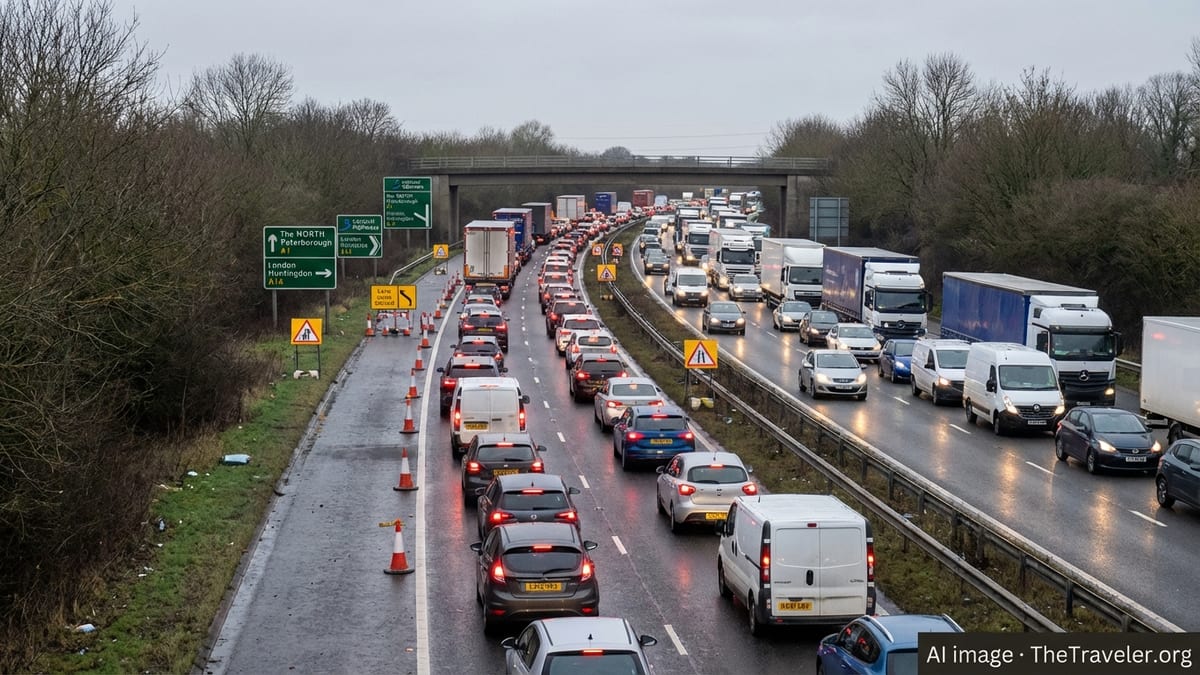
Crashes Snarl Key Commuter Routes
Early reports from local traffic maps, broadcast updates and driver accounts pointed first to a series of crashes on Interstate 35 and MoPac Expressway, two of Austin’s most heavily used commuter arteries. Collisions in or near existing construction zones significantly reduced travel lanes during the height of the morning rush, causing backups that rapidly propagated for miles in both directions.
Publicly available congestion data showed speeds dropping into the single digits on sections of I-35’s upper and lower decks, with some segments briefly registering as stopped traffic. On social channels and community forums, commuters described sitting through multiple light cycles without moving, while navigation apps repeatedly recalculated arrival times upward.
The incidents came on top of a pattern of recent wrecks tied to last-second lane changes and shifting ramp configurations around long-term construction projects. Observers noted that when even a minor crash occurs in these constrained areas, there is often little shoulder space to relocate vehicles, forcing full or partial lane closures that quickly ripple across the network.
Once those early crashes were in place, alternate routes such as surface streets parallel to I-35 and MoPac began absorbing diverted traffic, creating stop-and-go conditions well beyond the original incident locations.
Construction Bottlenecks Leave Little Room for Error
The sudden standstill also highlighted the limited resilience of Austin’s road network during the current wave of expansion and maintenance work. Ongoing projects on I-35, MoPac and key feeder roads have already narrowed lanes, shifted alignments and eliminated shoulders in several sections, creating persistent bottlenecks even on clear days.
Traffic modeling presented in recent city meetings has described how these projects, although intended to improve long-term mobility, temporarily reduce capacity and make the system more vulnerable to disruption when crashes or stalled vehicles occur. With lane closures in place, there are fewer opportunities for drivers to merge around obstacles, increasing the likelihood that a single blockage will slow or halt traffic for thousands of vehicles.
On Tuesday morning, that vulnerability was evident as drivers attempting to bypass highway tie-ups encountered slowdowns on frontage roads and arterials. Intersections along these corridors experienced heavier queuing than usual, with turning movements further complicating efforts to clear backlogs.
Transportation analysts note that this kind of cascading congestion is typical in corridor-wide work zones, where the margin between heavy but flowing traffic and gridlock can be thin. Once volume crosses a certain threshold, recovery from even short-lived incidents can take hours.
Flight Restrictions Add an Unusual Security Twist
Layered onto collisions and construction was an atypical factor for Austin’s commute: a temporary flight restriction centered on Austin-Bergstrom International Airport associated with a high-level federal visit. Aviation notices indicated that the restriction applied Tuesday morning, affecting airspace as Air Force Two arrived in the region.
While the limits were formally tied to aviation, published coverage and local discussion pointed to related ground impacts as security perimeters tightened and motorcade planning unfolded. Access routes serving the airport and nearby highways experienced intermittent slowdowns as drivers encountered heavier law-enforcement presence and short-lived closures or rolling blocks around key movements.
Even modest adjustments to ramp access or signal timing near the airport can have outsize effects during the morning peak, particularly when they coincide with the ongoing construction that is already constraining capacity across southeastern Travis County. Drivers reported longer-than-normal delays on approaches to the terminal and surrounding corridors at roughly the same time that highway incidents elsewhere were unfolding.
The overlap of a national-security-related movement with a fragile rush-hour network reliant on a few main corridors contributed to the sense that traffic had seized up across much of the city at once.
Commuter Frustration Highlights Broader Mobility Strains
The abrupt slowdown on Tuesday morning intensified frustrations that have been building among Austin residents as population growth, construction and changing driving behavior strain a roadway system that has struggled to keep pace. In online discussions, commuters described near-daily experiences with sudden standstills, aggressive lane changes and drivers blocking intersections or remaining in travel lanes after minor collisions.
Many of those accounts frame events like Tuesday’s as less of an anomaly and more as a vivid example of how little slack exists in the system. When crashes, construction and special events coincide, even for a short window, the resulting gridlock can spill into neighborhoods, delay transit buses and complicate emergency-response routes.
City planning documents and academic studies examining Austin’s traffic have long warned that, absent major shifts toward transit, walking and cycling, vehicle miles traveled would continue to climb and congestion would grow more severe. The current round of highway expansions is intended to help manage that pressure, but it also comes with years of transitional pain for daily commuters.
Tuesday’s standstill therefore served as both a practical disruption and a visible reminder of the challenges ahead. As investigations into individual crashes proceed and the temporary security footprint around the airport recedes, transportation advocates are likely to point back to the morning’s gridlock in debates over how the region invests in roads, transit and safety improvements in the years to come.