


More news on this day
From Europe’s freight corridors to New York’s subway yards, a new generation of “go-anywhere” locomotives is gaining ground, blending electric, diesel and battery power to keep trains moving seamlessly across wired and unwired tracks.
Get the latest news straight to your inbox!
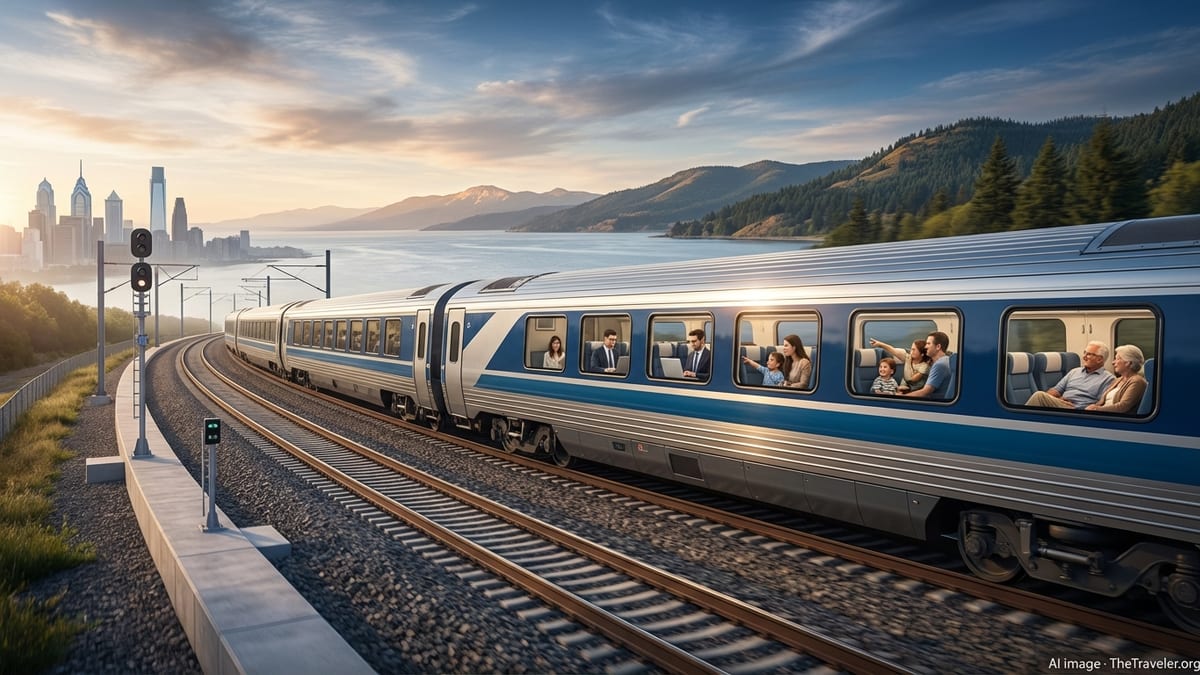
A platform built to cross borders and power systems
Bi-mode mainline locomotives have moved from niche concept to reference product on several key corridors in the past few years. In Europe, Stadler’s EuroDual platform has become emblematic of the trend, combining high-output electric traction with a full-power diesel engine so a single locomotive can haul heavy freight over both electrified and non-electrified lines without a change of motive power.
According to publicly available technical data, EuroDual locomotives can deliver more than 6 MW under overhead wires while still offering several megawatts of diesel power, a step change from earlier dual-mode designs that carried only small “last mile” engines. Reports indicate the type is operating with multiple operators across Germany, France, Spain and the Nordic countries, reflecting demand for a versatile machine that can traverse different signaling systems, gradients and electrification regimes.
Regulatory approvals are extending that reach. In April 2026, media releases and industry coverage reported that a EuroDual variant received authorization for operation across parts of Austria and the western Balkans, reinforcing the concept of a locomotive designed from the outset to cross borders, voltage systems and infrastructure standards. For leasing companies and operators, that flexibility is a core part of the business case.
The same manufacturer is now extending the concept into a new four-axle Euro DuFour design, described in trade-press reporting as a tri-mode machine capable of running on overhead power, diesel engines or batteries. Early orders from a Swiss freight operator underline how go-anywhere traction is evolving from a six-axle heavy-haul niche toward a broader family of multi-purpose locomotives.
Hybrid and bi-mode traction moves into the mainstream
Railway planners and operators increasingly describe go-anywhere locomotives as a practical answer to uneven electrification. While major corridors are wired, extensive branch lines and yards remain diesel territory, especially in North America and parts of southern and eastern Europe. Hybrids and bi-modes are emerging as a way to bridge that gap without waiting for catenary to reach every siding.
In Germany, publicly available information from Siemens Mobility highlights a recent hybrid order for DB Cargo that couples conventional electric capability with onboard diesel power, allowing the same locomotive to haul trains over electrified main lines and continue under its own power on unelectrified routes. Industry analysis notes that such fleets can simplify planning, reduce locomotive changes at borders between power systems and cut idle time in yards.
In Britain, the Class 93 locomotive offers another interpretation of the go-anywhere idea. Technical descriptions published by rail reference sites show that the design combines a high-power 25 kV AC electric mode with a smaller diesel engine and traction battery, enabling freight and potential passenger services to run on wires where available and switch to diesel and battery for branches and terminals. The smaller diesel module is balanced by lighter axle loadings suited to mixed-traffic work.
Rail-sector commentators increasingly group these designs into a wider “multi-mode” family that also includes pure battery locomotives and units prepared for future hydrogen conversions. The unifying feature is the ability to operate across infrastructure that will remain patchwork for years, while still delivering measurable emissions and fuel savings compared with legacy diesel fleets.
North American railroads test go-anywhere concepts
On the other side of the Atlantic, freight railroads in the United States and Canada are cautiously adopting hybrid and dual-mode platforms in a network that remains largely unelectrified. While overhead wires are limited to a handful of passenger corridors, battery and diesel hybridization is opening new options for yard work and specialized mainline applications.
In April 2024, Canadian National announced the purchase of a mainline hybrid diesel-battery locomotive from Progress Rail as part of its decarbonization strategy. Company statements and government reports indicate that the project is intended both to cut fuel consumption and to build experience with batteries that could support future zero-carbon concepts such as hydrogen fuel-cell traction.
In New York, the Metropolitan Transportation Authority has expanded its fleet of battery-diesel locomotives used for engineering and work trains on the subway network. Sector coverage notes that an additional batch of R255 locomotives was ordered in early 2025 after initial units underwent testing, with the dual-power design allowing operation in tunnels and yards where low-emission and low-noise performance is critical, while retaining diesel capability for extended work away from charging points.
Policy documents from the United States Department of Transportation describe hybrid and dual-mode locomotives as one of several near-term levers for reducing rail emissions across a network that will not be electrified at European levels in the foreseeable future. By combining existing diesel infrastructure with battery packs and regenerative braking, railroads can improve fuel efficiency without wholesale replacement of trackside systems.
Beyond diesel and wires: batteries and hydrogen
The go-anywhere locomotive is also becoming a test bed for emerging energy carriers. Hydrogen, in particular, is drawing attention from freight operators that need both long range and rapid refueling. Trials in North America and Europe are exploring how fuel cells and hydrogen tenders can integrate with existing diesel-electrics and hybrid platforms.
Coverage from specialist rail media in early 2024 detailed trial operations of a hydrogen tender wagon partnered with modified locomotives on a major North American freight railway. The tender stores hydrogen and supplies it to onboard fuel-cell systems, expanding range without fundamentally altering the locomotive’s basic architecture. Industry analysts see such demonstrators as a bridge step, gathering operational data while larger regulatory and supply-chain questions are addressed.
At the same time, a growing number of hybrid and multi-mode designs are being engineered with battery modules that can be swapped, expanded or paired with future hydrogen systems. Technical brochures for platforms such as EuroDual and Euro DuFour highlight modular underframe spaces for additional equipment, signaling an expectation that traction energy mixes will evolve during each locomotive’s service life.
Japan and New Zealand are among the countries using hybrid multiple units and shunting locomotives to test these ideas at smaller scale. Publicly accessible material on new Japanese hybrid diesel multiple units and New Zealand’s forthcoming battery-diesel switcher fleet indicates a focus on routes where full overhead electrification is not economically justified, but where operators still seek quieter, cleaner trains for regional and yard duties.
Why go-anywhere traction is gaining commercial traction
The spread of bi-mode, hybrid and tri-mode locomotives reflects a mix of commercial arithmetic and climate policy. For freight and passenger operators, the costs of intermediate locomotive changes, delays at power-system boundaries and underutilized fleets are increasingly out of step with demands for faster, more reliable logistics. A single locomotive that can work under wires, on diesel and in some cases on battery alone promises higher asset utilization and simpler diagrams.
Publicly available emissions inventories underline why governments are encouraging such shifts. Rail remains one of the lowest-carbon modes of land transport per ton-kilometer, yet diesel traction still dominates in many regions. Hybridization allows operators to capture some of the benefits of regeneration and grid electricity without waiting for comprehensive electrification programs that may take decades to finance and complete.
For manufacturers, go-anywhere platforms offer an opportunity to standardize components across diverse markets. Multi-system transformers, modular diesel engines, battery racks and common control software can be configured differently for a European freight pool, a Japanese regional operator or a North American Class I railroad, while retaining shared engineering and maintenance practices.
Analysts point out that multi-mode locomotives are unlikely to replace targeted electrification or, in the long term, fully zero-emission trains. Instead, they are emerging as the transitional traction of choice, giving railways the flexibility to respond to evolving regulation, power prices and technology without being locked into a single source of energy. In that sense, the rise of the go-anywhere locomotive marks an adaptation strategy as much as a technological leap.