

More news on this day
Indonesia’s TransNusa is rapidly scaling up flights between Singapore, Jakarta and Bali at the same time hotel bookings across key Indonesian destinations are climbing, underscoring how renewed regional air connectivity is feeding a sharp rebound in tourism demand.
Get the latest news straight to your inbox!
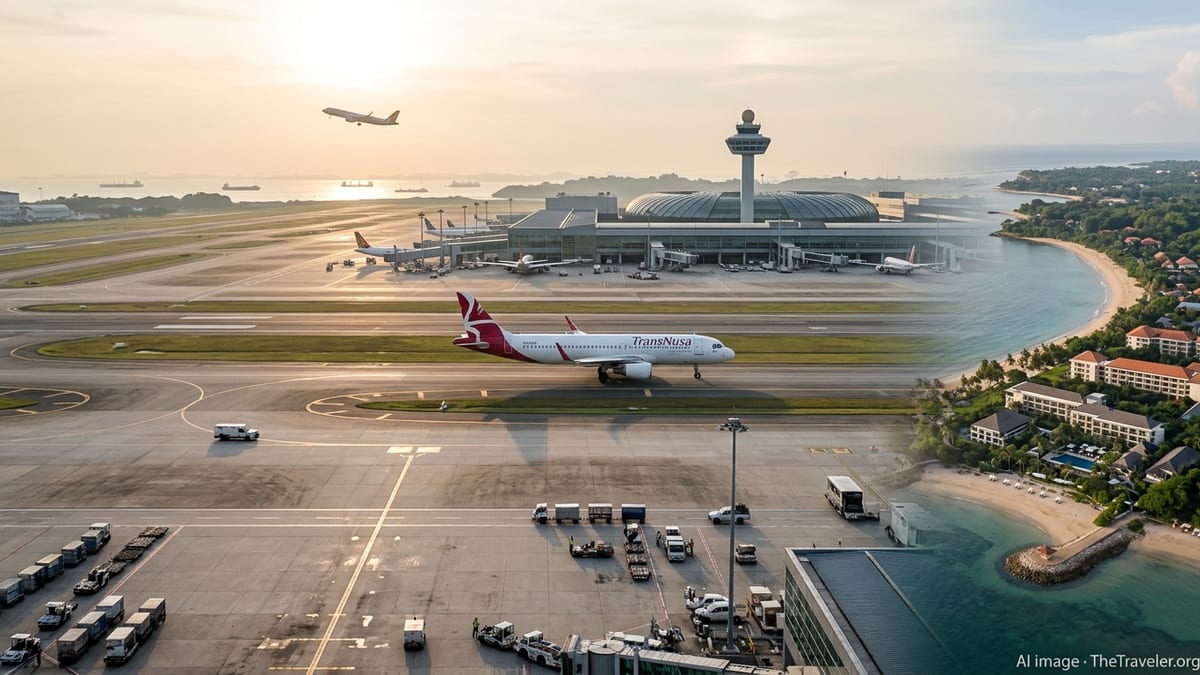
New Capacity on Singapore–Jakarta and Singapore–Bali
Publicly available flight schedule data for Singapore Changi Airport shows TransNusa operating regular services on the Singapore–Jakarta corridor, positioning the Indonesian carrier directly in one of Southeast Asia’s busiest short-haul markets. The route links Singapore’s major international hub with Jakarta’s Soekarno Hatta International Airport, the primary gateway to the Indonesian capital and a key transfer point for domestic connections.
Changi’s airline listings also indicate that TransNusa has added Singapore–Bali operations via Denpasar’s I Gusti Ngurah Rai International Airport, reinforcing air links to Indonesia’s leading leisure destination at a time when international arrivals to the island are rising. The carrier’s presence on both the Jakarta and Bali legs supports a growing trend in which secondary and mid-sized airlines look to capitalize on strong point-to-point demand between Singapore and Indonesia’s largest tourism and business centers.
Industry reports describe this build-up as part of TransNusa’s broader regional push, following recent route launches that prioritize leisure and migrant worker corridors. By strengthening its network around Singapore, the airline is effectively plugging into one of Asia’s most important aviation hubs, where competition is intensifying as low-cost and full-service carriers restore or expand capacity on Indonesia routes.
For travelers, the increased TransNusa presence is translating into more flight options and, in some cases, competitive fares on peak weekend and holiday departures between Singapore, Jakarta and Bali. This added choice is particularly relevant for short-break leisure travelers and Indonesia’s sizable expatriate and business communities who routinely shuttle between the three cities.
Hotel Bookings Climb as Indonesia’s Tourism Recovery Accelerates
The airline’s expansion is unfolding against a backdrop of strengthening tourism indicators for Indonesia. Official statistics and industry analyses show foreign tourist arrivals into the country growing at double-digit annual rates in 2025, with further gains recorded in early 2026. Singapore consistently ranks among the top three source markets, alongside Malaysia, Australia and China, highlighting the importance of cross-border traffic flowing through Changi.
Sector-focused publications report that both international and domestic travel have been instrumental in lifting hotel performance in Indonesia’s main gateways, particularly Bali and Jakarta. Data cited from national statistics and hotel benchmarking studies points to improving occupancy rates compared with the early post-pandemic years, as leisure demand normalizes and business travel gradually recovers.
Analysts tracking the Indonesian hospitality market note that hotel operators are seeing stronger booking curves for 2026, encouraged by rising airline seat capacity and a more event-heavy calendar across the country. Revenue management tools and closer partnerships with online travel agencies are helping hotels capture this demand, with some reports indicating double-digit growth in room revenue per available room for properties that have aggressively embraced digital distribution.
In Bali, local commentary highlights that international arrivals have recently outpaced domestic passengers at Ngurah Rai International Airport, a reversal of patterns seen during the immediate recovery phase. This shift reflects renewed interest from long-haul and regional travelers, many of whom route through Singapore before flying on to the island with carriers such as TransNusa, creating a virtuous cycle between air connectivity and hotel demand.
Singapore–Indonesia Flows Drive Competitive Aviation Landscape
The Singapore–Indonesia corridor is one of Southeast Asia’s densest short-haul markets, supporting a mix of full-service and low-cost airlines linking Singapore to Jakarta, Bali, Surabaya and Medan. As airlines restore capacity following earlier cuts, competition on the flagship Singapore–Jakarta and Singapore–Bali legs has intensified, pressuring carriers to differentiate on schedule, reliability and ancillary services.
TransNusa’s entry and frequency build-up on these sectors adds another player to an already crowded field dominated by Indonesian majors and regional competitors. Aviation industry commentary suggests that the airline is aiming to carve out a niche with targeted schedules aligned to business travel windows between Singapore and Jakarta and peak leisure waves into Bali, rather than attempting to match the largest operators on sheer volume.
For Singapore, the added Indonesian capacity supports broader tourism objectives. Government and industry forecasts point to visitor arrivals that are approaching pre-pandemic levels, with Indonesia identified as one of the city-state’s largest and fastest-recovering source markets. Increased point-to-point connectivity from Jakarta and Bali is seen as a crucial factor in sustaining that growth, especially during major events, conferences and sports fixtures that draw regional visitors.
Travel platforms tracking regional bookings report that sports and event tourism in Singapore has already generated significant spikes in inbound demand from Indonesia. Those flows tend to be highly time-sensitive, rewarding airlines that can offer convenient departure times and competitive pricing, and further encouraging carriers like TransNusa to fine-tune their schedules on the Singapore–Indonesia axis.
Hotel Operators Respond With Dynamic Pricing and New Product
As more seats become available between Singapore, Jakarta and Bali, Indonesian hotels are moving quickly to align room inventory strategies with shifting travel patterns. Industry analyses on Indonesia’s hotel market describe a clear pivot to dynamic pricing, with properties using demand forecasts, event calendars and flight capacity information to adjust rates more frequently.
Reports from hotel technology and investment firms indicate that properties which have invested in revenue management software and integrated booking platforms are outperforming peers in occupancy and average daily rate. These tools help hotels capture surges in bookings linked to new or expanded air routes, such as additional Singapore–Bali frequencies, by nudging rates higher when flight searches and reservations spike.
At the same time, developers and operators continue to focus on midscale and upscale properties in urban centers like Jakarta, as well as resort-heavy regions such as Bali, Lombok and Labuan Bajo. Market commentaries suggest that rising international arrivals, coupled with strong domestic travel, are supporting a pipeline of new hotels and resorts that cater to short-haul regional visitors who often arrive via Singapore.
Travel advisors note that travelers from Singapore and other regional hubs are increasingly combining Jakarta business trips with weekend leisure extensions in Bali or secondary destinations. TransNusa’s enhanced connectivity makes these multi-stop itineraries more viable, feeding demand for both city hotels and resort stays within a single journey.
Outlook: Connectivity, Regulation and Demand Risks
Looking ahead, aviation and tourism analysts generally expect Indonesia’s visitor numbers to continue trending upward in 2026, supported by a combination of new routes, increased frequencies and coordinated promotion by tourism authorities. TransNusa’s effort to entrench itself on the Singapore–Jakarta and Singapore–Bali sectors aligns with these expectations, as the airline seeks to secure share in a market where demand appears resilient.
However, there are emerging risks that could reshape the trajectory for both airlines and hotels. Discussions around tighter licensing rules for short-term rentals and alternative accommodations in Indonesia, for example, could push more demand back toward traditional hotels, further boosting occupancy but also intensifying competition among branded and independent properties. Economic headwinds in key source markets could also weigh on discretionary travel spending, particularly for price-sensitive short-haul leisure trips.
Despite these uncertainties, most current assessments of Indonesia’s tourism sector remain broadly optimistic. Improved air connectivity from Singapore, ongoing investment in infrastructure and airports, and the continued appeal of Bali and Jakarta as flagship destinations underpin this confidence. In that environment, TransNusa’s expansion on the Singapore–Indonesia corridor appears well timed, giving the airline a stronger foothold just as hotel bookings are gaining momentum across the archipelago.