

More news on this day
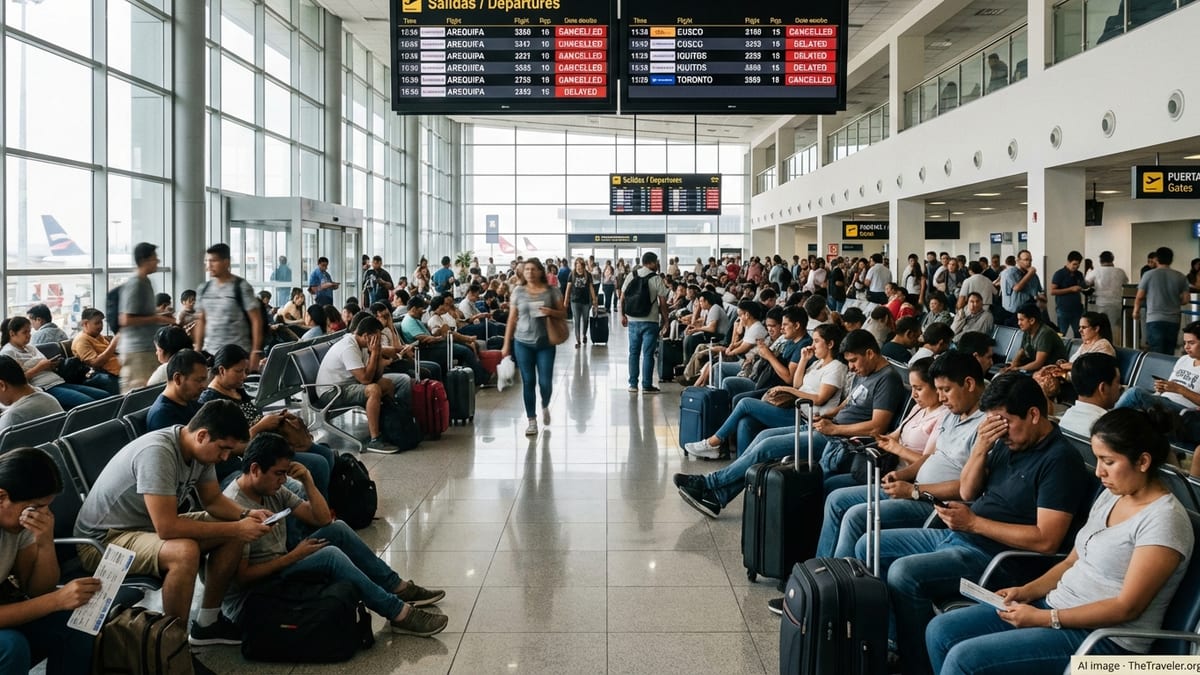
Air travelers in Peru faced fresh disruption this week as airports in Callao and Arequipa reported more than a dozen flight cancellations and numerous delays, with LATAM Peru, Sky Airline, Air Canada and other carriers adjusting schedules on key domestic and international routes.
Key Peruvian Hubs Hit by New Wave of Cancellations
Jorge Chávez International Airport in Callao, serving the Lima metropolitan area, and Alfredo Rodríguez Ballón International Airport in Arequipa have again emerged as focal points of air travel disruption, according to updated operational data reviewed on Thursday. The latest figures indicate that over a dozen departures and arrivals were cancelled across the two hubs, alongside a series of late-running services affecting both domestic and long-haul passengers.
The cancellations mirror a pattern seen earlier this month at Peru’s main gateways, when a cluster of scrubbed flights at Lima and Cusco rapidly cascaded through the national network. This time, the operational strain has extended more visibly into Arequipa, a critical southern hub that connects travelers to Peru’s Andean and desert regions and increasingly functions as a link on regional South American routes.
While exact tallies continue to shift throughout the day as airlines re-time aircraft and rebook customers, airport monitoring platforms and airline status pages show that the majority of affected flights are short-haul services within Peru and to neighboring countries, with select long-haul connections also experiencing knock-on delays.
The disruptions come during a period of sustained volatility for air travel in the wider region, with operational challenges at Peruvian airports intersecting with broader schedule pressures tied to weather systems and network disruptions elsewhere in the Americas.
LATAM Peru, Sky Airline and Air Canada Among Most Affected
National carrier LATAM Peru once again accounts for a significant share of the cancellations and delays at Callao and Arequipa, reflecting its dominant role in Peru’s domestic and regional markets. Several of its high-frequency routes linking Lima with southern cities, including Arequipa and Cusco, were either withdrawn from Thursday’s schedules or subject to extended departure holds as the carrier repositioned aircraft and crews.
Chilean low-cost operator Sky Airline, which has built a strong footprint on key Peruvian corridors, also reported disrupted operations, particularly on services between Lima and major domestic destinations as well as select cross-border sectors. Sky’s lean scheduling model, designed to maximize aircraft utilization, can magnify the impact of each individual delay, leading to rolling knock-ons across the day’s rotation.
On the international front, Air Canada services connecting Lima with Toronto and other North American gateways were among those adjusted, reflecting the sensitivity of long-haul operations to even relatively small timing disruptions at departure airports. Schedule monitoring showed revised departure and arrival times and, in some cases, the removal of a planned rotation as the airline sought to keep the broader transcontinental network stable.
Other foreign carriers with operations into Lima and beyond, including regional South American airlines and selected European and North American operators, recorded isolated delays linked to congestion on the ground and repositioning of aircraft. However, early indications suggest that the lion’s share of the disruption continues to fall on carriers most deeply embedded in Peru’s domestic network.
Knock-On Effects for Domestic and International Travelers
For passengers, the latest wave of cancellations has translated into missed connections, unplanned overnight stays and compressed itineraries. Travelers connecting in Callao from Arequipa and other regional cities onto long-haul flights to North America and Europe faced particular challenges, with some forced to rebook onto later departures or reroute via alternative hubs such as Santiago or Bogotá.
Within Peru, the impact has been especially visible on routes linking Arequipa with Lima, Cusco and other high-demand destinations, where even a small reduction in capacity can quickly push up load factors on remaining flights. Tourists heading to popular destinations such as the Colca Canyon or using Arequipa as a stepping stone toward the southern Altiplano reported longer queues at check-in, tighter seat availability and a higher reliance on last-minute re-accommodation by airlines.
Local business travelers have not been spared either, with curtailed schedules complicating same-day return trips between regional centers and the capital. Travel agents in Lima and Arequipa reported a spike in requests for alternative routing options, as well as increased interest in flexible fares that allow for changes without penalty when operational issues flare up.
Despite the turbulence, most airports in Peru, including those in Callao and Arequipa, have remained operational, with air traffic control and ground services functioning normally. The core difficulties have stemmed from airline-level decisions on aircraft availability, crew rostering and reactive schedule adjustments rather than infrastructure failure or extended airport closures.
Operational Pressures and Regional Context
The renewed disruption at Peruvian airports comes against a backdrop of broader turbulence in the Americas aviation market, where carriers are juggling fleet utilization challenges, tight crew resources and weather-related volatility in other countries. Earlier this week, winter storms in North America contributed to thousands of flight cancellations and delays, including services operated by Canadian and U.S. airlines that link into South American networks.
Air Canada’s adjustments on Peru-bound routes are understood to be part of a wider recalibration of schedules intended to absorb pressure from weather-hit operations in North America, while still maintaining critical international links. Industry analysts note that when long-haul aircraft and crews are delayed or redeployed due to storms or other disruptions at their home bases, downstream markets like Peru can quickly feel the ripple effects.
At the same time, regional low-cost carriers such as Sky Airline are navigating their own constraints, with tight turnarounds and high utilization leaving limited margin to recover from interruptions. Any unexpected maintenance event, crew timing restriction or congested arrival sequence at Lima can trigger schedule compressions that radiate out to secondary airports, including Arequipa.
Peru’s aviation authorities have been monitoring the situation, but so far there has been no indication of systemic safety or infrastructure issues at Callao or Arequipa. Instead, the disruptions highlight the vulnerability of a highly interconnected route network to external shocks, whether originating from weather systems far from Peru or from bottlenecks in regional hubs.
Advice for Travelers Transiting Callao and Arequipa
With further schedule adjustments possible as airlines work to restore normal operations, travelers planning to pass through Jorge Chávez International Airport in Callao or Alfredo Rodríguez Ballón International Airport in Arequipa over the coming days are being urged to build additional buffer time into their itineraries. Industry guidance suggests allowing longer minimum connection times than usual, especially for those linking from domestic flights onto international services.
Passengers are advised to make full use of airline mobile apps and text alerts to track real-time changes to flight status, gate assignments and rebooking options. Many carriers active in Peru, including LATAM, Sky Airline and Air Canada, have been extending flexible change policies during periods of disruption, enabling customers to move to later flights or modify routings without additional fees when schedules are significantly altered.
Travelers with fixed onward commitments, such as cruise departures, guided tours or nonrefundable hotel stays in destinations like Cusco, Arequipa or across the border, are being encouraged by agents to consider arriving a day earlier than strictly necessary. This approach, while adding cost, can provide a critical cushion when cancellations or rolling delays hit.
For now, operators expect gradual normalization of schedules at Callao and Arequipa if no new external shocks emerge. However, the latest wave of cancellations serves as a reminder that even routine operational challenges can swiftly cascade through Peru’s tightly interconnected aviation network, leaving travelers with fewer options and a renewed incentive to plan for contingencies.