

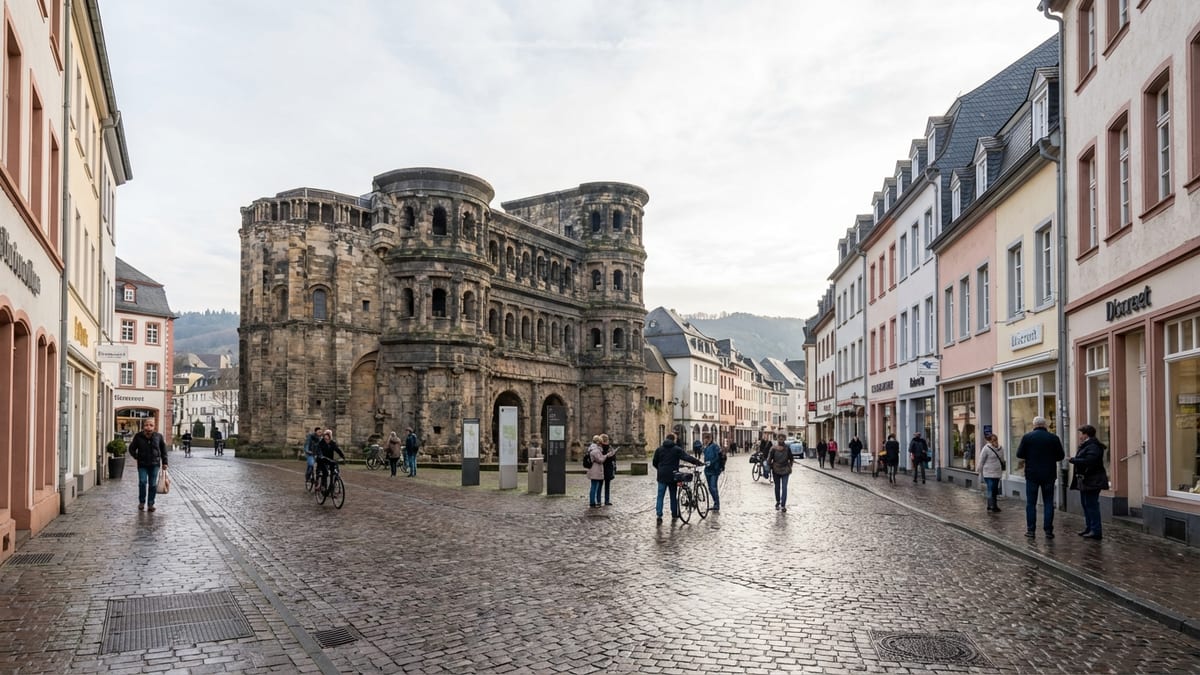
Trier is a compact German city on the Moselle River, but its story is anything but small. Known in Roman times as Augusta Treverorum, it rose from a frontier colony to become one of the imperial capitals of the late Roman Empire, a seat of emperors and bishops, and today one of Europe’s most vivid windows onto antiquity.
To understand Trier is to understand how Rome projected power far beyond the Mediterranean and how that legacy still shapes politics, religion and identity in Europe. This is a city where an ancient city gate stands in the middle of a shopping street, where a Roman throne room doubles as a Protestant church, and where archaeological research continues to refine what we know about the world’s most influential empire. Once you understand the history, it becomes easier to judge whether Trier is worth visiting.
From Tribal Heartland to Augusta Treverorum
Long before Rome arrived, the Moselle valley was the homeland of the Treveri, a Celtic people who controlled trade routes between the Rhine and the interior of Gaul. Their territory straddled the frontier between Latin and Germanic worlds, a liminal zone that Rome both feared and coveted. When the Romans consolidated their hold over Gaul in the first century BC, the Treveri alternately resisted and cooperated. Over time they became essential partners in administering the borderlands, supplying cavalry to Roman armies and hosting military roads that stitched the frontier together.
The founding of Augusta Treverorum, the forerunner of modern Trier, is usually dated to the reign of Emperor Augustus, between about 18 or 17 BC and the early years of the first century AD. Rome chose a site on a bend of the Moselle, slightly inland from the Rhine, where a river crossing and existing settlement patterns made a city both practical and strategic. The name itself, “City of Augustus in the land of the Treveri,” captured a dual identity: this was a Roman foundation rooted in indigenous territory, designed to anchor imperial rule with monumental architecture and an orderly grid of streets.
By the second century, Augusta Treverorum had grown into a prosperous urban center of the province of Gallia Belgica. The city’s layout followed the classic Roman model. A north south axis, the cardo, and an east west axis, the decumanus, structured the street plan that still shapes central Trier today. Public baths, a forum, temples and residential quarters spread out between the river and the low hills. The first stone bridge across the Moselle linked the city to supply routes leading toward the Rhine limes, the fortified frontier. What had begun as a colonial foothold was becoming one of the most important cities north of the Alps.
This transformation was not merely architectural. The Treveri elite adopted Roman citizenship, Latin language and urban lifestyles, helping to diffuse Roman culture throughout the region. At the same time, archaeological finds show a blending of traditions: local deities coexisted with the Roman pantheon, and rural sanctuaries retained Celtic forms even as they adopted Roman building techniques. In Augusta Treverorum, Roman and indigenous worlds fused into something distinctively provincial, yet fully part of the empire’s vast network.
The Making of a Roman Imperial Capital
Trier’s golden age arrived in late antiquity, when the city pivoted from regional hub to imperial capital. Crises along the frontiers and internal power struggles forced Rome to rethink how it governed its sprawling territories. Emperors began to spend more time in frontier cities that could better coordinate military and administrative responses. Out of this process, Augusta Treverorum emerged as one of the main capitals of the western empire.
By the late third century, during the Tetrarchy, Trier was the seat of the praetorian prefecture of the Gauls, an administrative region that covered vast swathes of what is now France, the Low Countries, western Germany, Britain and parts of Spain. Several emperors ruled from here, including Constantius Chlorus and, crucially, his son Constantine. From around 306 to 316, Constantine used Trier as his principal residence while he consolidated his power. The city’s strategic location near the Rhine and at the crossroads of major military roads made it an ideal base for campaigns and for overseeing the western provinces.
Imperial presence translated into monumental building. The palace district on the eastern side of the city expanded with grand halls and audience chambers. The most spectacular survivor of this complex is the Aula Palatina, also known as the Basilica of Constantine, a vast brick hall that served as the emperor’s throne room. Its scale and austere geometry were powerful visual statements: this was not a city merely hosting imperial visits, but a true sedes imperii, a seat of empire in its own right. Together with new baths, an amphitheater and reinforced fortifications, these projects transformed Trier into what late Roman writers occasionally called a second Rome.
At its peak around the year 300, Trier is thought to have had a population in the high tens of thousands, making it the largest city north of the Alps. Trade flourished along the Moselle and Rhine, while the urban elite played key roles in the imperial bureaucracy. Coins minted in Trier circulated across the Roman world, carrying the city’s name and imagery to distant provinces. In the balance between Rome and the frontiers, Augusta Treverorum had moved decisively into the inner circle of imperial politics.
Porta Nigra and the Roman City in Stone
Nothing encapsulates Trier’s Roman origins more dramatically than the Porta Nigra, the massive city gate that dominates the northern entrance to the old town. Built in the late second century as part of a new circuit of walls, it combined practical fortification with grand urban design. The gate’s twin towers, stacked galleries and monumental arches were as much about impressing visitors as about defending the city. Over the centuries its sandstone blocks darkened, giving rise to the modern name “Black Gate.”
The Porta Nigra is extraordinary not just for its preservation but for its layered history. In the Middle Ages, local tradition associated the structure with a Greek hermit, Simeon of Trier, who lived in one of its towers and was later canonized. The gate was partially converted into a double church, with chapels stacked above one another inside the Roman fabric. This unusual adaptation helped preserve the building, even as medieval masons punched new openings and altered its silhouette. In the early nineteenth century, under the influence of Romantic fascination with antiquity, the Prussian authorities stripped away most of the medieval additions in an effort to restore the gate’s Roman appearance. What visitors see today is therefore both ancient and reconstructed, a curated vision of Rome on the Moselle.
Beyond the Porta Nigra, traces of the Roman city remain imprinted in Trier’s streets. The modern Simeonstrasse largely follows the ancient cardo, the main north south thoroughfare. Archaeological excavations beneath shop floors and courtyards regularly uncover sections of walls, mosaics and drainage systems that belonged to long vanished houses and public buildings. In some places, such as the Hauptmarkt and the area around the cathedral, information panels mark where forum buildings, baths or temples once stood. Walking through Trier involves moving through layers of time that lie just below the asphalt and cobblestones.
The broader defensive system around the city also speaks to Trier’s strategic importance. Although only fragments of the late Roman walls survive, their original course can be reconstructed through archaeological work and street names. The amphitheater, tucked into a slope on the city’s edge, was integrated into the fortifications and doubled as a defensive strongpoint. Here gladiatorial games and public spectacles once took place, a reminder that entertainment, imperial ideology and military preparedness were tightly intertwined in Roman urban life.
Thermae, Bridges and Everyday Roman Life
While Trier’s imperial halls and city gates draw immediate attention, its Roman infrastructure tells an equally revealing story about daily life in a provincial metropolis. Public baths, bridges and water systems were the connective tissue of Roman urbanism, signaling not just wealth but also a belief in shared civic amenities. Trier boasted several large bath complexes, of which the Barbara Baths and the Imperial Baths survive as sprawling ruins.
The Barbara Baths, located near the Moselle, were constructed in the second century and counted among the largest baths north of the Alps. Although only about a tenth of the complex is visible today, what remains hints at vaulted halls, heated rooms and sophisticated hypocaust systems that circulated hot air beneath floors. The later Imperial Baths, begun in the early fourth century near the palace district, were conceived on an even grander scale. Massive brick walls, underground service corridors and carefully engineered water channels speak to the technical expertise available in the imperial capital. Ironically, there is no firm evidence that the Imperial Baths were ever completed as a functioning bath complex; some scholars suggest they may have been repurposed into a kind of barracks or administrative facility as political priorities shifted.
Equally vital was the stone bridge across the Moselle, a lifeline for commerce and military traffic. The original Roman piers, dating to the second century, still support a later roadway. Barges, supply boats and trading vessels once assembled here, bringing wine, ceramics, metals and agricultural products in and out of the city. Recent archaeological discoveries elsewhere in Germany, such as Roman marching camps and coin hoards, underline how intensively these river and road networks were used to move troops and goods between frontier and interior. Trier’s bridge plugged directly into that continental infrastructure, turning it into a node in a wider economic web.
For ordinary inhabitants, these monumental structures shaped the rhythm of everyday existence. Citizens bathed, exercised and socialized in the thermae; merchants and soldiers crossed the bridge with their wares and orders; children played in the shadow of the amphitheater’s walls. Religion, too, permeated the landscape through temples and roadside shrines. Although many of these smaller sanctuaries have vanished, inscriptions and dedications recovered by archaeologists reveal a cosmopolitan pantheon that included Roman gods, local deities and sometimes imported eastern cults. Life in Augusta Treverorum was both thoroughly Roman and richly diverse.
Christian Trier and the Long Shadow of Constantine
Trier’s Roman story cannot be separated from the rise of Christianity. As Constantine shifted from persecutor’s son to imperial patron of the new faith, the city that hosted his residence became an early laboratory for Christian architecture and church organization. The monumental complex that would evolve into today’s Cathedral of St Peter and the adjacent Church of Our Lady traces its origins to a vast palace church commissioned in the early fourth century. This made Trier one of the earliest places in the western empire where Christianity manifested itself in stone at imperial scale.
The cathedral that stands today is a multi-layered structure. Beneath its Romanesque and Gothic forms lies the footprint of a Constantinian double church, likely built as part of the emperor’s attempt to align imperial authority with Christian legitimacy. The adjacent Church of Our Lady, a delicately proportioned early Gothic church, occupies the site of the southern half of that original complex. Together, the two buildings illustrate how a Roman imperial residence morphed into a medieval ecclesiastical center. People in Trier continued to worship on the same sacred ground long after the empire that first consecrated it had vanished.
Elsewhere in the city, Roman buildings found new religious roles. The Aula Palatina, once the emperor’s throne room, was eventually converted into a church and today serves as a Protestant place of worship. Its soaring brick walls and austere interior still communicate imperial grandeur, but the focus has shifted from imperial ritual to liturgical gathering. The Porta Nigra, as mentioned earlier, became a pilgrimage site surrounding the tomb and cult of Saint Simeon. These transformations reveal how Christianization in late antiquity and the early Middle Ages did not simply erase the Roman city; it repurposed and reinterpreted it.
By the early medieval period, Trier had emerged as a powerful bishopric within the Frankish and later Holy Roman Empires, its bishops inheriting some of the prestige once reserved for imperial officials. Manuscripts produced in Trier, such as the richly illuminated Egbert Codex and the Ada Gospels, attest to a flourishing Christian intellectual and artistic life. In this way, the city’s late Roman Christian foundations seeded a religious importance that lasted for more than a millennium, long after the legions had left.
UNESCO World Heritage and Ongoing Rediscovery
In 1986, UNESCO recognized the outstanding significance of Trier’s Roman and early Christian monuments by inscribing the “Roman Monuments, Cathedral of St Peter and Church of Our Lady” on the World Heritage List. The inscription covers a constellation of sites: the Porta Nigra, the Imperial Baths, the Barbara Baths, the Aula Palatina, the amphitheater, the Moselle Bridge, the Igel Column just outside the city, and the two great churches at the heart of Trier. Collectively they form one of the densest ensembles of Roman architecture anywhere north of the Alps, a kind of open air textbook for students of antiquity.
UNESCO highlighted not only the age and scale of these monuments but also their integrity and authenticity. In much of Trier, the urban grid still echoes its second century layout, and major thoroughfares follow ancient alignments. Many of the monuments have been carefully conserved or restored, often after complex debates about how much to reconstruct and how much to leave as ruin. The Porta Nigra’s nineteenth century de restoration, the modern consolidation of the Imperial Baths and the sensitive integration of Roman remains into the fabric of the cathedral all reflect changing philosophies of heritage management over two centuries.
Recent years have seen a renewed effort to document and interpret Trier’s Roman legacy using digital tools. Projects have begun to create detailed three dimensional models of major sites, including the sprawling Barbara Baths. These digital twins allow researchers to test hypotheses about construction techniques and function, and they open new possibilities for virtual tourism and education. For visitors on the ground, interpretive centers and guided tours increasingly incorporate augmented reality elements that help bridge the gap between ruined walls and their original forms.
Archaeological work also continues to refine the picture of Roman life in and around Trier. Excavations linked to construction projects regularly turn up new finds, from household objects and burial goods to industrial installations. Meanwhile, discoveries elsewhere in Germany, including newly identified marching camps and coin hoards, feed into a broader understanding of how cities like Trier fit into frontier strategy and imperial logistics. Far from being a static relic, the Roman past along the Moselle is an active field of research that constantly reshapes how we tell Trier’s story.
Why Trier Matters Today
For modern travelers, Trier offers obvious attractions: a picturesque old town, atmospheric ruins, wine country on its doorstep and a compact footprint that makes exploration easy. Yet the city’s deeper significance lies in how visibly it embodies long term European history. Here, the processes that defined the continent Roman conquest, imperial administration, Christianization, urban continuity and reinvention are on display within walking distance of one another. This historical context explains why these are the key things to do in Trier.
Trier also forces a rethinking of what “Rome” means. Too often, travelers imagine the Roman Empire as centered uniquely on the city of Rome on the Tiber. Augusta Treverorum complicates that picture. For much of the fourth century, critical decisions about the governance of western Europe were made here on the Moselle. Edicts were issued, taxes collected, troops dispatched and bishops appointed from this supposed periphery. The city reminds us that the empire was a network of power nodes, not a single point radiating authority outward.
In a broader sense, Trier’s survival illustrates the resilience of cities. It weathered invasions, political collapse, economic contraction and religious transformation, yet it never vanished entirely. Roman walls were cannibalized to build medieval houses; baths became quarries or foundations; an imperial audience hall became a church. Each era interpreted and reused what it inherited, leaving its own imprint without fully erasing what came before. For anyone interested in how urban places endure across centuries, Trier is a case study in continuity through change.
Finally, Trier matters as a reminder that borders are dynamic. In Roman times it stood near the empire’s military frontier; later it lay close to the contested divide between France and Germany. Today, it sits in a peaceful corner of western Germany, not far from Luxembourg and France, part of a borderless Schengen zone. The same river that once carried legionary supply boats now brings river cruisers and cyclists. The city’s Roman stones witness to how profoundly Europe’s political landscape has evolved, even as the physical landscape remains recognizably the same.
The Takeaway
Trier is more than a charming stop on a Rhine and Moselle itinerary. It is one of the clearest and most accessible places to see how Rome remade Europe and how that transformation continues to echo in modern life. From the fortified arches of the Porta Nigra to the vast brick shell of the Aula Palatina, from the ruined bath complexes to the layered cathedral precinct, the city offers a continuous dialogue between past and present. Every stroll through its streets is a walk along the fault lines of empire, faith and identity.
Understanding Trier’s Roman origins explains why the city matters: it was a frontier experiment that became an imperial capital, a pagan city that nurtured early Christianity, and a provincial backwater that today holds a central place in Europe’s cultural memory. Travelers who take the time to explore its monuments and stories will find not just picturesque ruins, but a living laboratory of history in stone and brick.
FAQ
Q1. Is Trier really Germany’s oldest city?
Trier is widely considered one of Germany’s oldest cities, with Roman Augusta Treverorum founded in the late first century BC under Augustus. While other settlements in Germany have ancient roots, Trier stands out for its continuous urban history and its early, well documented Roman foundation.
Q2. Why did the Romans choose Trier’s location?
The site offered a strategic river crossing on the Moselle, access to important trade and military routes and a position slightly inland from the volatile Rhine frontier. It allowed Rome to control movements between the Rhine and the interior of Gaul while tapping into existing settlement patterns of the Treveri people.
Q3. What made Trier an imperial capital in late antiquity?
During the third and fourth centuries, crises along the frontiers and internal power struggles led emperors to govern from multiple centers. Trier’s location near the Rhine and at the intersection of major roads made it ideal as a residence for emperors like Constantius and Constantine, and as the administrative seat for the western provinces.
Q4. How much of Roman Trier can I still see today?
Visitors can see major Roman monuments including the Porta Nigra, the Aula Palatina, the Imperial Baths, the Barbara Baths, the amphitheater and the Moselle Bridge piers. The ancient street grid still shapes much of the city center, and Roman remains are visible or documented below many modern buildings.
Q5. Why is the Porta Nigra so famous?
The Porta Nigra is one of the best preserved Roman city gates anywhere and a symbol of Trier. Its combination of fortification and monumental design, its unusual medieval conversion into a double church and its later de restoration make it a unique witness to both Roman and post Roman history.
Q6. What role did Constantine play in Trier’s history?
Constantine used Trier as his main western residence for several years in the early fourth century. From here he directed military campaigns, minted coins and began to favor Christianity. He commissioned major building projects including the imperial palace complex and the original large church complex that would evolve into today’s cathedral and Church of Our Lady.
Q7. How did Trier become a Christian center?
Under Constantine and his successors, Trier became an early seat of Christian bishops and hosted substantial church building. The Constantinian church complex in the city center, later transformed into the cathedral and adjacent church, made Trier one of the earliest major Christian urban centers in the western empire.
Q8. What does UNESCO World Heritage status mean for Trier?
UNESCO status recognizes the outstanding universal value of Trier’s Roman and early Christian monuments and commits the city and authorities to preserving them. It helps coordinate conservation, supports funding and raises global awareness, which in turn attracts visitors interested in history and culture.
Q9. Is Trier only interesting for Roman history enthusiasts?
While Roman heritage is Trier’s headline attraction, the city also offers rich medieval and early modern layers, riverfront landscapes, wine culture and contemporary arts and festivals. Even travelers with only a casual interest in antiquity often find that the sheer physical presence of the ruins brings Roman history vividly to life.
Q10. How much time should I plan to explore Trier’s Roman sites?
To visit the main Roman monuments Porta Nigra, Aula Palatina, Imperial Baths, Barbara Baths, amphitheater and Moselle Bridge remains along with the cathedral complex at a comfortable pace, most travelers should plan at least one full day. Two days allow for deeper exploration, museum visits and a more relaxed experience of the city and its surroundings.