

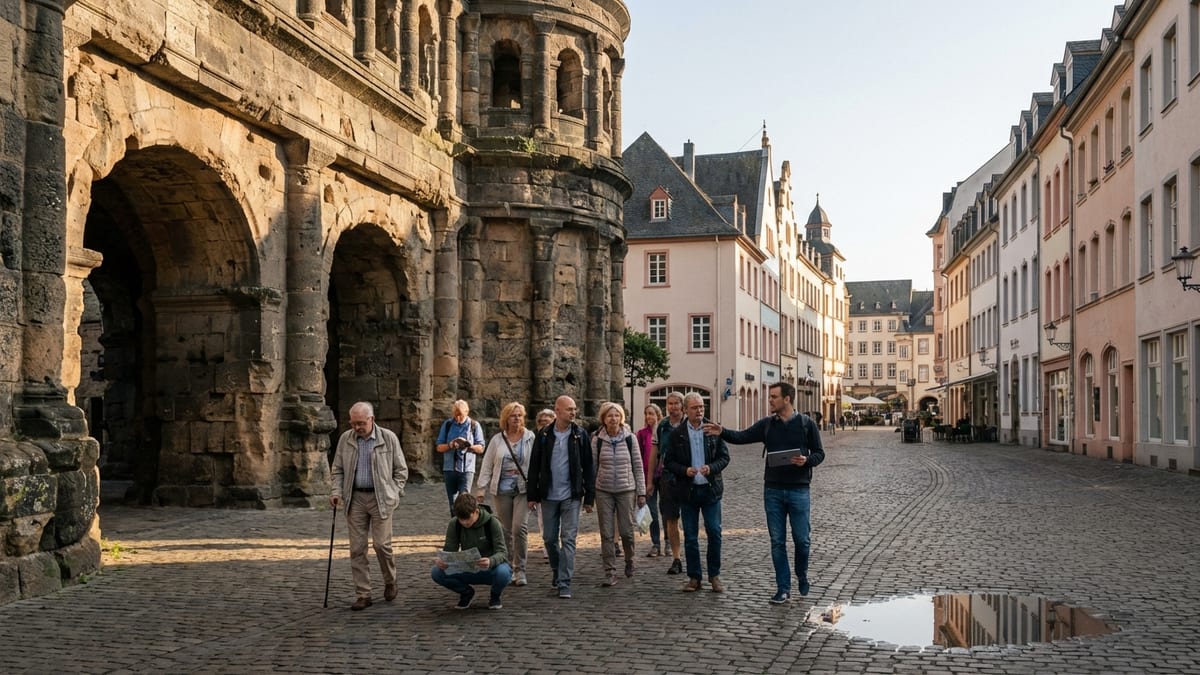
Trier has long traded on its reputation as Germany’s oldest city, but recent investment in visitor infrastructure, new “centre of antiquity” branding and the 40th anniversary of its UNESCO World Heritage designation have sharpened the focus on guided experiences.
For travelers who want more than snapshots of the Porta Nigra or a quick wander through the Imperial Baths, the question is simple: which Trier guided tours are genuinely worth booking, and which Roman history and walking tours actually bring Augusta Treverorum to life?
Why Trier Is a Prime City for Guided Tours
Trier is unusually dense with monuments from different eras, layered within a compact historic core. Roman gates and bath complexes sit minutes from medieval churches and 18th‑century palaces, all stitched together by cobbled streets and Moselle wine culture. Guided tours make more sense after reviewing the key things to do in Trier.
A well‑chosen guided tour helps decode this complexity, turning a pleasant stroll into a coherent journey from imperial capital to modern university town. Before booking activities, many visitors want to know if Trier is worth visiting beyond a short stop.
In the past few years, local institutions have doubled down on presenting Trier as a “centre of antiquity,” with coordinated branding and ticketing across the main Roman sites. That means a growing menu of thematic tours, from general introductions to specialist Roman engineering walks and evening performances in costume. For first‑time visitors, a guide can also help navigate practical details such as AntikenCard museum passes, monument opening times, and the best sequencing of sites so you spend less time queuing and more time exploring.
Essential Overview: Classic Trier Old Town Walking Tours
If you only book one guided experience in Trier, make it a classic old town walking tour. These routes knit together the headline Roman monuments with the medieval and baroque layers that followed, giving you the mental map you need for the rest of your stay. Most last around two hours and cover a manageable loop between the Porta Nigra and the cathedral quarter, with minimal gradients that are suitable for most visitors.
Old Town Highlights Walking Tour
The standard city highlights tour is designed as a fast but structured introduction to Trier’s 2,000 years of history. Groups typically meet near the Porta Nigra, where guides explain how this hulking sandstone gate once formed part of a 6.4‑kilometer city wall and why its stone has turned dark over time. You will usually have time to step inside and climb the inner levels for views over the rooftops, which helps you visualize Roman Augusta Treverorum beneath the modern street grid.
From there, the route usually runs down Simeonstraße into the Hauptmarkt, the main square lined with gabled houses and the Steipe, a late‑medieval banquet hall. Guides point out how the street pattern preserves the outline of the Roman forum, even though the buildings have changed. Short stops explain the market cross, fountain, and guild houses, giving texture to daily life in what was once a city of up to 80,000 residents at its late Roman peak.
The final section leads into the cathedral quarter, where two of Trier’s nine UNESCO‑listed monuments stand almost side by side: the Romanesque Cathedral of St Peter and the Gothic Church of Our Lady, both partly rooted in late Roman foundations. Good guides will pivot here from imperial politics to early Christian Trier, pointing out reused Roman bricks, the scale of the original Constantinian church complex and the layers of rebuilding through wars and renovations.
Evening or Nighttime City Walks
Several local operators offer evening variants of the classic city walk, sometimes branded as night watchman tours or themed storytelling walks. These swaps daytime crowds for atmospheric lighting on the Porta Nigra, cathedral façade and Hauptmarkt gables. The narrative usually leans harder into legends, darker episodes and quirky anecdotes from Roman gladiators to medieval justice.
Although you may not enter as many interiors after hours, an evening tour is worth considering if you arrive in Trier late in the day or are visiting in high season when daytime groups can feel congested. The sightlines are also better for photography, and the quieter streets make it easier to imagine the urban fabric in earlier centuries. Summer departures can be late enough to catch full darkness, while in shoulder seasons you often walk at dusk, when the city’s sandstone takes on a warm glow.
Private Customized Walking Tours
Travelers with specific interests in Roman archaeology, religious history or architecture may prefer a private walking tour tailored to their focus. Independent guides and small local companies can often design routes that spend more time at sites such as the Forum Baths excavation or lesser‑known medieval corners of the city, rather than rushing through the main circuit.
Private guides are particularly valuable if you are traveling with children or multigenerational groups and want to control pace, include café breaks, or add side trips such as the Karl Marx House or Moselle riverfront. They can also coordinate logistics around site reservations, current restoration work and temporary exhibitions, which is useful during Trier’s current cycle of UNESCO anniversary events and ongoing stone conservation at major monuments.
Roman Trier in Depth: Best Ancient History Tours
While overview walks give you the big picture, dedicated Roman history tours dive deep into individual monuments and the city’s role as an imperial center. These experiences usually combine several major archaeological sites into a half‑day programme and are the most rewarding way to understand why Trier’s Roman remains are considered unique north of the Alps.
Comprehensive Roman Monuments Tour
A full Roman monuments tour typically strings together three or four of Trier’s UNESCO‑listed sites: the Porta Nigra, Amphitheater, Imperial Baths and Basilica of Constantine are common anchors, sometimes supplemented by the Roman Bridge or Barbara Baths depending on time and transport. Many tours are structured around the AntikenCard, a pass that grants access to multiple Roman monuments and the state museum within a week, offering good value if you plan intensive sightseeing.
Guides on these tours tend to be archaeologists, historians or trained interpreters who unpack not only what you can see but also what has disappeared. At the Amphitheater, they explain how the arena was cut into a hillside, once seating around 18,000 to 20,000 spectators for gladiator contests and animal hunts. In the cellar, where modern visitors can walk through the vaulted spaces that held lifts, cages and scenery, they reconstruct the choreography of a games day and the politics of spectacle on the Roman frontier.
The Imperial Baths reveal a different side of elite Roman culture. Although the complex was never fully completed as intended and later reused as a fortress, its remaining walls, hypocaust systems and underground service corridors illustrate the engineering behind heated pools, vaulted halls and ancillary facilities. A guided visit helps you read the rubble as three‑dimensional architecture, not just ruins, and connects it to better preserved bath complexes in Rome and Caracalla‑style plans.
Porta Nigra and City Walls Focus Tour
For travelers interested in defensive architecture and urban planning, a shorter but highly focused tour centered on the Porta Nigra and the line of the former city walls is worthwhile. These walks usually begin outside the gate, where you examine the huge, unmortared sandstone blocks that make up this second‑century structure and learn why the planned ring wall was only partially realized before later alterations.
Inside, guides lead you across the different internal levels, pointing out original staircases, blocked archways and later medieval alterations made when the gate was converted into a church. From the higher floors, you can trace the former course of the wall and note how later development slipped beyond it. Such tours often include discussion of recent stone conservation campaigns, including current work on cleaning and consolidating weathered masonry, which adds a contemporary heritage‑management angle to the visit.
Basilica of Constantine and Imperial Residence Tour
The Basilica of Constantine, or Aula Palatina, is one of Trier’s most striking Roman interiors: an enormous brick hall with a simple apse and high windows that once formed part of the imperial palace complex. A specialist tour centered on this monument explores Trier’s role as a late Roman capital and imperial residence, connecting architectural forms to power and propaganda.
Guides will normally reconstruct the larger palace precinct in words and images, showing how the basilica functioned as an audience hall where emperors appeared before subjects, and how its stark volume later influenced church design. These tours often extend into the adjoining baroque Electoral Palace gardens, where you can still read traces of the Roman footprint beneath later landscaping, and sometimes tie in the nearby Forum Baths excavation for a layered view of the palace quarter.
Roman Baths and Daily Life Tour
Travelers fascinated by daily routines and social history should look for tours that combine multiple bath complexes and archaeological sites. A typical itinerary might visit the Barbara Baths, Imperial Baths and Forum Baths in the city center, or substitute other excavation sites depending on access and ongoing research projects.
At the Barbara Baths, once one of the largest bath complexes in the empire by area, guides emphasize how these facilities served ordinary citizens, not just elites. Even though only foundations and underground structures survive, on‑site walkways and visualizations help you grasp the original scale. The Forum Baths excavation, integrated beneath a modern square, offers a powerful contrast between ancient infrastructure and present‑day commercial life. Such tours are particularly engaging for visitors interested in urban archaeology and the mechanics of water supply, heating and sewerage in a dense Roman city.
Themed and Experience‑Based Tours Worth Considering
Beyond conventional sightseeing, Trier’s tourism agencies and museums now offer a growing menu of themed and performance‑based tours. These blend traditional guiding with theater, family activities or seasonal programming tied to anniversaries and special exhibitions. They are especially appealing if you have already covered the basics or are visiting with children and want a more immersive way to connect with the city’s Roman heritage.
Roman Toga and Costumed Performance Tours
Costumed tours are among Trier’s most distinctive offerings. Led by guides dressed as Roman citizens, legionaries or historical figures, these walks mix factual history with light theatrical elements. Participants may be invited to don simple cloaks or accessories, handle replicas of everyday objects or participate in role‑play scenes that illustrate topics such as law, trade or religion in Augusta Treverorum.
Such experiences often focus on a limited number of sites to allow time for interaction. A typical route might include the Porta Nigra, cathedral precinct and Imperial Baths, but instead of dense dates and names, the guide frames each stop through the eyes of a character. This format makes complex topics like Roman citizenship, provincial administration or religious change more accessible, while still rooted in credible research. The tours are popular with school groups and families but can be enjoyable for adults who appreciate a more informal tone.
Family‑Friendly Roman Discovery Walks
For families with younger children, specialized discovery walks and interactive trails emphasize hands‑on learning over long speeches. Guides may equip kids with a simple “Roman passport” to stamp at each monument, distribute puzzle booklets, or set small challenges like spotting reused Roman stone blocks in medieval walls.
These tours typically avoid the steepest climbs and choose monuments where there is space to move safely, such as the Amphitheater, where children can run up the terraces and imagine the roar of the crowd, or the large open grounds around the Imperial Baths. Many also include basic introductions to Latin words, Roman numerals and everyday objects like oil lamps or stylus and tablet, helping younger visitors connect more deeply with the ancient world without feeling like they are in a classroom.
UNESCO Anniversary and Special Exhibition Tours
In the current anniversary cycle marking four decades of Trier’s UNESCO World Heritage listing, local museums and cultural authorities are curating special exhibitions and temporary installations. Guided tours that explicitly link the core monuments to these events can provide added depth and context for repeat visitors who have seen the main sites before.
Depending on your travel dates, these may include evening walks that incorporate light art at the Basilica of Constantine, special access to ongoing digital reconstruction projects at the Barbara Baths, or combined tickets with museum shows that explore the reception of Roman architecture in later periods. Joining a guided tour rather than visiting independently often grants access to curators, behind‑the‑scenes information and a clearer understanding of how conservation and interpretation strategies have evolved over the last 40 years.
Combining City Walks With Moselle Wine & Countryside
While Trier’s Roman and medieval core commands most attention, many visitors also look for ways to combine city exploration with the surrounding Moselle valley. Guided experiences now frequently bundle walking tours with short excursions to viewpoints, vineyards and riverside villages, giving a fuller sense of the landscape that supported the Roman metropolis.
City and Moselle Riverfront Walks
Shorter tours that extend from the Porta Nigra and Hauptmarkt down towards the Moselle offer a bridge between urban history and riverine geography. Guides explain how the river served as a trade artery for wine, ceramics and military supplies, and how the Roman Bridge with its second‑century piers still carries traffic today.
These walks often conclude at the water’s edge, where you can continue independently with a boat trip or simply linger at riverside cafés. They are a good choice if you have limited time in Trier but want at least a glimpse of the broader setting, including views back towards the cathedral and hilltop vineyards that frame the city.
Roman Trier and Wine Village Excursions
For a fuller day, consider tours that split time between Trier and nearby Moselle wine villages. A typical format devotes the morning to a focused Roman city walk, then travels by coach, minibus or train to a village such as Bernkastel‑Kues or Trittenheim for vineyard visits and tastings.
Guides on these combined tours highlight continuity and change: how viticulture developed in Roman times, where archaeological traces of Roman wine presses have been found, and how the Moselle’s terraced slopes have been reshaped by centuries of cultivation. While the wine component is a clear draw for adults, many operators also incorporate non‑alcoholic options and scenic walks suitable for families, making this a flexible add‑on to a heritage‑focused city trip.
Hiking and Viewpoint Walks Above Trier
Travelers who enjoy moderate hiking can opt for guided walks that climb to vantage points above Trier, such as the Petra‑ or Markusberg hills overlooking the city. From these viewpoints, guides can point out the alignment of Roman roads, the footprint of the ancient city, and the way later districts sprawled beyond the original core.
These hikes often tie into sections of longer regional trails and may be combined with rustic wine tavern stops. While less strictly “Roman” than city‑center tours, they help situate Trier’s monumental remains within their wider topography, highlighting strategic considerations that attracted Roman planners to this bend in the Moselle in the first place.
Practical Tips for Choosing and Booking Trier Tours
With an expanding range of walking, themed and Roman history tours, selecting the right experience in Trier benefits from a bit of advance planning. Considering duration, group size, language and physical demands will help ensure that the tour you book aligns with your interests and energy levels.
When to Book and How Far Ahead
In peak season, especially during warm months and around major events such as UNESCO anniversaries or city festivals, the most popular guided tours can sell out. It is advisable to reserve at least core city walks and Roman monuments tours a few days ahead, and earlier if your visit coincides with school holidays or long weekends.
In shoulder seasons and winter, walk‑up availability is more common, but guided schedules may be reduced, particularly in the evenings. Checking the latest timetables and language offerings shortly before your trip can prevent disappointment. For private and customized tours, more lead time is helpful to allow guides to craft itineraries and manage monument reservations.
Group Size, Pace and Accessibility
Group size is a key factor in tour quality. Smaller groups generally make it easier to hear the guide, ask questions and adapt the pace. If you prefer a more intimate experience, look for operators that cap group sizes or explicitly market small‑group or private options.
Most standard walking tours involve roughly two kilometers of walking on cobbled surfaces, with occasional steps at monuments such as the Porta Nigra. Travelers with mobility concerns should verify whether interior visits are included and whether there are lifts or alternative viewing points. Some providers offer dedicated accessible tours that minimize stairs and steep gradients, focusing on street‑level viewpoints and accessible museum spaces.
Language Options and Guide Qualifications
Trier’s position on international itineraries means guided tours are offered in several languages, typically including German and English, with additional options on request. When booking, ensure the language of your preferred departure matches your needs, as mixing languages in one tour can fragment the narrative and slow the pace.
Guide qualifications vary from freelance storytellers to certified city guides and museum educators. If depth of Roman history is a priority, look for tours advertised as led by archaeologists or specialists, or those affiliated with local heritage institutions. Reviews that highlight clear explanations of complex topics, use of visual aids and readiness to answer detailed questions can be a good indicator of quality.
Tickets, Passes and the AntikenCard
Many Roman monuments in Trier charge separate admission, but coordinated ticketing now allows for more efficient access. The AntikenCard offers several tiers, from basic passes covering two Roman sites plus museum entry to premium versions that include all major Roman buildings within a validity period of one week. Some guided tours integrate the cost of these passes, while others require you to purchase entry tickets separately at each site.
Before booking, check precisely what is included in your tour price: guiding only, guiding plus monument entry, or full package with transport and passes. If you plan extensive independent sightseeing alongside guided tours, buying an AntikenCard yourself may offer better flexibility and value, while shorter stays may justify bundled tickets arranged by the tour operator.
The Takeaway
Trier’s claim as Germany’s oldest city is not just a marketing phrase but a lived reality in sandstone, brick and brick‑lined tunnels beneath your feet. Thoughtfully chosen guided tours are the most efficient way to thread together the city’s Roman nucleus with its medieval and modern layers, whether through a brisk old town highlights walk, a specialist deep dive into imperial baths and amphitheaters, or a costumed Roman toga performance that makes children’s eyes light up.
From comprehensive Roman monuments circuits to wine‑infused countryside excursions along the Moselle, today’s tour offerings are more varied and experience‑driven than ever. Taking time to match your interests, physical comfort and travel dates with the right itinerary will repay itself with a richer, more coherent understanding of how Augusta Treverorum became Trier, and why its UNESCO‑listed monuments remain a reference point for Roman heritage in Central Europe.
FAQ
Q1. Are guided tours in Trier necessary, or can I explore the Roman sites on my own?
Guided tours are not strictly necessary, but they add substantial value by connecting scattered monuments into a clear narrative and helping you visualize missing structures. Independent exploration is possible with on‑site panels and audio guides, yet many visitors find that even a single two‑hour city walk or Roman monuments tour transforms later self‑guided visits into a more meaningful experience.
Q2. How much time should I allow for a good Roman history tour of Trier?
A focused overview of key Roman sites such as the Porta Nigra, Amphitheater and Imperial Baths typically requires about three hours. If you want a deeper experience that includes multiple baths, the Basilica of Constantine and museum time, plan for a half day. Combining a morning tour with free afternoon exploration works well for most travelers.
Q3. Are Trier’s walking tours suitable for children and families?
Yes. Many operators offer family‑oriented tours with shorter routes, interactive activities and simplified explanations. Costumed Roman tours and discovery walks with puzzles or “passports” are especially engaging for children, while still informative for adults. Be sure to mention ages and interests when booking so the guide can adapt content and pace.
Q4. What is the AntikenCard, and do I need it if I book guided tours?
The AntikenCard is a multi‑site pass that grants access to several Roman monuments and the state museum within a set time frame. Some guided tours include it or bundle individual admissions into the price, while others do not. If you intend to visit multiple Roman sites both on and off tours, purchasing an AntikenCard can be cost‑effective, but for very short stays a simple single‑site ticket plus one guided walk may suffice.
Q5. Which Trier monuments are included in most Roman history tours?
Most Roman history tours prioritize the Porta Nigra, Amphitheater, Imperial Baths and often the Basilica of Constantine, as these best illustrate Trier’s role as an imperial residence. Depending on duration and logistics, some tours also include the Barbara Baths, Forum Baths excavation or views of the Roman Bridge. Cathedral visits are common on broader historical walks that span more than the Roman period.
Q6. Are Trier’s guided tours accessible for travelers with limited mobility?
Accessibility varies by route and monument. Street‑level old town walks on mainly flat surfaces are manageable for many, but interiors like the Porta Nigra involve stairs without lifts, and the Amphitheater has uneven ground. Several providers offer adapted tours that avoid the most challenging sections and focus on accessible vantage points, so it is important to discuss your needs in advance when reserving.
Q7. In which languages are Trier guided tours usually offered?
Guided tours are most commonly offered in German and English, with additional languages such as French, Dutch or others available on request or at specific times. Public group tours may be language‑specific, so you should confirm the language of your chosen departure to avoid mixed‑language groups or misunderstandings during the tour.
Q8. When is the best time of year to take walking tours in Trier?
Spring and early autumn offer comfortable temperatures and fewer crowds, making them ideal for longer walks and outdoor explanations. Summer brings extended daylight and more evening tour options but also higher visitor numbers and heat on open stone sites. Winter can be atmospheric and quiet, though some outdoor tours may be reduced and you will need warm clothing for longer stops at monuments.
Q9. Can I combine a Trier city tour with Moselle wine tasting on the same day?
Yes. Many travelers take a morning city or Roman history tour, then join an afternoon excursion to nearby Moselle villages or vineyards for tastings. Some operators package these elements into a single product, while others leave you to arrange the wine component independently. Allow for travel time between Trier and the villages, and factor in a relaxed schedule if tastings are included.
Q10. How far in advance should I book Trier guided tours?
During high season and special event periods, it is wise to book popular city and Roman monuments tours at least several days ahead, especially if you prefer small groups or specific time slots. For private or themed experiences, booking one to two weeks in advance provides guides with enough time to customize itineraries. In off‑peak months, same‑day bookings are sometimes possible, but checking availability ahead of arrival is still recommended.