

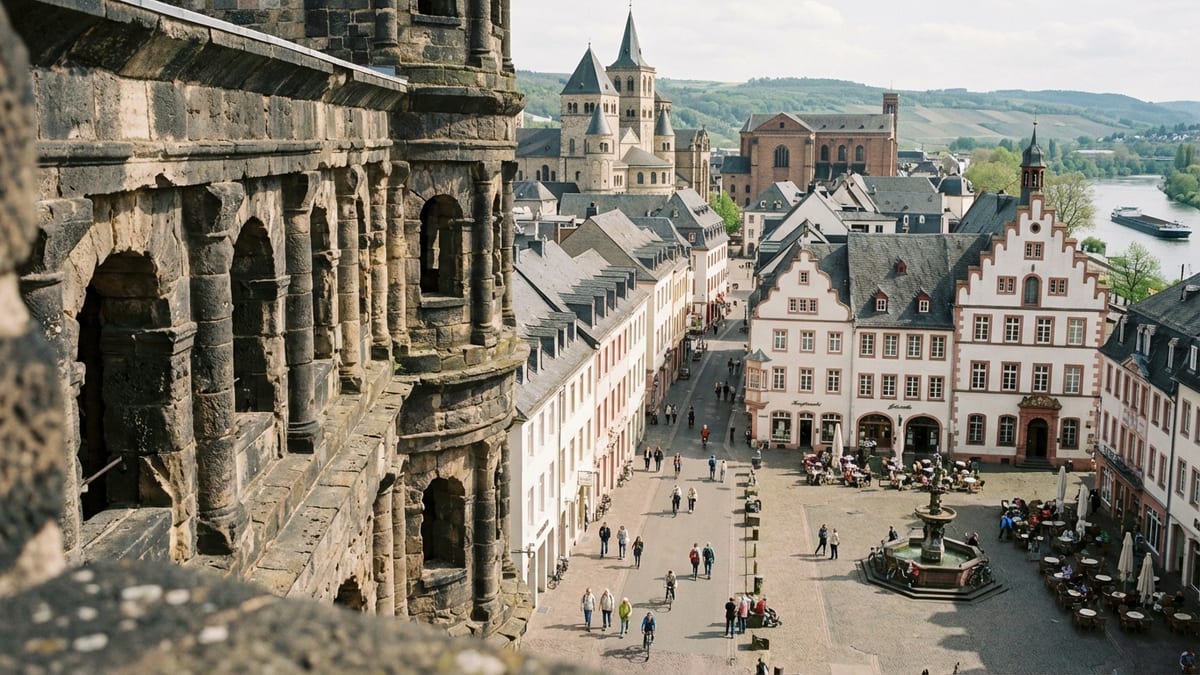
Trier is a compact riverside city with an ancient Roman core, a graceful medieval old town and a relaxed Moselle valley setting. Founded as Augusta Treverorum in 17 BC and later elevated to imperial capital, it concentrates some of the best preserved Roman monuments north of the Alps within walking distance of half-timbered squares and wine taverns.
Understanding the layout helps prioritize the main things to do in Trier. For travelers, this blend of archaeology, urban charm and manageable scale makes Trier both an easy weekend city break and a rewarding base for exploring the Moselle region.
Understanding Trier’s Layout and Neighborhoods
Modern Trier spreads along the east bank of the Moselle, but almost everything a visitor comes to see is concentrated in and around the historic center. This walkable core stretches from the Porta Nigra city gate in the north to the Imperial Baths and amphitheater near the southern edge of the old town.
In between lie the main pedestrian shopping street, Simeonstraße, the Hauptmarkt square, the cathedral precinct and the basilica. With distances measured in hundreds of meters rather than kilometers, you can move from one major sight to another in minutes. This guide often leads travelers to ask whether Trier is worth visiting.
The districts that matter most to short-term visitors cluster around this center. Mitte/Gartenfeld, which covers the old town around the Hauptmarkt and cathedral, is the heart of historic Trier and where you will spend most of your time. Nord, just above it, includes residential streets that fan out from Porta Nigra. To the south, neighborhoods such as Süd and Feyen/Weismark stretch toward the Saar confluence and hold a mix of housing, green spaces and a few Roman remains. Across the Moselle, the West/Pallien district faces the old town and connects to the Roman bridge.
Trier’s shape follows the Moselle valley. Steep vine-covered slopes rise toward the Eifel highlands on one side and the Hunsrück plateau on the other, but the city itself occupies a broad, relatively flat basin. The Moselle bends gently past quays, parks and the old harbor area, which has been reshaped into recreational paths. Because the valley is enclosed, views from higher streets or from the top of Porta Nigra quickly reveal how compact the core is and how the Roman legacy still defines today’s street grid.
For orientation, think of the old town as a broad rectangle. Porta Nigra anchors the north side, the Moselle river the west, the amphitheater and Imperial Baths the southeast, and the central train station the northeast. The cathedral and Church of Our Lady sit slightly off-center. Once you fix these landmarks in your mind, moving around Trier becomes intuitive and you can easily navigate without constantly checking a map.
Roman Trier: A Walk Through the Empire
Trier’s Roman monuments form a constellation woven directly into the modern streetscape. Designated together as a UNESCO World Heritage Site, they date from the city’s centuries as Augusta Treverorum, a major administrative center and later imperial residence for the western empire. Walking from one monument to the next is not a specialized archaeological exercise but a natural way of experiencing the city, since markets, cafes and contemporary life continue around and sometimes inside the ancient structures.
The most dramatic starting point is Porta Nigra, the massive sandstone gate that once guarded the northern entrance to the Roman city. Built after 170 AD, it is both a symbol of Trier and one of the best preserved Roman city gates north of the Alps. Time and urban history have layered over it: in the Middle Ages it was converted into a church, then stripped back in the 19th century to emphasize its Roman form. Today travelers can climb through its interior passageways to terraces that offer wide views over the roofs of the old town and the Moselle valley ridges.
South of Porta Nigra, the invisible footprint of the Roman city walls still shapes the old town. The long axis of Simeonstraße follows an ancient street leading toward the forum area, where the Hauptmarkt now spreads out with its blend of medieval and Renaissance facades. Under this everyday square lie earlier Roman foundations. Interpreting panels scattered around central Trier point out where bath complexes, warehouses and civic buildings once stood, hinting at a city that in late antiquity ranked among the largest in the northern provinces.
Farther along the Roman line, the amphitheater occupies a slope at the edge of the center, partially sunk into the hillside. With seating for tens of thousands, it hosted spectacles that rivaled those in better-known arenas farther south. Some of its stone was quarried away in later centuries, yet the oval shape, tunnels and underground chambers are still clear enough to evoke its former crowds and noise. Nearby, the Imperial Baths and the older Barbara Baths represent different phases of ambitious Roman bathing culture, and even in ruin they dwarf surrounding buildings, underscoring Trier’s one-time importance.
Exploring the Old Town: From Porta Nigra to the Moselle
Most visits to Trier begin directly under the looming arches of Porta Nigra and then flow south through the old town. Simeonstraße, the main pedestrian artery, runs straight from the gate into the heart of the center. Lined with department stores, boutiques and bakeries housed in renovated buildings, it can feel purely modern at first glance. Look up, though, and you notice historical rooflines and occasional Roman fragments worked into walls, reminders that this has been a thoroughfare for nearly two millennia.
At the midpoint of Simeonstraße, the space widens into the Hauptmarkt, the principal market square since the Middle Ages. It is framed by an eclectic mix of gabled merchant houses, the stepped Renaissance city hall and the tall red-and-white Steipe, historically used for civic ceremonies. In the center stands a richly carved fountain surrounded by outdoor tables where residents linger with coffee and wine. From this square, narrower alleys spill in all directions, some leading to quiet corners and others toward major monuments tucked just out of view.
Just west of the Hauptmarkt, small streets descend toward the Moselle. The riverfront itself has been reshaped into promenades and parkland, making it a pleasant counterpoint to stone and pavement inland. Sitting on a bench along the river, you look back on a skyline where church towers and the dark mass of Porta Nigra stand out above tiled roofs, while inland barges slip past on their way deeper into the wine region. Cross-river views from the opposite bank are equally atmospheric and show how tightly the old town nestles against the valley wall.
The old town also rewards those who wander without a strict agenda. Short detours lead to courtyards, small baroque chapels and stretches of medieval wall. Streets like Brotstraße and Neustraße remain busy commercial spines but pause occasionally at tiny plazas ringed with pastel facades. Between shops, you find wine bars specializing in Moselle Riesling and cozy cafes in vaulted stone cellars, offering a softer, more intimate experience of the city’s long history than the monumental ruins alone can provide.
Key Roman Sites: What to See and How to Visit
Trier’s main Roman monuments are managed as interconnected attractions, and visiting several in a single day is both practical and rewarding. The UNESCO-listed ensemble includes Porta Nigra, the amphitheater, the Imperial Baths, the Barbara Baths, the Roman bridge, the Basilica of Constantine, and, just outside town, the Igel Column. They collectively illustrate the range of Roman urban functions from defense and spectacle to bathing, governance and burial.
Porta Nigra is the most visible and easily accessible of these sites. Located at the northern edge of the pedestrian zone, it keeps extended opening hours and typically offers interpretive displays that explain its structure and history. Climbing the internal staircases to the viewing platforms is worth the modest extra fee, especially on clear days when the hills, river and full sweep of the old town come into view. Because it stands beside a main traffic junction and the city tourist information office, it also functions as a practical orientation point.
Moving south, the Basilica of Constantine, also known as the Aula Palatina, stands behind the palace gardens near the cathedral. This enormous brick hall once formed the throne room of the imperial palace in the early fourth century. Today it serves as a Protestant church, but its cavernous single nave, unbroken by columns, still conveys imperial scale. Nearby, the Electoral Palace with its rococo facade overlays later centuries of power onto the same site, offering a visual dialogue between Roman authority and early modern princely rule.
The bath complexes show a different face of Roman Trier. The Imperial Baths near the city walls were planned as one of the largest thermal complexes of their time, comparable in ambition to those in Rome itself. Although never completed as originally intended, their soaring walls, subterranean service passages and floor plans remain legible enough for visitors to imagine hot and cold pools, vaulted halls and bustling routines. Across town, the Barbara Baths occupy a lower riverside site and represent an earlier, sprawling complex. In both places, informational boards and partial reconstructions help you visualize what is now largely ruin.
Cathedral Quarter and Medieval Layers
Just a short walk from the commercial bustle of the Hauptmarkt lies the cathedral precinct, where Roman foundations give way to medieval and early modern religious architecture. Trier Cathedral, dedicated to St. Peter, is widely regarded as the oldest church in Germany. Its core incorporates walls and masonry from a vast fourth-century imperial church, around which Romanesque, Gothic and Baroque additions have accumulated over the centuries. The result is a dense, layered interior full of chapels, tombs and relic displays.
Adjacent to the cathedral is the Church of Our Lady, or Liebfrauenkirche, which stands out as one of the earliest Gothic churches in Germany. More compact and delicate than its imposing neighbor, it occupies the site of a former Roman building and reflects the transition from Romanesque solidity to the vertical lightness of Gothic design. The proximity of these two churches, together included in the UNESCO listing, offers a concise lesson in how sacred architecture changed while remaining anchored to an ancient urban footprint.
The cloister courtyards, small gardens and narrow cobbled lanes around the cathedral invite slower exploration. Here the noise from the shopping streets fades, replaced by the muffled sound of bells and footsteps on stone. Evocative passageways lead under arches and between centuries-old houses toward hidden squares. This is where the continuity of Trier as a place of Christian pilgrimage and ecclesiastical power is most tangible, with medieval masonry often resting on clearly identifiable Roman blocks.
Beyond the churches, other medieval landmarks punctuate the old town. Towers and gates from the city’s later fortifications survive in places, while fragments of wall trace older boundaries. Timber-framed houses lean over lanes in districts that escaped heavy war damage, and ornate facades testify to the wealth of wine merchants and civic elites in early modern times. Together, these layers mean that even when you are not consciously tracking down Roman remains, you are rarely far from some visible remnant of Trier’s long urban story.
Getting Around: Orientation, Transport and Walking Routes
Trier’s compact layout makes it particularly friendly to travelers on foot. From Porta Nigra to the amphitheater is a walk of roughly 15 minutes at a relaxed pace. The distance from the central train station to Porta Nigra is under a kilometer, typically less than 10 minutes of walking. Most major sights, including the cathedral, Hauptmarkt, Basilica of Constantine and Imperial Baths, fall along or close to a loose north–south walking axis that can be covered easily in a single day of sightseeing.
Public transport complements this walkability. City buses connect the train station, Porta Nigra, outlying districts and the university area on the hills above town. For visitors planning multiple journeys or a stay of several days, local passes combine unlimited bus travel with discounted or bundled entry to key monuments. These cards are most useful if your accommodation lies outside the tightly packed center or if you intend to include side trips along the Moselle during your visit.
One of the most efficient ways to understand Trier’s layout is to stitch the main monuments into a single loop. Begin at Porta Nigra, stroll through the old town via Simeonstraße and the Hauptmarkt to the cathedral and Church of Our Lady, then continue to the Basilica of Constantine and palace gardens. From there, head south to the Imperial Baths and amphitheater before circling back through residential streets to the Moselle riverside. Following this route not only ensures that you see the main highlights but also reveals how the Roman city extended along the same axes as today’s streets.
Cycling offers another perspective. The Moselle valley hosts long-distance bike routes, and dedicated paths run along the riverbank through Trier itself. Bicycles make it easy to reach locations slightly outside the core, such as the Roman bridge or neighboring wine villages, while still keeping distances short. For those driving, parking garages cluster near but not inside the pedestrian zone, allowing you to leave the car and experience the historic center on foot without the stress of navigating narrow streets.
Planning Your Visit: Practical Tips and Seasonal Considerations
Trier is appealing year-round, but the character of a visit shifts with the seasons. Late spring and early autumn generally bring mild temperatures that suit long days of walking among ruins and along the river. Summer can be lively, with outdoor cafes full and regional festivals in nearby wine villages. Winter is quieter and can be chilly and damp, yet the city’s Christmas market season brightens the Hauptmarkt and cathedral square with stalls and lights, adding a seasonal twist to historic surroundings.
Allow at least one full day to see Trier’s principal Roman and medieval sites, though two days provide a more comfortable pace with time to linger in museums or return to especially atmospheric corners. Travelers particularly interested in archaeology or religious history can easily fill three days, especially if they include visits to the Rheinisches Landesmuseum, which holds extensive Roman artifacts from Augusta Treverorum, or short excursions to nearby Roman and medieval sites in the surrounding countryside.
Comfortable shoes are essential. Even though distances are short, many surfaces are cobbled or uneven, particularly around ruins and older streets. Carrying a light rain jacket or umbrella is wise in all but the warmest months, given the valley’s changeable weather. Most monuments and churches offer multilingual information panels, and guided tours, including themed walks focusing on Roman history, operate regularly during the main visitor season.
Accommodation options range from family-run guesthouses in restored townhouses to larger hotels close to the train station or along the river. Staying within or on the edge of the old town maximizes your ability to explore early in the morning or after dusk, when day trippers have left and the monumental stones of Porta Nigra, the baths and the basilica take on a more contemplative character under illumination.
The Takeaway
Trier’s appeal lies in the way its Roman monuments, medieval churches and modern daily life are tightly interlaced within a small, legible urban space. Unlike sites where ruins stand isolated on the edge of town, here ancient gates, baths and arenas appear directly along your walking routes between cafes, shops and riverbank paths. Understanding the city layout, with Porta Nigra at the northern gate, the cathedral quarter at the center and the baths and amphitheater on the southern edge, allows even first-time visitors to move confidently and see how the layers of history fit together.
For travelers interested in the Roman world, Trier offers an unusually concentrated window into imperial urbanism, from fortifications and public baths to palatial halls and bridges. For those drawn to European old towns, its squares, churches and timber-framed houses offer the familiar pleasures of cobbled streets and lively markets. Anchored by the Moselle and framed by vineyards, the city adds a scenic backdrop and culinary dimension that encourages longer stays and regional exploration. Taken together, these qualities make Trier a compelling stop on any journey through western Germany or the greater Moselle region.
FAQ
Q1. How much time do I need to see Trier’s main Roman sites?
Most travelers can visit the core Roman monuments, including Porta Nigra, the amphitheater, the Imperial Baths, the Basilica of Constantine and the cathedral quarter, in a full day of reasonably paced walking, though two days allow for a more relaxed schedule and time in museums.
Q2. Is Trier’s old town walkable for most visitors?
Yes. The main sights lie within roughly a 15 to 20 minute walk of each other on generally flat terrain, though cobbled streets and uneven surfaces around ruins mean that sturdy shoes are recommended.
Q3. Where is the best place to stay for first-time visitors?
Staying in or immediately around the historic center, especially near the Hauptmarkt, cathedral or Porta Nigra, places you within easy walking distance of almost all major attractions and simplifies evening dining or riverside strolls.
Q4. Can I visit Trier as a day trip from Luxembourg or other nearby cities?
Trier is well connected by train and bus to Luxembourg City and other regional hubs, making a long day trip feasible, but staying overnight provides more time to experience the atmosphere after day visitors have left.
Q5. Are there combined tickets for the Roman monuments?
Local visitor passes typically bundle admission to several Roman sites, and sometimes include museum entry or bus travel, offering good value if you plan to visit multiple monuments during your stay.
Q6. How crowded do the main sites get in peak season?
In summer and on weekends, Porta Nigra, the cathedral and central squares can be busy, especially in late morning and afternoon, but crowds are usually manageable and thin out noticeably early and late in the day.
Q7. Is Trier suitable for families with children?
The city’s short walking distances, open-air ruins and climbable structures like Porta Nigra and the amphitheater make it appealing for families, though parents should keep an eye on children near steep steps and uneven stonework.
Q8. What is the best way to reach the Roman bridge and riverside areas?
You can walk from the old town to the Roman bridge in roughly 15 to 20 minutes or reach it quickly by bike or local bus, then continue along the Moselle paths for scenic river views and quieter surroundings.
Q9. Are the churches and Roman sites open every day?
Most major churches and Roman monuments open daily or on most days, though hours vary by season and special events, so it is wise to check current schedules locally when planning your route.
Q10. Do I need a guide to appreciate Trier’s history?
Self-guided visits are entirely possible thanks to clear signage and maps, but guided tours, especially those focused on Roman Trier, can add depth by tying the scattered monuments together into a coherent story of the city’s evolution.