

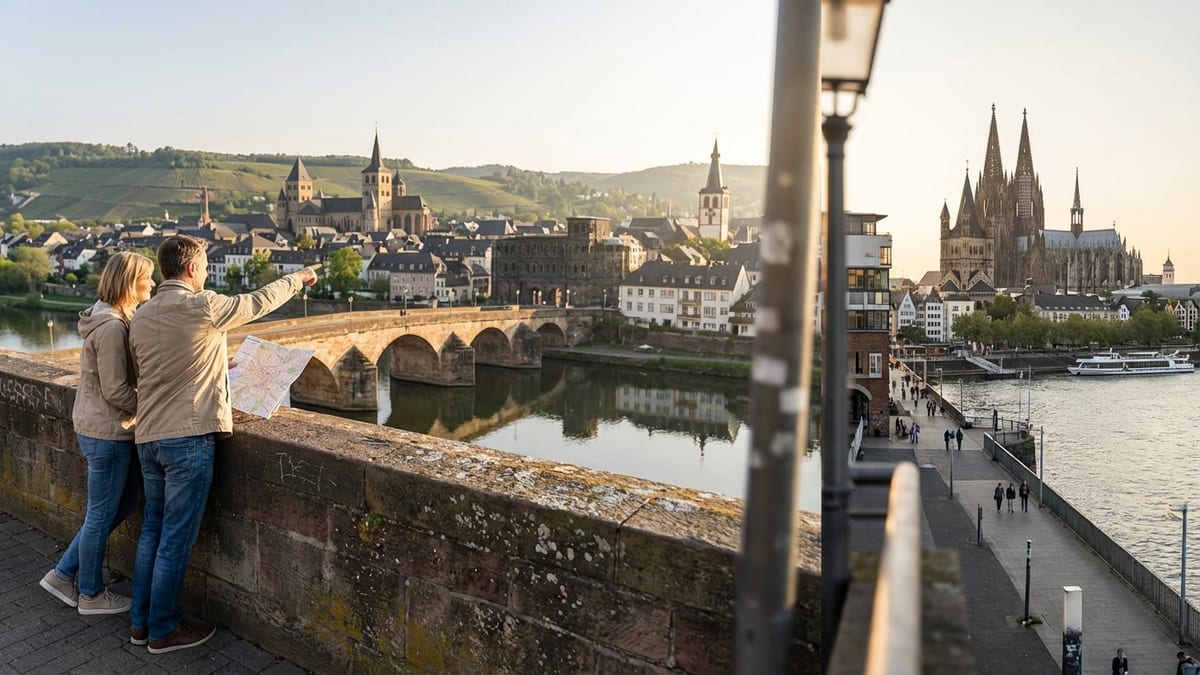
For travelers who chase stories written in stone, few rivalries are as tempting as Trier versus Cologne. One is a compact riverside city that calls itself Germany’s oldest and wears its Roman past almost intact. The other is a major Rhine metropolis whose Gothic cathedral dominates the skyline, while layers of Roman, medieval and modern history unfold beneath your feet.
Both are rich in heritage, both are easily reached, and both reward slow, curious exploration. Yet each offers a different experience for history lovers, from the way the past is preserved to how it is interpreted on today’s streets. This comparison works best after understanding whether Trier is worth visiting on its own.
First Impressions: Two Very Different Historic Landscapes
Arriving in Trier, you immediately feel the scale of its ancient past. The Roman gate of Porta Nigra rises in dark sandstone above modern traffic, amphitheater steps cut into a hillside still host performances, and massive bath complexes sit only a short walk from vineyards.
The city grew out of Augusta Treverorum, founded under the emperor Augustus in the late first century BC, and by the fourth century it was one of the largest cities north of the Alps and an imperial residence. That long arc of history is compressed into a small, walkable center where Roman, medieval and Baroque layers lie almost on top of one another. Reviewing the main things to do in Trier highlights how it differs from Cologne.
Cologne conveys a different kind of historical drama. Its Gothic cathedral, with twin towers ranking among the tallest church spires in Europe, dominates the old town and the Rhine in a way that immediately asserts medieval power more than classical Rome. Yet beneath that dramatic skyline sits a city whose roots also reach back deep into antiquity, as Colonia Claudia Ara Agrippinensium, a major Roman provincial capital. Modern Cologne feels larger, busier and more urban than Trier, and for the visitor that usually means a history experience that is more dispersed but also more varied, mixing archaeology with big-city museums, nightlife and contemporary culture.
For history lovers deciding between them, the initial contrast is striking. Trier offers density of Roman and early Christian monuments within a compact core, ideal for immersive, almost open air museum style wandering. Cologne offers breadth and contrast, with Roman archaeology threaded through a metropolis that also tells powerful medieval, wartime and postwar stories. Your preference may hinge on whether you want to spend your days walking in an almost intact ancient cityscape, or reading the city across multiple eras layered into a major urban center.
Roman Footprints: Imperial Trier vs Provincial Cologne
In Roman terms, Trier has few equals this side of the Alps. As Augusta Treverorum, it became the capital of the province of Gallia Belgica and later an imperial residence in the late third and fourth centuries. At its height around the year 300 it likely had a population in the high tens of thousands, the largest city north of the Alps, with emperors such as Constantine the Great commissioning monumental projects. That imperial chapter is written into the surviving fabric of the city: the Porta Nigra city gate, the sprawling Imperial Baths, the Barbara Baths, the Roman bridge across the Moselle, and the vast Aula Palatina, also known as the Basilica of Constantine, which still stands as an austere brick hall that once housed an imperial throne.
The density and scale of these remains are what make Trier extraordinary for Roman history enthusiasts. The amphitheater, cut into a slope east of town, gives a clear sense of spectacle and crowd life in the Roman city. The thermen complexes demonstrate both engineering and social life, with underground service corridors, hypocaust heating systems and massive masonry preserved in situ. Even the city’s UNESCO listing recognizes a cluster of Roman monuments along with the medieval cathedral and Church of Our Lady as a single heritage ensemble, underlining just how closely late Roman and early Christian histories are intertwined here.
Cologne’s Roman chapter is less imperial and more provincial, but no less fascinating. As Colonia Claudia Ara Agrippinensium, it served as the capital of the Roman province of Germania Inferior, a strategic city on the Rhine frontier. Much of its Roman fabric lies beneath later development, but modern archaeology and museum work make it accessible. The Romano Germanic Museum, currently operating from a temporary exhibition space while its main building undergoes renovation, houses one of Europe’s richest collections of Roman glass, domestic objects, mosaics and funerary monuments from the city and region. For many visitors it provides the clearest window into everyday life in Roman Cologne, through tableware, tools, toys and tombstones.
Out on the streets, guided walking tours along Cologne’s Roman history use foundation lines, excavated towers and surviving stretches of city wall to reconstruct the plan of the ancient colony. Hohe Straße, now a busy pedestrian shopping artery, follows the line of the former Roman cardo maximus, illustrating how the Roman street grid still shapes modern movement. Sections of the old city wall and a largely preserved Roman tower on the edge of the old town let you imagine the fortified river city that once guarded the empire’s border. Where Trier excels in monumental survivals above ground, Cologne invites you to read Roman history in traces, objects and alignments, a subtler but rewarding pursuit for travelers willing to look down and look closely.
Medieval Powerhouses: Cathedral Spires and Episcopal Cities
After the fall of the Western Roman Empire, both cities reinvented themselves as major ecclesiastical centers, though again on different scales. Trier became an important seat of a bishop and later an influential prince archbishop within the Holy Roman Empire. The city’s cathedral, Dom St. Peter, grew over centuries around what tradition holds to be an early Constantinian church. Step inside and you find a dense layering of styles, from Roman masonry reused in later walls to Romanesque and Gothic additions and Baroque furnishings. Attached to it is the Liebfrauenkirche, one of the earliest Gothic churches in Germany, which with the cathedral forms part of Trier’s UNESCO ensemble.
For the traveler, Trier’s medieval heritage feels tightly woven into its Roman spine. The cathedral precinct stands close to the Roman basilica and baths, making it easy to compare construction techniques, scale and symbolism across centuries in a single circuit. The medieval market square with its market cross and richly decorated facades lies between ancient gate and cathedral, a reminder that mercantile life continued to thrive amid religious and political power. The result is a cityscape where the continuity of urban life from antiquity through the Middle Ages is unusually legible.
Cologne in the Middle Ages was simply larger, richer and more influential. It developed into one of the biggest cities in medieval northern Europe, a member of the Hanseatic League with far reaching trade connections. Its crowning symbol is the Kölner Dom, a Gothic cathedral whose construction began in the thirteenth century but was only completed in the nineteenth. Today its immense nave, intricate stonework and soaring towers dominate the skyline and anchor many visitors’ understanding of Cologne’s history. Standing on the platform or simply walking the nave, you sense the ambition of a city that sought to rival the great cathedrals of France and assert itself as a major pilgrimage center.
Beyond the cathedral, Cologne’s medieval past appears in its twelve Romanesque churches, remnants of its old city walls and gate towers, and the fabric of its old town streets along the Rhine. Museums such as the Kölnisches Stadtmuseum, recently moved into a new building, tell the civic story from the Middle Ages through the modern era, placing battle flags, guild objects, religious art and everyday items side by side. For the history traveler, Cologne’s medieval heritage is less concentrated than Trier’s but arguably more varied and better suited to those who enjoy thematic exhibitions and urban walks that tie architecture to social history.
Museums and Interpretation: How Each City Tells Its Story
For serious history lovers, the quality of interpretation matters almost as much as the stones themselves. In Trier, you are dealing with a city that has spent decades refining how it presents its Roman and early Christian heritage. The main Roman monuments are managed as a coordinated ensemble with well structured visitor centers, signage in multiple languages and a growing use of multimedia to explain construction phases and urban life. At the amphitheater and baths, underground corridors and remains are lit and signed to make engineering solutions and day to day routines comprehensible even to non specialists.
Trier’s museums complement this in focused ways. The Rheinisches Landesmuseum, the regional archaeological museum, anchors the narrative with rich collections of sculpture, inscriptions, mosaics and small finds that trace the region from prehistory through the Roman period and beyond. Exhibitions often tie closely to current research and new discoveries, and regular temporary shows explore themes such as imperial power, trade routes or late antique religion. For a traveler who wants to immerse in context after seeing monuments in the open air, this combination of physical site and curated collection is extremely rewarding.
Cologne, as a much larger city, spreads its interpretive resources across multiple institutions and themes. The Romano Germanic Museum is central for Romanists, despite its current temporary quarters, with its glass collection, mosaics such as the famous Dionysus scene, and funerary monuments like the towering Poblicius tomb all evoking both luxury and mortality in the provincial capital. The advantage here is the detail with which everyday life is reconstructed: objects from workshops, domestic interiors, children’s toys and religious offerings help visitors imagine not just emperors and soldiers but artisans and families.
Complementing that, Cologne’s spectrum of history museums extends into later eras, from the city museum’s treatment of medieval guilds and early modern trade to documentation centers that confront the city’s experience under National Socialism and during the Second World War. For travelers who enjoy tracing a place’s whole trajectory up to the present, Cologne offers a more continuous museum landscape. Trier’s narrative is more tightly focused on antiquity and its immediate aftermath, which is ideal for Roman specialists but leaves less space for exploring later industrial or contemporary chapters.
Walking the Past: On the Ground Experiences for History Lovers
Beyond individual monuments and museums, the day to day experience of walking and exploring matters enormously, especially for travelers who prefer to let history reveal itself in street patterns and architectural details. Trier is especially strong here because the core historic area is compact and low rise, with limited postwar rebuilding compared to major industrial cities. You can leave your hotel near the old town and within a ten or fifteen minute stroll reach the Porta Nigra, the cathedral complex, the Roman basilica and the thermal baths, often via streets where building plots and alignments echo the ancient grid.
The Moselle riverfront adds another layer to that experience. The Roman bridge, still carrying traffic, underscores the continuity of crossing and commerce, while vineyards climbing the surrounding hills remind you of viticulture traditions that date back to Roman times. Short walks take you to panoramic vantage points where you can read the valley as a whole, placing monumental remains within their wider landscape. For many visitors this combination of walkability, riverside scenery and relatively small scale urbanism creates an especially immersive and relaxed environment for historical exploration.
Cologne, by contrast, offers a more urban, high energy walking experience. The immediate area around the cathedral and old town is dense with visitors, street musicians and river cruise passengers. Yet step a few streets back and you find quieter corners where traces of Roman walls, medieval churches and postwar reconstruction can be studied in relative calm. Guided walking tours that follow Cologne’s Roman footprint take in parts of the old fortifications, the outline of the praetorium and the route of the cardo, helping visitors connect present day streets to the ancient plan.
Because Cologne is larger, public transport also plays a bigger role in exploration. Trams and U Bahn lines make it easy to string together visits to the cathedral, Roman archaeological sites, city museum and outlying Romanesque churches in a single day, but the feel is more metropolitan than contemplative. Travelers who thrive on big city buzz, varied neighborhoods and long, complex days of walking and riding between sites will likely appreciate Cologne’s scale. Those who prefer to absorb history at a slower pace, with minimal logistics and more time in a well defined core, will probably find Trier more to their taste.
Atmosphere, Logistics and Practical Considerations
Choosing between Trier and Cologne is not only about monuments and museums; it is also about the kind of trip you want, from atmosphere and dining to transport and accommodation. Accommodation options also influence the choice, especially when comparing the best hotels in Trier.
Cologne, as one of Germany’s largest cities, is an international transport hub on major rail lines and with its own airport. That makes it an easy base for travelers coming from abroad or combining multiple destinations along the Rhine. The hotel and restaurant scene is broad, from luxury riverside properties to budget friendly chains and family run guesthouses, and food options range from traditional brewery taverns to global cuisine.
Trier is smaller and more intimate, often attracting travelers who combine it with wine tourism in the Moselle region or with visits to neighboring Luxembourg. Rail connections are good but generally involve a change from major international lines, and there is no large airport in the immediate vicinity, though Luxembourg’s airport is within reach. Accommodation tends to be more concentrated in and around the historic center and along the river. The dining scene emphasizes regional cuisine and wine, with many establishments taking advantage of riverside and hillside settings to create atmospheric terraces that lend themselves to long, reflective evenings after a day of exploring ruins.
From a purely historical logistics perspective, Trier can often be more efficient. Because many of its major sites cluster within walking distance, you can see a high proportion of its Roman and early Christian highlights in two to three days without feeling rushed. Cologne, with its larger geographic footprint and greater diversity of eras, may require more time if you want to do justice not only to Roman and medieval heritage but also to twentieth century history and modern cultural institutions. On the other hand, Cologne’s larger infrastructure means more frequent guided tours, broader opening hours across museums and a wider choice of special exhibitions across the year.
Seasonality also plays slightly different roles. Both cities experience their tourist peaks in summer, along with a particular surge in Cologne during its famous Carnival period and during Christmas markets. Trier’s summer season tends to feel calmer compared to Cologne’s major events, and the surrounding Moselle landscape is particularly attractive in late spring and autumn when vineyards change color. For travelers sensitive to crowds who want to linger at ruins and churches without too much noise, shoulder seasons in Trier can be especially rewarding.
Which City Wins for Different Types of History Lovers
Attempting to declare an overall winner between Trier and Cologne for history lovers risks simplifying what is ultimately a matter of personal preference. It can be more useful to think in terms of traveler profiles and historical interests. If you are primarily fascinated by the Roman world, imperial politics and late antiquity, Trier clearly has the edge. Its suite of monuments offers a rare opportunity to experience the urban environment of an imperial residence outside Italy, with substantial above ground remains that can be visited in sequence and understood as a coherent whole. Add the archaeological museum and UNESCO listed ecclesiastical buildings, and you have a destination that can sustain several intensive days focused mainly on the first half of the first millennium.
If your interests range more widely across the medieval and modern periods, and you prefer to see how cities reinvent themselves across wars, economic shifts and changing religious landscapes, Cologne may be the stronger choice. Its Gothic cathedral ranks among Europe’s great ecclesiastical monuments, its network of Romanesque churches offers a condensed lesson in medieval architecture, and its museums and documentation centers cover topics from guilds and trade to the city’s experiences in the twentieth century. The Roman story is very present but functions more as a foundation for a much longer narrative that continues vigorously into the present.
Travel style matters as well. Solo travelers or couples who enjoy quiet evenings and repeated passes through the same historic streets, discovering new details each time, often report feeling particularly at home in Trier. Families, groups of friends or travelers who like to intersperse history with nightlife, contemporary art and large scale events will likely find Cologne’s energy compelling. Budget can play a role too, although both cities offer a range of price points; in general, costs for accommodation and dining may be somewhat lower in Trier, while Cologne provides more variety for every budget.
For many history lovers, the ideal solution is not to choose at all but to pair the two cities within one itinerary. Rail connections between them are straightforward, and visiting both allows you to compare two very different manifestations of Roman and Christian urbanism along the western edge of Germany. Doing so deepens your understanding of how imperial frontiers, trade routes, church politics and modern reconstruction have shaped not just these cities but the broader region over two millennia.
The Takeaway
Both Trier and Cologne reward history lovers with depth, variety and a sense of continuity across centuries. Trier’s strengths lie in its remarkably intact Roman and late antique landscape, where imperial scale monuments coexist with an early cathedral complex in a compact, walkable setting framed by river and vineyards. For travelers whose hearts beat fastest at the sight of turrets, thermen and amphitheaters, and who prefer a slower pace in a smaller city, Trier is hard to beat.
Cologne, by contrast, thrives on contrast and scale. Its Gothic cathedral and Romanesque churches speak to medieval power and piety, its Roman archaeology emerges through a rich museum culture and urban walks, and its modern history, from wartime destruction to postwar rebuilding, unfolds in galleries and streets alike. For travelers who want their history served alongside big city buzz, diverse neighborhoods and an ambitious cultural program, Cologne may well be the better fit.
In the end, the question of which city is “better” for history lovers is less about absolute rankings than about matching places to passions. Those seeking an immersive journey into Roman imperial urbanism will find their ideal classroom in Trier. Those eager to trace a city’s evolution from Roman colony through medieval powerhouse to modern metropolis will find Cologne unmatched. If your schedule and budget allow, consider giving yourself the luxury of not deciding, and instead let both cities tell their intertwined stories in their own voices.
FAQ
Q1. Is Trier really Germany’s oldest city, and does that matter for travelers?
Trier traces its origins to the Roman foundation of Augusta Treverorum in the late first century BC, and it is widely regarded as Germany’s oldest city in continuous existence. For travelers, this means a uniquely long and well documented urban history, with Roman, early Christian and medieval layers visible within a compact area.
Q2. How many days should I spend in Trier versus Cologne if I am focused on history?
If your primary interest is Roman and early medieval history, two full days in Trier are usually enough to see the main monuments and museums without rushing. Cologne’s broader range of eras and institutions often rewards at least three days, particularly if you want to combine Roman and medieval sites with museums covering modern history.
Q3. Which city is better for experiencing Roman ruins in person rather than just in museums?
Trier offers more substantial above ground Roman architecture in situ, including the Porta Nigra, multiple bath complexes, an amphitheater and a Roman bridge still in use. Cologne’s Roman heritage is highly significant but more fragmented, with much of the physical experience concentrated in museum settings and archaeological zones rather than large standing monuments.
Q4. Are the major Roman museums in Cologne open during the current renovation period?
Yes. The Romano Germanic Museum’s main building near the cathedral is undergoing renovation, but its collections are displayed in a temporary exhibition space in the Belgian House near Neumarkt. Visitors can still see key pieces such as Roman glass, mosaics and funerary monuments, although some large in situ works remain inaccessible.
Q5. If I have mobility issues, which city is more accessible for historical sightseeing?
Both cities make efforts to provide accessible routes, but their character differs. Trier’s main monuments cluster within a relatively small area, reducing travel distances, though some Roman sites like the amphitheater involve slopes and uneven ground. Cologne offers wider pavements, modern public transport and more elevators in major museums and at the cathedral, which can be an advantage for visitors with limited mobility.
Q6. Can I visit Trier and Cologne as day trips from each other?
It is logistically possible to visit each as a long day trip from the other by train, but history focused travelers usually find this rushed. The travel time eats into museum and site hours, and both cities deserve unrushed exploration. If time is tight, consider basing yourself for at least one night in each city rather than commuting back and forth.
Q7. Which city offers better guided tours specifically tailored to history enthusiasts?
Cologne, being larger, offers a wide range of themed tours, including walks focused on Roman traces, medieval churches, Jewish history and wartime destruction and reconstruction. Trier has fewer total options but several highly specialized Roman and UNESCO heritage tours that provide detailed context at major monuments. The best choice depends on whether you prefer many theme options or a smaller number of deeply focused tours.
Q8. How child friendly are Trier and Cologne for families interested in history?
Both cities can work very well for families. Trier’s visible ruins, such as the amphitheater and city gate, tend to capture children’s imaginations, and walking distances are short. Cologne offers more varied indoor options, including interactive exhibits in some museums, which can be helpful in poor weather. Families who want outdoor, hands on history may lean toward Trier, while those needing rainy day flexibility might prefer Cologne.
Q9. Does Cologne’s size and nightlife distract from its historical character?
Cologne’s lively nightlife and modern cultural scene certainly add noise and energy, especially around the old town and riverfront, but they do not erase the city’s historic core. The cathedral, Romanesque churches and archaeological sites remain central to the city’s identity, and quieter streets and churches are never far away. Many travelers enjoy the contrast between daytime history exploration and evening urban life.
Q10. If I am particularly interested in early Christianity, which city should I prioritize?
Both cities have deep Christian roots, but Trier may be especially compelling for early Christianity. Its cathedral complex, with origins linked to the late Roman imperial period, and its UNESCO recognized ensemble of religious buildings provide a close look at the transition from Roman imperial to Christian urbanism. Cologne’s cathedral and churches are magnificent but generally reflect later medieval and Gothic developments more strongly than late antique Christianity.