


If you are planning a winter trip to Norway for the Northern Lights, two names appear again and again: Tromsø and the Lofoten Islands. Both sit inside the auroral oval, both have dramatic Arctic scenery, and both now offer polished winter tourism with guided tours, rental cabins and direct international flights. Yet they deliver very different experiences once you arrive. This guide compares Tromsø and Lofoten for Northern Lights seekers and winter adventurers, focusing on climate, darkness, access, tours and real-world costs for the 2025/2026 and 2026/2027 seasons.
Get the latest updates straight to your inbox!
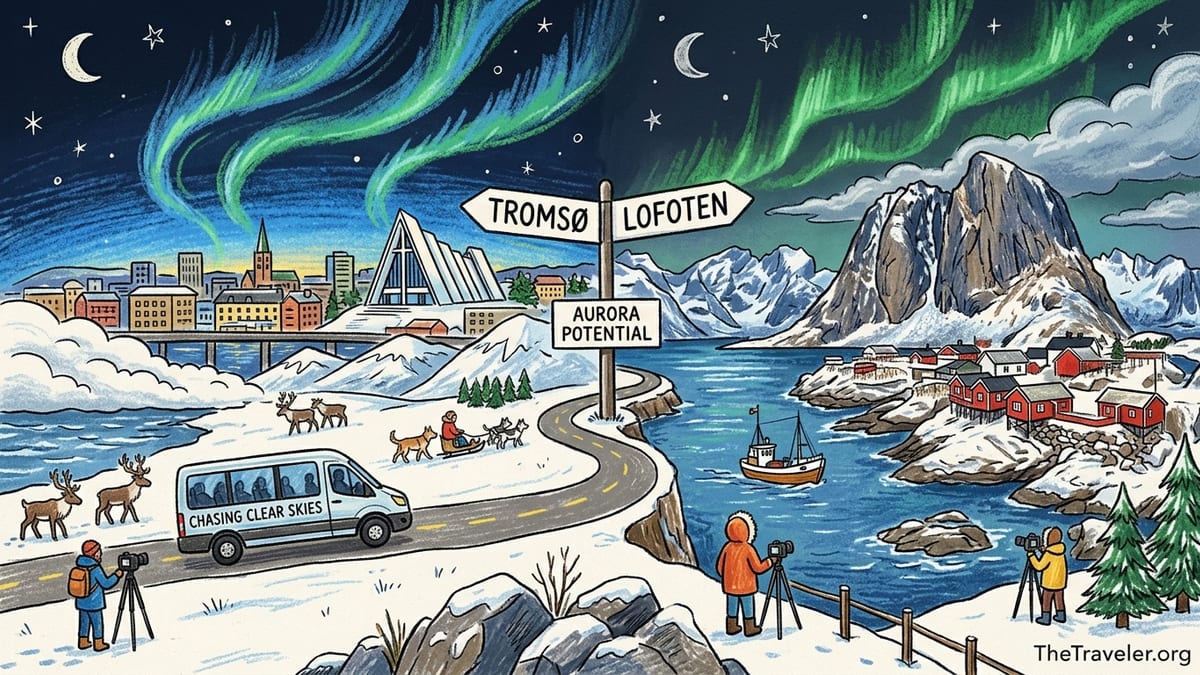
Overall Northern Lights Potential
Tromsø lies at around 69 degrees north and directly under the auroral oval, which gives it very frequent aurora activity on clear nights between roughly late September and early April. Weather is the bigger limiting factor than solar activity. Local guides often describe their trips as "hole in the clouds" tours rather than Northern Lights tours, because the key is driving away from coastal cloud into clearer inland valleys. This is why so many tours out of Tromsø head toward drier inland areas in Troms and Finnmark rather than staying near the city itself.
Lofoten also sits well inside the auroral zone, but further southwest and fully exposed to the Norwegian Sea. The islands receive more frequent Atlantic low-pressure systems, which means cloud and fast-changing conditions. Travelers who stay several nights still have good chances to see the lights, but on any single evening the odds of clear skies are generally a little lower than in the inland areas that Tromsø tours can reach. Many Lofoten operators highlight flexibility in choosing the leeward side of the islands to escape cloud, but they cannot drive as far inland as Tromsø-based operators who routinely cross to the drier side of nearby fjords and plateaus.
In practice, for a one- or two-night Northern Lights stop, Tromsø usually offers better overall odds because of the combination of frequent aurora and the ability to drive hours inland in search of clear skies. For a week-long photography trip in winter, Lofoten's wild scenery and coastal weather can still produce spectacular aurora reflections over beaches and fishing villages, but you should build more "buffer" nights into your stay to ride out storms.
Darkness, Polar Night and Daylight Hours
From roughly late November to mid-January, Tromsø enters the polar night period when the sun does not rise above the horizon. Even then, there is a long blue twilight around midday, so it is not fully dark 24 hours a day. Around the solstice you can walk around the city at 11:00 in a deep blue dusk and still take in the Arctic Cathedral, waterfront and cable car views. This extended darkness is ideal for late-afternoon aurora photography, but it also means very short "daytime" windows for activities like dog sledding or scenic fjord cruises.
Lofoten does not sit as far north as Tromsø, but much of the archipelago still experiences a period in December and early January when the sun stays below the horizon or only just brushes it. In practical terms, daylight feels similar: a long, dim twilight rather than true brightness. The difference becomes more noticeable in February and March. Tromsø regains long days quickly, with March often offering bright snow, high sun and long evenings. Lofoten also brightens rapidly, and because of its open seascapes, the late winter light can feel especially luminous as low sun reflects off the water.
For travelers focused purely on Northern Lights, the deep winter period from late November to late January works well in both destinations, since darkness comes early and lasts long into the morning. If you also want to photograph sharp mountain scenery and enjoy winter hikes, many photographers prefer February and early March in both Tromsø and Lofoten. You get dark enough nights for aurora, but much more usable daylight for other adventures.
Climate and Comfort in the Arctic Cold
Tromsø’s climate is classified as subarctic, but thanks to the Gulf Stream it is milder than many people expect at this latitude. Winters are snowy, yet in the city itself near sea level there are frequent periods close to freezing when snow becomes heavy and wet. Long-term climate data for Tromsø show average mid-winter temperatures a few degrees below zero Celsius, with the coldest recorded temperatures in the region around minus twenty degrees Celsius. That kind of deep cold is now relatively rare at sea level, though it still occurs in inland valleys where many aurora tours travel.
Lofoten has an even milder oceanic climate. Climate records for the islands show that winter temperatures often hover around freezing or slightly above, which climatologists sometimes describe as one of the world’s strongest positive temperature anomalies for such a high latitude. The same Gulf Stream influence that keeps fishing harbors ice free also means more humid air and passing Atlantic weather, including wind, sleet and wet snow. On a practical level, someone stepping from a minibus on a Lofoten beach in January is more likely to deal with wet, slippery surfaces and wind than with extreme dry cold.
For comfort, this means that in Tromsø you should prepare for a wider range of winter conditions. A Northern Lights chase might start near the coast at minus two degrees Celsius and end several hours inland at minus twelve with clear skies and dry snow. Many Tromsø operators include insulated suits and boots for this reason. In Lofoten, shell layers and truly waterproof boots are especially important, since coastal wind and spray can quickly chill you even when the thermometer shows only slightly below freezing.
Access and Getting There from Europe and North America
Tromsø has grown into a genuine winter hub, and this shows in current flight schedules. Airport and route overview services list more than twenty airlines flying to Tromsø from around fifty airports worldwide in the 2026 winter season. Direct winter flights operate from major European hubs such as London, Copenhagen, Amsterdam and Helsinki, along with seasonal services from southern Europe, at times including Madrid and Munich. New seasonal routes are still being announced for the 2025/2026 and 2026/2027 winters as airlines tap demand for aurora travel.
From North America in winter 2026/2027, travelers typically reach Tromsø with one connection via Reykjavik, Copenhagen, Oslo, Helsinki, London or Amsterdam. For example, an itinerary might combine a flight from New York to Reykjavik and then a roughly three-and-a-half-hour flight onward to Tromsø, or a flight from Chicago to Copenhagen followed by a short domestic leg north. Many carriers align these schedules so that you arrive in Tromsø by early afternoon, with time to check into a hotel and still join a Northern Lights tour departing early evening.
Lofoten has no major international airport. Most visitors fly into Evenes or Bodø and then continue by short domestic flight, bus, ferry or a rental car drive. For instance, you might fly from Oslo to Evenes, collect a car and drive three hours to Svolvær, or take a ferry to reach Moskenes on the western side of the islands. Winter conditions along these roads can be challenging, with snow, narrow coastal sections and occasional closures. Travel planners often recommend building an extra buffer day into your schedule when connecting a long-haul flight with a winter drive into Lofoten.
If you are flying from overseas with limited vacation time, Tromsø's concentration of direct winter routes and short transfers gives it a clear advantage. For travelers already exploring Norway or those who enjoy scenic road trips and ferries, the journey into Lofoten can be part of the adventure, but it does add complexity and potential weather-related delays compared with simply landing in Tromsø and taking a taxi into town.
Tour Scene and Signature Winter Experiences
Tromsø has one of the densest Northern Lights tour markets anywhere in the Arctic. Local and regional companies offer minibus chases, large-bus budget trips, small-group photo tours, and packages that combine aurora hunting with reindeer visits, Sami cultural presentations or dog sledding. Recent price surveys from regional tour operators show that classic small-group Northern Lights chases from Tromsø typically cost between about 1,700 and 2,400 Norwegian kroner per person for a 6 to 9 hour evening, with some big-bus options starting just above 1,000 kroner. Higher-end photo tours with very small groups or added activities can reach over 3,000 kroner per person.
Because the tour scene is so mature, it is possible in Tromsø to choose very specific experiences: a photography-focused chase with tripods and image files included, a Spanish-speaking guide for a particular night, or a family-friendly bus tour that avoids very late hours. Many operators publish detailed timings, such as departures around 17:30 and returns often after midnight, to give themselves flexibility to drive to clearer skies many tens of kilometers away if needed. Reviews and recent traveler discussions highlight how these guides spend much of the evening checking satellite images and road conditions in search of the best "hole in the clouds."
In Lofoten, the winter tour scene is smaller but growing. Northern Lights tours based in Svolvær, Henningsvær and Reine usually focus on 3 to 6 hour evening outings by minibus or van, sometimes combined with short walks to beaches or viewpoints. Recent listings for well-known Lofoten operators show prices broadly in the 1,200 to 2,500 kroner range per person for these tours, depending on group size, duration and whether photography guidance is included. Because Lofoten’s charm is as much about the landscape as the aurora, many winter tours during the day focus on scenic drives to fishing villages, sea eagle safaris or snowshoe hikes, with the aurora hunting added as a separate evening experience.
If dog sledding or snowmobiling is a priority, Tromsø again has the advantage. Numerous kennels and wilderness camps within a one- to two-hour drive of the city operate winter programs that combine daytime sled runs with evening aurora chases. In Lofoten, dog sledding and snowmobiling options are fewer and often require additional travel to mainland areas, so winter time there tends to focus more on photography, light hiking and cozy evenings in coastal cabins.
Budgets, Accommodation and Real-World Costs
Accommodation in Tromsø covers everything from basic hostels to upscale waterfront hotels. In the heart of the winter high season from roughly mid-December to mid-March, centrally located hotels often price standard double rooms somewhere in the range of 1,800 to 3,000 kroner per night, with occasional deals below that on shoulder-season dates in October or early November. Apartment-style hotels and guesthouses can offer better value for families or small groups sharing a kitchen. Because much of the action departs from the city center, staying in or near downtown Tromsø can save on taxi costs to tour meeting points.
In Lofoten, prices vary strongly by village and whether you stay in classic rorbuer cabins or in more conventional hotels. Winter rates for a well-heated cabin on the water in villages like Reine, Hamnøy or Svolvær can be broadly comparable to Tromsø, but there are also more self-catering options where you can reduce food costs by cooking. On the other hand, the lack of a dense restaurant scene in some villages means that eating out might be limited to a few open cafes and hotel restaurants in winter, and grocery store opening hours can be shorter than in Tromsø.
For tours, up-to-date price ranges suggest that a traveler who joins two classic Northern Lights chases and one daytime excursion will spend a similar amount in both destinations, with Tromsø showing slightly wider price variation because of the many operators and tour formats. For instance, a visitor might spend around 2,000 kroner on a mid-range Tromsø aurora chase, about 1,500 kroner on a big-bus option on a second night, and roughly 2,500 to 3,000 kroner on a daytime whale-watching cruise or snowmobile safari. In Lofoten, budgeting around 1,500 to 2,200 kroner per person for an evening Northern Lights tour and a similar amount for a daytime scenic photography or sea eagle trip would be realistic based on current listings.
When comparing overall budgets, transport often becomes the deciding factor. Flying directly to Tromsø usually means higher airfare than flying only to Oslo, but when you add the extra flights, car rental and potential overnight stops needed to reach Lofoten, the total cost difference can narrow. Self-catering in a Lofoten cabin can save money on food compared with eating out in Tromsø restaurants, but that benefit may be offset by the need for a rental car and winter driving insurance for the duration of your stay.
Independence vs Guided Chases and Winter Driving
Both Tromsø and Lofoten can work for independent travelers chasing the lights without paid tours, but conditions differ. Around Tromsø, local advice often warns that weather in the city is cloudy and light polluted much of the time, so you need to drive well away from town to improve your chances. That means navigating snow-covered roads, sometimes late at night, often for several hours at a stretch. Local guides and recent visitor accounts point out that winter driving confidence and experience on ice are essential if you plan to self-drive rather than book a guided chase.
Lofoten's road network is more limited, with one main road stringing the islands together and numerous short spurs to fishing villages and beaches. Traffic is lighter than around Tromsø, but the roads can be narrow, exposed to wind and occasionally icy. Many popular aurora spots in Lofoten, such as certain beaches and viewpoints near Uttakleiv or Haukland, lie along coastal sections where blowing snow and black ice are common in mid-winter. For confident winter drivers, renting a car in Lofoten can open up excellent opportunities to watch the lights in silence from a beach, but it still carries safety considerations.
For first-time Arctic visitors, especially in mid-winter months like December and January, guided tours significantly reduce risk in both destinations. In Tromsø, a single high-quality aurora chase may cost more than a one-day car rental, but it brings experienced winter drivers, real-time weather analysis and safety equipment like thermal suits. In Lofoten, guides add critical local knowledge about which side of the islands has clearer skies after a storm and where to stand safely near waves and rocks on dark beaches. A practical compromise is to book at least one guided Northern Lights tour early in your trip to learn about conditions, then use any remaining nights to explore independently if you feel comfortable.
Which Destination Fits Your Style
If you picture a lively small city with cafes, museums, a university atmosphere and a tightly organized tour infrastructure, Tromsø is the stronger match. You can land in the afternoon, check into a central hotel, and be picked up at the door by a Northern Lights minibus the same evening. On non-aurora days there are indoor options like the Polar museum, Arctic cathedral concerts, and a cable car that, on clear nights, doubles as a low-effort aurora viewpoint. This convenience and density of services particularly suit short winter breaks of three or four nights, or multi-generational groups where some members might prefer city comforts over wilderness cabins.
Lofoten, by contrast, appeals most to travelers who value scenery and atmosphere as highly as their aurora chances. Days might involve walking around almost-empty fishing harbors, photographing red rorbuer cabins beneath towering peaks, or driving a snow-dusted road as a passing snow shower briefly hides and then reveals sunlight on the sea. When the Northern Lights appear, they often do so over dramatic foregrounds of surf, mountains and traditional villages, creating some of the most recognizable Arctic images. This slower, more landscape-focused rhythm suits photographers, couples and independent travelers who are comfortable with some unpredictability.
For many visitors, the choice comes down to priorities. If your primary goal is to maximize your probability of seeing the Northern Lights in a short window, Tromsø’s combination of strong tour infrastructure, flexible inland routes and direct flights makes it the safer bet. If you have more time, are comfortable with winter travel logistics and dream of aurora displays above empty beaches and fishing cabins, Lofoten rewards patience with unforgettable scenes when weather, light and solar activity line up.
Conclusion: How to Decide Between Tromsø and Lofoten
Choosing between Tromsø and Lofoten for a Northern Lights trip is less about which destination is objectively "better" and more about what kind of Arctic experience you want. Tromsø offers higher convenience, more tours, easier access and strong aurora odds in a compact city setting. Lofoten offers wilder landscapes, softer maritime light and a quieter, more contemplative pace, at the cost of more complex travel and slightly lower odds of clear skies on any single night.
For a first-time winter visitor with four or five nights to spend, Tromsø is often the most practical starting point. You can fly in on one ticket, book one or two guided aurora chases, add a dog sledding or snowmobile trip, and still have time to explore the city without worrying about long winter drives. For returning visitors, or those willing to allocate a full week or more and accept some weather-related uncertainty, Lofoten can deliver some of the most beautiful Northern Lights settings in Norway, especially from late January into March when days lengthen and storms ease.
Whichever you choose, build flexibility into your itinerary. Stay several nights, avoid planning every evening in advance, and be prepared to move or change plans if a promising aurora forecast aligns with a clear-sky window. The Northern Lights remain a natural phenomenon that no operator can guarantee. Tromsø and Lofoten simply give you two distinct, rewarding stages on which to wait for the sky to perform.