

More news on this day
Air travelers across the United States are facing another day of mounting disruption, with widespread delays and cancellations reported at major hubs including Seattle, Boston, Detroit, Nashville, and Philadelphia, while Raleigh–Durham International Airport has logged 104 newly delayed flights and 80 cancellations, according to real-time tracking data and publicly available airline information.
Get the latest news straight to your inbox!
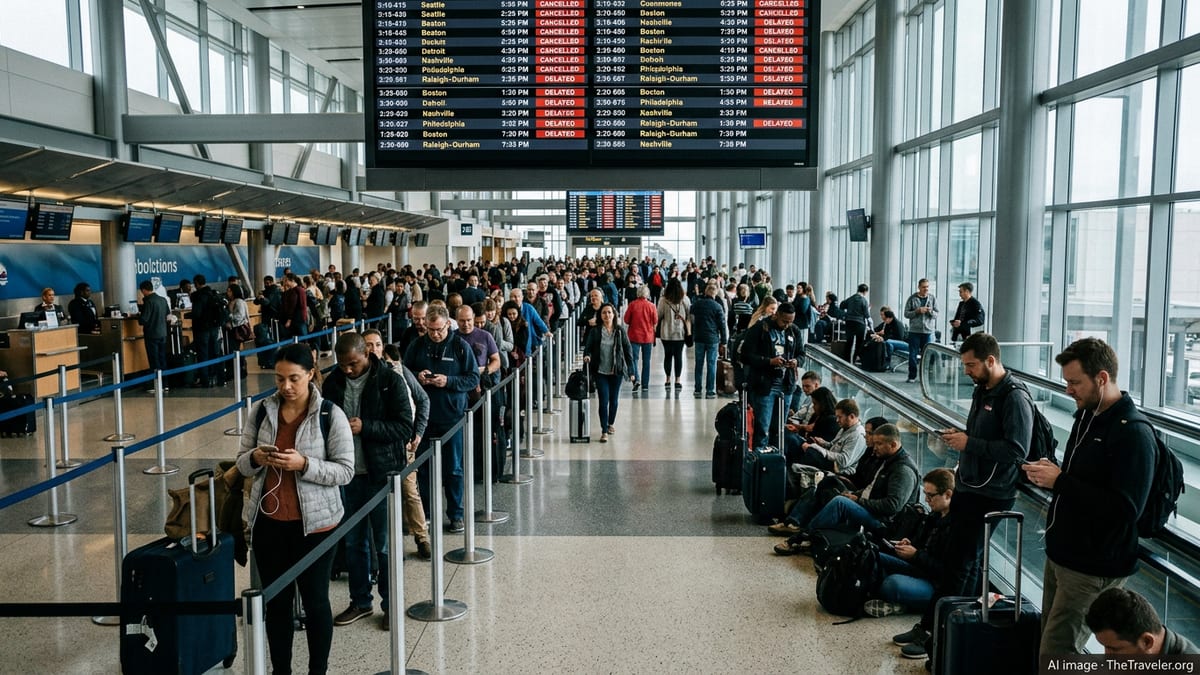
Ripple Effects Across Major U.S. Hubs
Operational disruptions at key airports on both coasts and in the Midwest are combining to create a difficult travel environment for passengers. Reports indicate that travelers departing from or connecting through Seattle, Boston, Detroit, Nashville, and Philadelphia are seeing extended waits at gates, last-minute schedule changes, and aircraft held on the ground as airlines attempt to rebalance networks.
These cities function as vital nodes in domestic and international air travel, handling tens of thousands of passengers daily. When multiple hubs experience problems at the same time, even a modest percentage of delayed or canceled flights can quickly cascade across the country, affecting travelers far beyond the original departure points.
Publicly available monitoring tools show that the disruptions are not confined to a single carrier or route structure. Instead, the pattern suggests a combination of factors, from shifting weather systems and airspace constraints to ongoing crew and aircraft positioning challenges that remain a persistent feature of the post-pandemic aviation landscape.
For many travelers, the immediate impact is uncertainty. Tight connections are being missed, business trips are being rearranged on short notice, and leisure travelers are facing unexpected extra nights in hotels or airport terminals as schedules continue to change throughout the day.
Raleigh–Durham International Records 104 Delays and 80 Cancellations
While major coastal and Midwestern hubs absorb much of the national attention, Raleigh–Durham International Airport has emerged as a focal point in the current wave of travel disruption. According to flight tracking dashboards and airline status pages reviewed on Sunday, the airport is reporting 104 delayed departures and arrivals, alongside 80 flight cancellations.
This volume of disruption is significant for a fast-growing but still mid-sized airport that serves the Research Triangle region of North Carolina. With a mixture of business travelers, university traffic, and leisure passengers, the concentration of delays and cancellations at Raleigh–Durham is rippling through itineraries that extend across the country.
Publicly available information shows that the affected flights at Raleigh–Durham span multiple carriers and a wide range of destinations, including key connections to the Northeast, Midwest, and West Coast. The high number of cancellations indicates that airlines are not merely pushing departure times later into the day, but in many cases are removing flights from the schedule entirely, forcing passengers to rebook on limited remaining options.
Travelers relying on Raleigh–Durham as a connecting point are particularly vulnerable in this environment. When an originating flight into the airport is delayed or canceled, downstream connections are often missed, triggering a chain of rebookings and further strain on already busy routes and overtaxed re-accommodation systems.
Weather, Congestion, and Resource Constraints Combine
While the precise mix of causes behind today’s disruptions can vary by airport and airline, several familiar pressure points continue to influence overall reliability. Weather remains a major factor, with storm systems, reduced visibility, and high winds periodically slowing traffic into and out of key hubs. Even when conditions improve locally, earlier weather-driven delays can leave aircraft and crews out of position for subsequent flights.
Airspace congestion and traffic management initiatives also play a role. When volumes are high along popular corridors on the East and West Coasts or across the Midwest, routing restrictions and flow-control measures can force airlines to hold aircraft at the gate or on the taxiway, pushing schedules behind and increasing the risk of missed connections.
Industry analysis published in recent months continues to highlight the lingering effects of staffing and resource constraints, including limited crew availability and maintenance backlogs. According to aggregated on-time performance data, the overall system has not yet returned to the operational stability seen before the pandemic, leaving airlines with less margin to absorb unexpected shocks without resorting to large-scale delays and cancellations.
At airports like Seattle, Boston, Detroit, Nashville, Philadelphia, and Raleigh–Durham, these overlapping pressures can be clearly seen in the daily boards of delayed and canceled flights. As one route after another shifts out of its scheduled window, the entire network becomes more fragile, and passengers encounter growing difficulty finding timely alternatives.
What Passengers Are Experiencing on the Ground
For passengers, the systemic issues translate into very immediate challenges at check-in counters, security lines, and departure gates. Travelers in affected airports report crowding around rebooking desks, lines at customer service kiosks, and rolling announcements as departure times continue to move. Some passengers are being offered later same-day flights, while others are being rebooked for the following day or routed through less direct connections.
Airport terminals in Seattle, Boston, Detroit, Nashville, and Philadelphia are seeing elevated numbers of stranded travelers attempting to adjust their plans. Families on school-break trips, solo business travelers, and international visitors alike are competing for limited open seats on remaining flights as airlines work through backlogs of disrupted itineraries.
At Raleigh–Durham International Airport, the 80 cancellations in particular are straining options for travelers who had planned to depart or arrive on specific time-sensitive flights. Publicly available information suggests that some passengers are turning to alternate airports within driving distance or shifting to different travel days entirely as remaining flights fill up.
Across the affected airports, hospitality businesses and ground transportation providers are also being pulled into the disruption cycle. Hotels near the terminals are seeing increased demand from travelers who suddenly need last-minute overnight stays, while rideshare and taxi services are making additional trips between airports, city centers, and nearby regional airports that may offer more reliable departures.
How Travelers Can Navigate Continued Disruptions
With disruptions continuing to ripple through the system, travel planning experts consistently emphasize preparation and flexibility. Public guidance regularly recommends that passengers monitor flight status closely through airline and airport channels, arrive early at the airport to account for security and check-in delays, and build longer connection windows into itineraries when possible.
Travelers facing canceled flights at hubs such as Seattle, Boston, Detroit, Nashville, Philadelphia, and Raleigh–Durham are often encouraged by consumer advocates to explore multiple rebooking options, including alternative nearby airports, different connection points, or even split itineraries on more than one carrier when practical. Same-day schedule changes can open up new opportunities as other passengers rebook or cancel their own trips.
Publicly available consumer rights information from federal agencies and airlines continues to stress that passengers should review the specific policies attached to their tickets, including rules on refunds, travel credits, and hotel or meal support in the event of significant delays or cancellations. While obligations can vary based on the cause of the disruption and the type of ticket purchased, understanding these details in advance can help travelers make quicker decisions at the airport.
For now, the latest data showing 104 new delays and 80 cancellations at Raleigh–Durham International Airport, alongside rolling disruptions at Seattle, Boston, Detroit, Nashville, and Philadelphia, suggest that U.S. air travel remains vulnerable to multi-day periods of instability. Passengers planning to fly in or out of these airports are likely to benefit from closely tracking developments throughout the day and remaining ready to adjust plans as conditions evolve.