

More news on this day
Air travel in the United Arab Emirates faced fresh disruption this week as publicly available tracking data showed 113 flight delays and several cancellations affecting major carriers including Air Arabia, Emirates, FlyDubai, IndiGo, Air India and EgyptAir across Dubai, Sharjah, Abu Dhabi and other airports.
Get the latest news straight to your inbox!
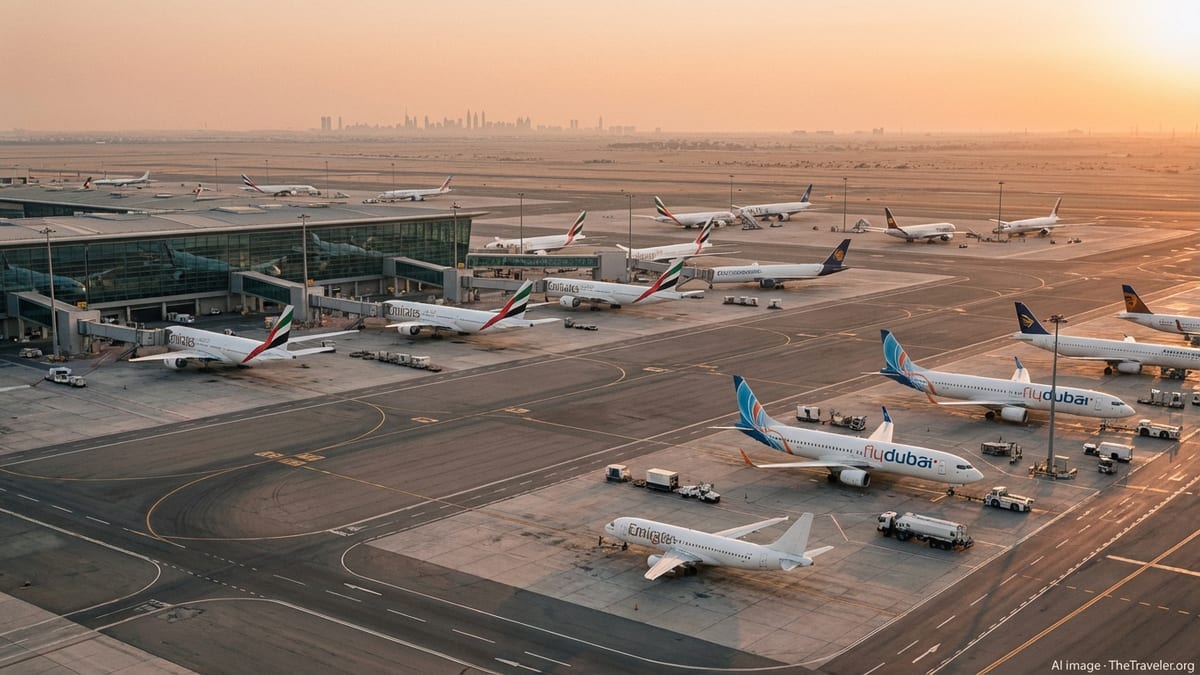
New Wave of Disruption Across UAE Hubs
The latest turbulence for travellers in the UAE comes on the heels of an already challenging spring for the region’s aviation sector. Data compiled from flight tracking platforms and airline operation updates indicates that a combined 113 flights were delayed and at least six services were cancelled or heavily curtailed across the country’s main hubs over a short window, with knock on effects on subsequent rotations.
Dubai International, Sharjah International and Abu Dhabi’s Zayed International Airport were at the center of the disruption, reflecting their role as key transit points between Europe, Asia and Africa. Delays stretched from moderate schedule slippages of under an hour to multi hour setbacks that pushed some services into the early hours of the following day, straining airport resources and passenger patience.
Reports from aviation analytics providers suggest that while the absolute number of cancellations remained limited compared with earlier peaks in March, the concentration of more than one hundred delayed flights within a compressed time frame created visible congestion at terminal gates and security checkpoints. The pattern also complicated aircraft and crew rotations, leading to further rolling delays on busy regional and South Asian routes.
The latest figures echo earlier episodes in mid May, when disruption tracking services logged 113 delays and a cluster of cancellations at Dubai and Sharjah, underscoring how sensitive UAE operations remain to regional airspace constraints and high seasonal demand.
Emirates, FlyDubai and Air Arabia Bear the Brunt
Home carriers Emirates and FlyDubai once again featured prominently in the disruption statistics, reflecting their dominant share of movements at Dubai International as well as their dense schedules on Gulf and South Asian routes. Publicly available airline advisories show that while most flights continued to operate, a significant portion did so outside their planned slots, in some cases after extended ground holds.
At Sharjah, low cost specialist Air Arabia and its Abu Dhabi unit were among the most affected operators. Published disruption summaries for mid May highlighted Air Arabia as the primary carrier impacted at Sharjah when more than one hundred flights were delayed or cancelled across the two northern emirate hubs. The airline has spent much of the spring adjusting schedules and re routing services around temporary airspace restrictions that lengthened flight times into and out of the Gulf.
Regional and international carriers were also caught up in the latest wave of delays. Flight status pages and real time trackers show scattered disruptions for EgyptAir on services between Dubai and Cairo, as well as for Indian carriers operating dense shuttle routes linking the UAE with major cities such as Delhi, Mumbai and Kochi. The clustered impact across several operators compounded congestion at peak bank times when many long haul connections are normally processed.
Operational experts cited in open industry analysis note that even modest timing slips at a hub like Dubai can quickly ripple through network schedules. When multiple airlines experience concurrent delays, access to stands, runway slots and air traffic management corridors becomes more constrained, making recovery slower even after the initial trigger eases.
IndiGo and Air India Adjust India UAE Corridors
Indian carriers IndiGo and Air India, including low cost affiliate Air India Express, have been especially exposed to the recent instability in UAE air operations. A series of media notes and schedule updates from Air India in March and April outlined repeated adjustments to flights serving Dubai, Abu Dhabi, Sharjah and Ras Al Khaimah, at times suspending regular services and relying on ad hoc operations to move stranded passengers.
In several recent updates, Air India detailed days when no scheduled services operated into Dubai, with only select relief flights mounted from Delhi and Mumbai. Abu Dhabi and Sharjah saw periods where scheduled operations were suspended and later partially restored through limited rotations to key Indian cities such as Bengaluru, Kochi, Kozhikode and Mangalore. These measures were framed as responses to capacity constraints and evolving guidance from airport operators in the Gulf.
IndiGo, which has built a substantial footprint in the India UAE market, has likewise been forced to tweak timings and routings. Coverage in Indian and Gulf media over recent weeks has documented rerouted services and selective cancellations as the airline navigated both regional airspace limits and tight ground capacity in the UAE. The latest cluster of 113 delays is expected to add further strain to already stretched India bound corridors, where load factors remain high and spare seat capacity is limited.
For passengers, the result has been longer journey times, unexpected overnight stays and complicated rebooking experiences, particularly for those travelling on separate tickets or connecting between low cost and full service carriers. Travel agents report that many customers now seek greater schedule buffers at Dubai and Abu Dhabi to guard against missed onward flights.
Airspace Constraints and Operational Bottlenecks
The renewed travel chaos cannot be separated from wider regional dynamics. Emergency airspace restrictions imposed over parts of the Gulf in early May, following missile and drone incidents involving Iran and the UAE, forced airlines to fly through narrower corridors and, in some cases, divert services to neighboring hubs. Industry briefings on these restrictions note that even when airports remain technically open, rerouting traffic through limited paths often adds flight time and compresses arrival and departure banks.
Earlier in the season, disruption trackers recorded hundreds of cancellations and more than three hundred delays across Dubai, Abu Dhabi and Sharjah in the space of a few days as carriers responded to rapidly changing overflight permissions. Although conditions have gradually improved and airspace within the UAE is reported to be fully available again, the system remains finely balanced and susceptible to renewed congestion when weather, technical issues or external events collide with peak demand.
Local airport operators have emphasized in public communications that they are working with airlines and service partners to rebuild capacity and smooth passenger flows. Recent updates from Dubai Airports highlight efforts to increase flight movements in line with available routing capacity while maintaining high load factors on key markets, particularly India, Saudi Arabia and the United Kingdom.
Analysts point out that the hub and spoke model that made the UAE a global connection point can also magnify the impact of disruption. When several waves of connecting flights are tightly scheduled around shared transfer windows, relatively minor delays can cascade into missed connections and equipment misplacements, adding to the visibility of any operational hiccup.
What Passengers Are Experiencing and How They Can Respond
For travellers on the ground, the statistics translate into long queues at check in counters, crowded departure halls and uncertainty over boarding times. Social media posts and local coverage from recent disruption days in Dubai and Sharjah describe passengers waiting hours for updated gate information and, in some cases, learning of cancellations only after extended delays. Families connecting between South Asia, the Gulf and Europe have been particularly vulnerable due to limited alternative routings that avoid UAE hubs.
Consumer rights advocates note that passenger entitlements can vary significantly depending on the airline, route and jurisdiction. Some carriers operating out of the UAE have provided rebooking options, travel vouchers or refunds during the most severe disruption days, while others have emphasized that extraordinary external events constrain their obligations. Travel law specialists quoted in public guides recommend that passengers retain boarding passes, booking confirmations and any written notices of delay or cancellation to support later claims.
Advisories published by both airlines and airports in recent weeks consistently urge travellers to monitor their flight status closely before leaving for the airport, use official apps where available and allow additional time for security and immigration processing. Those with tight connections in Dubai, Abu Dhabi or Sharjah are being encouraged to consider longer layovers or flexible tickets that permit same day changes without significant penalties.
With summer travel demand beginning to build, industry observers warn that further pockets of disruption are possible if regional tensions flare again or if airspace corridors are temporarily narrowed. While the concentration of 113 delays and a handful of cancellations represents a smaller shock than the mass groundings seen earlier this year, it serves as a reminder that air travel across the Gulf remains exposed to external shocks, even as carriers and airports work to restore the predictability that helped turn the UAE into one of the world’s busiest aviation crossroads.