

More news on this day
As missiles, drones and airspace closures roil the Middle East, Gulf giants Emirates, Qatar Airways, Etihad Airways and Flydubai are cautiously restarting limited flights from Dubai and Abu Dhabi, leaving travelers to navigate shifting schedules, evolving waivers and mounting financial risks.
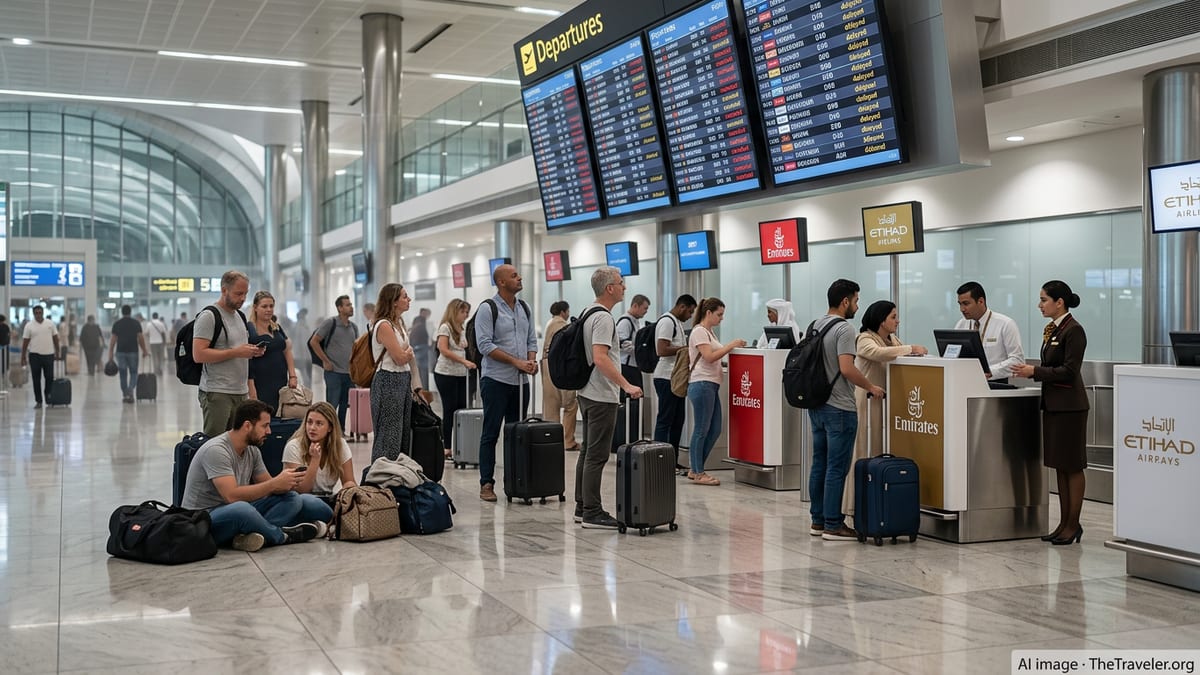
Patchwork Resumptions From Dubai and Abu Dhabi
Dubai and Abu Dhabi, long marketed as ultra-reliable global hubs, are now operating on a fragile patchwork of permissions as authorities partially reopen airspace in bursts. Emirates has begun running a reduced schedule of select services while keeping all regular scheduled flights formally suspended until at least March 7, with operations concentrated on repatriation and a handful of long-haul routes that can be flown via safer corridors. Passengers are being told not to go to the airport unless they have a confirmed booking and written confirmation that their specific flight is operating.
In Abu Dhabi, Etihad Airways is operating in an even narrower window. Commercial services to and from its Zayed International Airport base remain largely on hold, with the airline pivoting to evacuation, repositioning and cargo flights when airspace openings allow. Official advisories continue to warn that all scheduled flights to and from Abu Dhabi are suspended until at least the early hours of March 6, and that further extensions are possible if regional skies do not stabilize.
Qatar Airways, whose Doha hub sits directly under some of the most sensitive airspace, has kept its regular network frozen while it organizes ad hoc relief flights to move stranded travelers out of the region. Flydubai, the Dubai-based low-cost carrier, has resumed a limited number of flights to selected destinations after several days of total suspension, but emphasizes that operations remain highly constrained and subject to last-minute cancellation. Across the Gulf, what is flying is primarily exceptional, not yet a return to normal schedules.
For travelers on the ground in Dubai and Abu Dhabi, that means departures can vary dramatically from one hour to the next. Airports have reopened terminals, but capacity is far from full, with waves of passengers lining up for scarce outbound seats while many scheduled services remain blocked in reservation systems or disappear only hours before departure.
Refunds, Rebookings and Penalties: What the Airlines Say
The central concern for passengers is straightforward: if the airline cancels, will I get my money back, and how quickly can I be rebooked. Emirates has told customers that tickets on flights canceled due to the airspace crisis can be refunded without penalty or rebooked onto later dates, often without change fees. However, travelers report a clear distinction between flights formally canceled and those still listed as operating, with agents sometimes unable to process penalty-free changes until the system reflects an official cancellation.
Etihad is following a similar pattern, offering fee-free changes, travel credits or refunds on affected sectors while asking passengers to wait for confirmation that their specific flight is canceled before requesting a full refund. Both Emirates and Etihad are encouraging customers to use online self-service tools where possible, but heavy demand and incomplete automation mean many cases still require manual intervention. Contact centers and airport ticket desks remain overwhelmed, and some travelers have complained of conflicting information about which penalties apply.
Qatar Airways has announced that passengers booked to travel during the current airspace shutdown can change dates or seek refunds without standard penalties, but capacity to rebook is limited by the near-total closure of its Doha operations. Flydubai has issued its own disruption policies, allowing customers whose flights are canceled to rebook at no extra charge, request vouchers or seek refunds. In practice, travelers say the speed and generosity of resolutions can vary, particularly for complex itineraries involving codeshares or separate tickets.
One critical nuance is that standard fare rules and no-change clauses are often overridden by special disruption policies when airspace is closed due to conflict. Even highly restrictive economy tickets that normally attract steep fees are being converted into flexible vouchers or fully refunded in many cases. Passengers who bought the cheapest nonrefundable options before the crisis are finding that these emergency waivers can erase penalties that would otherwise have applied.
Hidden Risks for New Bookings and ‘Phantom’ Flights
At the same time as they cancel large swaths of their schedules, several Gulf carriers continue to sell tickets on flights later in March that may never take off if the conflict drags on. Consumer advocates warn that this can create so-called phantom flights, visible in booking engines but at high risk of cancellation, locking in thousands of dollars in future refunds rather than immediate travel certainty.
Emirates and Etihad argue that keeping future dates on sale allows them to restart quickly if airspace reopens, and that any subsequently canceled flights will be refunded or rebooked without penalties. Yet for travelers, especially those departing from North America and Europe, this can mean paying for a supposedly confirmed itinerary that unravels days before departure, with hotel stays, tours and connecting tickets thrown into disarray.
Qatar Airways faces similar scrutiny out of Doha. While regular operations are suspended, some itineraries for later this month remain purchasable, even as government advisories warn against nonessential travel to the region. Flydubai and other low-cost carriers have also kept forward schedules open in their systems while issuing rolling updates on which flights will actually operate, sometimes only 24 to 48 hours in advance.
Travelers considering new bookings into Dubai or Abu Dhabi are being urged by industry experts to treat every reservation as provisional, regardless of the fare class or marketing language around guarantees. The financial risk may be mitigated by eventual refunds, but the opportunity cost of stranded time, missed events and cascading rebookings can be severe, particularly for once-in-a-lifetime trips or business-critical travel.
How to Protect Yourself if You Must Travel
Given the volatility, specialists recommend that only essential travelers attempt to route through Dubai or Abu Dhabi until regular schedules clearly resume. For those who must fly, several practical steps can reduce exposure. First, book directly with the operating carrier rather than through third-party online agencies, which can complicate refund processing and delay rebookings. Having a single point of contact can be crucial when schedules change overnight.
Second, look for flexible or refundable fares where possible, even if they appear significantly more expensive on the screen. In the context of the current crisis, the price difference can be outweighed by the ability to shift dates without penalty or accept partial itineraries without losing the full value of the ticket. Where airlines offer explicit crisis waivers, reading the fine print before purchase can clarify whether voluntary changes are included, or if flexibility applies only once the airline cancels.
Third, lean on robust travel insurance that specifically covers war-related disruptions, government-imposed airspace closures and missed connections caused by security events. Many standard policies exclude these scenarios or only cover a fraction of costs. Travelers should verify in writing whether their policy recognizes the current Middle East conflict as a covered event and what documentation, such as airline cancellation notices, is required to substantiate a claim.
Finally, passengers in Dubai and Abu Dhabi are advised to maintain a conservative approach to airport trips. Airlines and airports continue to stress that no one should travel to terminals without a confirmed, operating flight, as crowds of hopeful standby passengers strain limited resources. Real-time flight tracking and direct airline alerts are becoming as important as passports and boarding passes.
What Comes Next for Gulf Aviation Hubs
The unfolding crisis is testing the resilience of the Gulf aviation model, which depends on open air corridors linking Europe, Asia, Africa and the Americas through Dubai, Abu Dhabi and Doha. Even as Emirates, Etihad, Qatar Airways and Flydubai experiment with partial resumptions and emergency corridors, their ability to restore normal traffic hinges on regional governments lifting airspace restrictions and security agencies assessing missile and drone threats as manageable.
In the short term, industry analysts expect more of the same: rolling extensions of suspensions punctuated by bursts of repatriation flights, all accompanied by evolving waiver policies on penalties and refunds. For airlines, balancing cash flow from new bookings with reputational risks around canceled services is a delicate act. For travelers, the path forward will involve constant vigilance and a willingness to change plans at short notice.
Over the longer term, the current upheaval may reshape how travelers think about Gulf hubs. Some may temporarily favor routings via Europe, East Asia or other regions perceived as safer, while others will return as soon as schedules normalize, drawn by the connectivity and service standards that made these carriers global favorites. For now, anyone booking into or through Dubai and Abu Dhabi must weigh the chance of smooth passage against the very real possibility of delays, diversions and extended stays they never planned.
Until the Middle East’s skies are reliably open again, every ticket on Emirates, Qatar Airways, Etihad or Flydubai carries a caveat that no set of fare rules can fully erase: in a conflict-driven shutdown, the rules can change overnight, and travelers share in that uncertainty.