

More news on this day
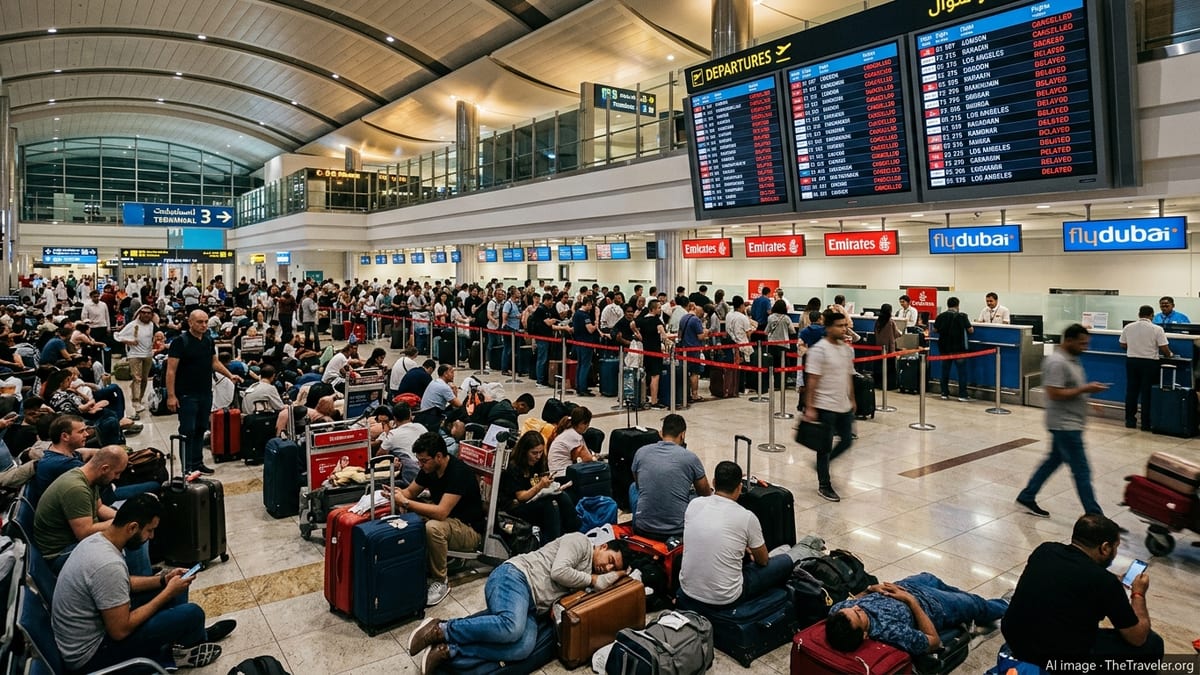
Hundreds of travellers were stranded across the United Arab Emirates today as airports in Dubai, Abu Dhabi, Al Ain and Fujairah cancelled at least 79 flights and delayed 125 more, disrupting operations for Emirates, FlyDubai, Etihad Airways, Gulf Air and several other regional and international carriers.
Get the latest news straight to your inbox!
Major Hubs in Dubai and Abu Dhabi Struggle to Stabilise Schedules
Dubai International and Abu Dhabi’s main airport remained under acute strain as airlines attempted to navigate regional airspace restrictions and evolving security assessments. Publicly available flight-tracking data and local media coverage show a rolling wave of cancellations and extended delays affecting both arriving and departing services, with knock-on disruption rippling across long-haul networks.
Dubai, normally one of the world’s busiest international hubs, has seen tight capacity limits and sudden schedule changes as airlines work around constrained routing options. Emirates and FlyDubai have cancelled or re-timed multiple services, affecting connections to Europe, Asia and North America. Passengers connecting through the city reported missed onward flights and lengthy rebooking queues.
In Abu Dhabi, Etihad Airways has been operating a reduced programme, with several departures scrubbed at short notice and others pushed back by hours. Available operational updates indicate that cargo, repatriation and limited commercial flights are taking priority, complicating travel plans for those on standard point-to-point itineraries and complex multi-leg journeys.
The twin-airport disruption has amplified pressure on the wider UAE aviation system, with aircraft and crew frequently out of position and airlines racing to rebuild coherent schedules one rotation at a time.
Smaller Airports in Al Ain and Fujairah Face Capacity and Routing Constraints
While Dubai and Abu Dhabi have absorbed most of the attention, smaller airports in Al Ain and Fujairah have also been drawn into the disruption. These secondary gateways, which typically handle a mix of regional services, charter operations and cargo flights, are now playing an outsized role in efforts to move stranded passengers.
Reports from regional outlets and traveller forums indicate that selected carriers, including Gulf Air and smaller Middle Eastern and South Asian airlines, have diverted aircraft or scheduled temporary services via these airports. The aim is to bypass the most congested hubs and make use of available slots and ground-handling capacity away from the main international gateways.
However, Al Ain and Fujairah were never designed to absorb sudden surges of passenger traffic on this scale. Terminal facilities, check-in capacity and ground transport links are under visible strain, leading to crowding, slow processing times and limited options for food, rest and onward travel. Travellers arriving unexpectedly in these cities often face an additional overland journey back to Dubai or Abu Dhabi once they finally secure a flight.
The patchwork use of secondary airports highlights how deeply the current disruption has penetrated the UAE’s normally smooth aviation ecosystem, forcing airlines and passengers alike into unfamiliar routings and improvised contingency plans.
Travellers Confront Long Queues, Limited Information and Accommodation Gaps
For passengers caught in the middle, the operational complexity translates into long hours on terminal floors, extended queues at service desks and uncertain timelines. Accounts shared on social media and travel forums describe travellers sleeping on chairs or carpets, competing for scarce charging points and struggling to secure updated itineraries as airline apps and websites lag behind real-time changes.
Accommodation remains a flashpoint. With so many short-notice cancellations, hotels near Dubai and Abu Dhabi airports have filled quickly, leaving some travellers to fend for themselves in distant neighbourhoods or remain inside terminals overnight. While some airlines are arranging hotel stays and transport for eligible passengers, capacity constraints and differing ticket conditions mean not everyone receives the same level of support.
Information gaps add to the frustration. Publicly accessible statements from airlines emphasise safety and evolving operational conditions, but individual passengers often report receiving conflicting messages from call centres, airport staff and automated notifications. Departure times can shift repeatedly within a single day as aircraft and crews become available or airspace conditions change.
Families with small children, elderly travellers and those with critical onward connections have been particularly affected. Medical appointments, exams, work commitments and key life events have been missed or postponed, underscoring how far-reaching the impact of disrupted Gulf aviation can be for travellers around the world.
Emirates, Etihad, FlyDubai and Gulf Air Adjust Networks in Real Time
The UAE’s flagship carriers and regional rivals are engaged in a complex, real-time reshaping of their networks to cope with the evolving situation. Publicly available schedules and airline advisories show a pattern of prioritising certain trunk routes while temporarily suspending or consolidating less critical services.
Emirates has been reallocating widebody capacity to high-demand destinations and key connection banks in an effort to clear backlogs of stranded passengers. Some long-haul flights are departing nearly full with rebooked travellers from earlier days, while others are merged or rescheduled to make better use of limited slots and safe flight corridors.
Etihad, based in Abu Dhabi, continues to operate a trimmed schedule centred on select regional and long-haul links, with a particular focus on repatriation flows. The airline’s public updates advise travellers not to proceed to the airport without a confirmed, active booking and stress that operations remain subject to rapid change.
Low-cost carrier FlyDubai has reduced frequencies on several short-haul routes while keeping a skeleton network alive to maintain essential connectivity within the region. Gulf Air and other Gulf-based airlines have rerouted or re-timed services to avoid heavily restricted airspace, further complicating connection patterns for passengers using the UAE as a transit hub.
What Passengers Can Expect in the Coming Days
Industry analysts and regional aviation observers suggest that while limited recovery is likely as airlines and regulators refine safe operating windows, disruption is expected to continue in the short term. Aircraft and crew remain significantly out of position, and the backlog of displaced passengers will take days, if not weeks, to clear even once more normal operations resume.
Publicly available guidance from airlines and local airport operators consistently urges passengers to check their flight status before leaving home, arrive at the airport only with a confirmed booking, and allow additional time for check-in and security. Travellers are also being encouraged to remain flexible about routings, dates and even departure airports, as last-minute changes and diversions remain common.
Travel insurers and consumer advocates note that policyholders should keep careful documentation of cancellations, delays, extra accommodation costs and alternative transport arrangements in case they are eligible for reimbursement. However, coverage terms vary widely, particularly where disruptions are linked to regional instability or airspace closures rather than routine operational issues.
For now, the immediate reality across Dubai, Abu Dhabi, Al Ain and Fujairah is one of continuing uncertainty. As airlines work to rebuild their schedules and restore confidence, passengers are likely to face a challenging mix of crowded terminals, changing departure boards and extended journeys through one of the world’s most important aviation crossroads.