


More news on this day
Passengers connecting through the United Arab Emirates continue to face rolling disruption after a wave of linked-flight cancellations across Emirates, FlyDubai, Air Arabia and partner carriers upended itineraries on key routes between Europe, the Gulf and South Asia.
Get the latest news straight to your inbox!
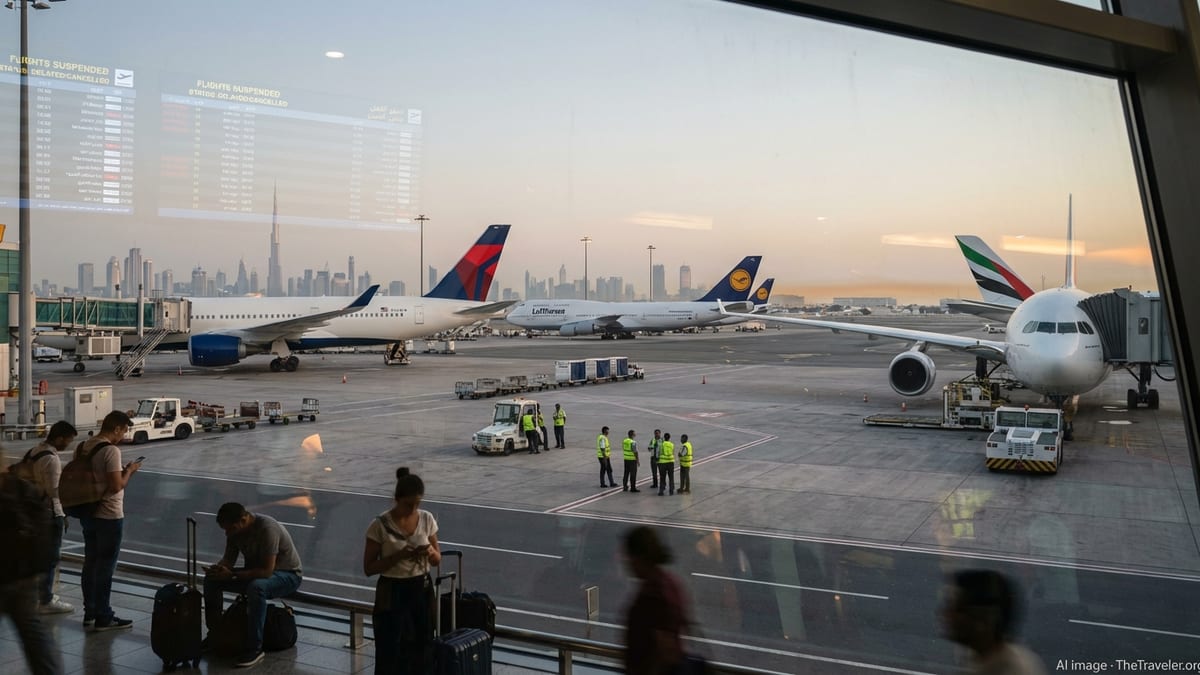
Regional Airspace Crisis Still Rippling Through UAE Hubs
Recent travel disruption traces back to late February 2026, when regional airspace closures around the Gulf forced major carriers to halt or sharply curtail operations. Publicly available timelines show that airspace restrictions affecting Dubai, Abu Dhabi, Sharjah and Doha triggered thousands of cancellations in the first week alone, overwhelming airports that function as critical connecting hubs between Europe, Africa and Asia.
Although airlines have since restored portions of their schedules, reports indicate that the network remains fragile, with disruption flaring whenever routes require detours around sensitive airspace. This instability has left many passengers stranded mid-journey, particularly those traveling on complex itineraries that combine multiple Gulf carriers on a single ticket.
Industry coverage suggests that more than 20,000 flights were canceled or rerouted across Dubai and Doha during the height of the crisis, creating a backlog that some carriers are still working through. With aircraft and crews out of position and slot availability constrained, recovery has been uneven across destinations and alliances.
For travelers, the result is a patchwork of last-minute delays, cancellations and rebookings that can turn what should be a predictable connection in the UAE into an unexpected overnight stay or multi-day wait.
Six Key Cancellations Disrupt Paris, Dubai, Cairo and Beyond
Within this broader turbulence, a new cluster of six key cancellations in recent days has drawn attention because of its impact across high-demand routes. According to published schedules and media summaries, affected flights include links between Paris and Dubai, as well as services touching Cairo, Kabul, Lahore, Doha, Abu Dhabi and Sharjah.
In several cases, long-haul flights from European gateways to Dubai have operated, only for onward regional legs to be scrubbed on short notice when operational clearances or crew availability could not be guaranteed. This dynamic has been especially pronounced for travelers heading onward from Dubai and Abu Dhabi to cities such as Kabul and Lahore, where alternative connections are limited and demand remains strong.
Regional media reporting also highlights disruption on routes connecting the UAE with Doha and Sharjah, compounding the challenge for passengers using multi-city itineraries or separate tickets to piece together cheaper journeys. A single canceled link in this chain can render an entire trip unworkable, as missed onward legs may carry strict no-show rules.
Capacity reductions on some Paris and other European services have further narrowed options. Even when replacement flights exist, seats on remaining departures can sell out quickly, making same-day recovery difficult for stranded passengers who were expecting seamless connections through Dubai or Abu Dhabi.
Emirates, FlyDubai, Air Arabia and Partner Carriers Under Pressure
Emirates, FlyDubai and Air Arabia, along with regional partners and codeshare airlines, continue to operate under constrained conditions brought on by earlier airspace closures. Publicly available airline advisories show that schedules have been rebuilt in stages, with priority placed on high-yield trunk routes and on repatriating travelers who were stranded during the initial shutdowns.
Emirates, the largest carrier at Dubai International, has progressively reintroduced long-haul services but still faces challenges aligning inbound and outbound connections on certain city pairs. Industry analysts note that even minor timing adjustments can cascade through a network of global connections, creating new missed links for passengers traveling from Europe to Africa or South Asia via Dubai.
FlyDubai and Air Arabia, which provide many of the short and medium-haul connections from Dubai, Abu Dhabi and Sharjah to secondary cities, play a crucial role in this ecosystem. When these regional feeders are disrupted, passengers arriving on widebody flights from hubs such as Paris, London or Toronto can find that their onward legs to destinations like Kabul, Lahore or smaller Middle Eastern cities are no longer operating as planned.
Partner carriers and codeshare arrangements add another layer of complexity. Some European and Asian airlines have suspended or reduced services to Dubai, Abu Dhabi and Doha in response to airspace and security concerns, narrowing the pool of alternative options that Gulf carriers can use for rebooking. The result is a constrained network in which a comparatively small number of cancellations or schedule changes can leave a disproportionate number of travelers without easy alternatives.
Impact on Stranded Transit Passengers in the UAE
The most visible consequence of the latest round of linked cancellations has been the number of travelers stranded in transit in Dubai, Abu Dhabi and Sharjah. Public reports from airport departure boards and local media coverage show passengers sleeping in terminals, queuing at service desks and competing for limited hotel rooms near the airports.
Transit passengers are particularly vulnerable because they often arrive in the UAE without local visas or confirmed accommodation, expecting only a brief layover before their next flight. When an onward leg is canceled or heavily delayed, they can be left in a legal and logistical gray area, reliant on airline assistance to secure rebooking, temporary hotel stays or facilitated entry when permitted under local regulations.
Families heading from Europe to South Asia via Dubai, business travelers bound for Gulf capitals such as Doha or Abu Dhabi, and migrant workers returning to cities like Lahore and Kabul appear among the groups most affected. For these travelers, delays can mean missed family events, forfeited hotel bookings, or lost days of work, as well as additional costs for food, accommodation and ground transport.
Travel industry observers also point out that the psychological impact is significant. Sudden uncertainty about safety, routing and timing, combined with rapidly changing information, can leave passengers feeling they must constantly monitor schedules and airline apps even while in the air or in transit lounges.
What Travelers Need to Know and Do Now
With the network still stabilizing, publicly available guidance from airlines, airports and travel advisors emphasizes preparation and flexibility for anyone connecting through the UAE in the coming days and weeks. Passengers are urged to check flight status repeatedly before departure, not only from their origin airport but also for all onward segments, particularly those touching Dubai, Abu Dhabi, Sharjah or Doha.
Travel experts recommend that passengers on itineraries involving high-risk corridors or multiple Gulf hubs build in longer connection times than usual, and avoid separate tickets where possible. Booking all legs on a single ticket, ideally with the same airline group or alliance, can improve the chances of automatic rebooking if one segment is canceled.
Those already stranded are advised to seek written confirmation of any cancellation or long delay, to keep receipts for meals, ground transport and accommodation, and to use official airline channels or airport information desks rather than informal intermediaries. Published guidance also suggests monitoring both the operating airline and the departure airport on social media and official channels, as schedule changes are sometimes announced there before they appear in booking systems.
While airlines across the UAE are gradually rebuilding their networks, the latest cluster of cancellations on routes linking Paris, Dubai, Cairo, Kabul, Lahore, Doha, Abu Dhabi and Sharjah shows that conditions remain fluid. Travelers planning to cross the region in the near term are likely to face a more unpredictable journey than usual and may need to prepare for sudden changes as carriers continue to navigate an evolving airspace and security landscape.