


More news on this day
UAE carriers including Emirates and Etihad are maintaining near-normal schedules despite renewed US-Iran tensions around the Strait of Hormuz, with publicly available data indicating high load factors and only targeted operational adjustments so far.
Get the latest news straight to your inbox!
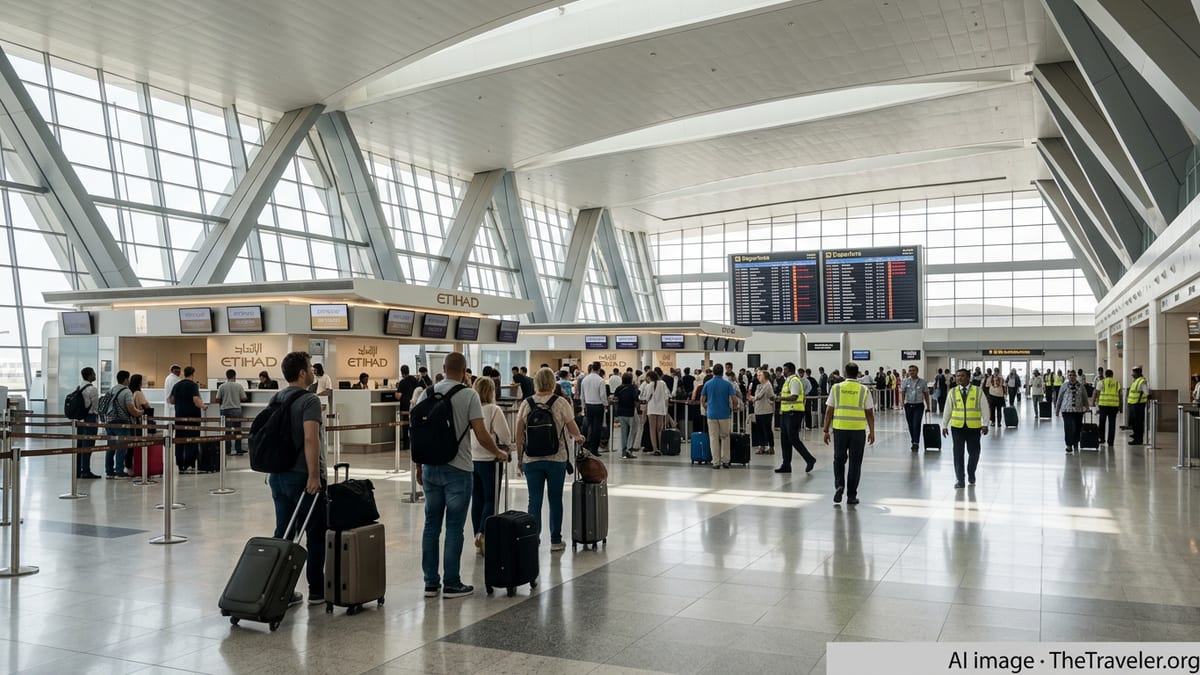
Near-full operations for Emirates, Etihad and other UAE carriers
Recent aviation and travel industry coverage indicates that major Gulf carriers have restored flight activity to close to pre-conflict levels, even as security concerns intensify across the region. Reports on airline capacity show Emirates, Etihad Airways, flydubai and Air Arabia operating at or near 90 percent of their earlier schedules, supported by strong demand on routes connecting Asia, Europe and North America.
Travel trade sources cited in regional business media describe Emirates and Etihad flights as heavily booked on key long-haul routes, with aircraft often departing at or close to full capacity. This pattern appears consistent with anecdotal accounts from recent passengers, who report limited empty seats on services between the UAE and major US and European gateways.
Industry analysis suggests that the hub-and-spoke model centered on Dubai and Abu Dhabi has helped sustain traffic flows, even as other parts of the Middle East aviation market remain more volatile. The proximity of UAE airports to fuel and logistics hubs, combined with established partnerships and codeshares, is also seen as supporting operational resilience during periods of geopolitical stress.
Despite the heightened security backdrop, publicly available flight-tracking data continues to show dense arrival and departure banks at Dubai International, Abu Dhabi’s Zayed International and Sharjah International. Summer travel demand from expatriate residents and transit passengers connecting between continents is contributing to the robust traffic levels.
Route adjustments and airspace management amid US-Iran flare-up
The latest escalation between the United States and Iran, including reported strikes and missile activity around the Strait of Hormuz, has refocused attention on regional airspace corridors that are critical for international aviation. Coverage from Gulf-based outlets notes that authorities and air navigation service providers in multiple countries are closely monitoring the evolving security environment and issuing route guidance as needed.
For UAE-based airlines, the primary operational response so far appears to involve selective rerouting and altitude adjustments on certain flight paths rather than large-scale cancellations. Historical practice in earlier phases of the conflict shows carriers temporarily avoiding specific airspace segments judged to carry higher risk, while still maintaining overall connectivity through alternative routings that may add modest time to some journeys.
Aviation analysts quoted in regional and international reports emphasize that commercial overflights are typically shielded from the most sensitive military zones through coordination between civil aviation authorities and airline operations centers. In practice, this means that passengers may experience longer flight times or minor schedule changes, but core links between the UAE, the United States and Europe remain intact unless formal airspace closures are announced.
Available information from previous surges in tension indicates that when wider airspace shutdowns have occurred, such as during earlier missile exchanges, Emirates and Etihad have temporarily suspended or consolidated selected services before gradually rebuilding schedules as conditions stabilized. At present, however, the prevailing pattern is one of continuity with adjustments, rather than sweeping suspensions.
Passenger experience: high demand, travel advisories and flexible policies
From a traveler’s perspective, the most noticeable impact of the latest US-Iran tensions has been a combination of strong demand on UAE routes and heightened caution reflected in government travel advisories. Some countries have updated their guidance to residents, advising them to avoid non-essential travel to certain destinations in the wider Gulf region or to exercise increased vigilance when transiting major hubs.
Despite these advisories, booking trends reported by travel agencies suggest that many passengers are continuing with their plans, particularly for routes that use Dubai or Abu Dhabi as transit points rather than final destinations. Long-haul itineraries linking Asia, Europe and North America via the UAE have remained popular, with travelers often prioritizing schedule frequency, service quality and connection times.
Publicly available statements and past policy updates from Emirates and Etihad indicate that the carriers typically respond to geopolitical uncertainty with flexible rebooking or refund options when flights are significantly disrupted. While there has been no broad announcement of new waivers specifically tied to the latest spike in tensions, travelers are being encouraged in published guidance to monitor airline channels and update contact details so they can receive real-time notifications of any changes.
Travel forums and social media posts show a mix of concern and reassurance among passengers, with some expressing anxiety about flying near conflict zones and others noting that previous trips through UAE hubs have proceeded without incident despite headline-grabbing developments. The common thread in much of the publicly shared advice is the importance of checking flight status frequently and allowing extra time at airports.
Regional context: Strait of Hormuz disruption risks and resilience
The renewed confrontation between Washington and Tehran has once again highlighted the strategic vulnerability of the Strait of Hormuz, a narrow waterway that is vital for global energy shipments and lies close to established air corridors. Recent coverage of missile and drone activity around the strait, as well as reported attacks on commercial vessels, has raised questions about how far the conflict might encroach on civilian aviation routes.
Security analysts cited in regional explainers underscore that while maritime traffic faces direct exposure to any closure or partial shutdown of the strait, aviation risk is managed through layered controls. Military and civil authorities generally prioritize the protection of civilian airliners, and air corridors can be shifted away from localized conflict areas, albeit at a cost in fuel and time.
The UAE’s aviation sector has already navigated multiple phases of the broader US-Iran conflict this year. Earlier flare-ups prompted temporary airspace restrictions and short-lived suspensions of some services before flight volumes recovered to more than 80 percent of pre-crisis levels, according to industry data published in recent months. This track record of phased disruption followed by rapid restoration is often highlighted as evidence of the sector’s underlying resilience.
Nonetheless, analysts note that a prolonged shutdown of key airspace or further escalation around the Strait of Hormuz could pressure schedules and airline finances, particularly if fuel costs rise or insurance premiums increase. In that scenario, carriers might be forced to trim frequencies on marginal routes or deploy smaller aircraft on selected services while preserving core trunk connections.
What travelers should watch in the days ahead
With tensions still elevated, aviation observers suggest that travelers planning to fly with Emirates, Etihad or other UAE-based carriers should pay close attention to several indicators in the coming days. These include any new notices from civil aviation regulators about airspace restrictions, updated travel advisories from home governments, and operational bulletins issued by airlines regarding schedule changes or waivers.
Publicly available information from previous periods of instability shows that airlines typically prioritize safety and regulatory compliance above all else. If risk assessments shift, adjustments can be implemented quickly, ranging from rerouting specific flights to temporarily suspending services on particular sectors. Such moves are generally communicated through official airline channels, airport announcements and direct messages to affected passengers.
For now, the prevailing picture is one of cautious continuity. Flights into and out of the UAE’s major hubs remain busy and broadly on schedule, even as the geopolitical backdrop grows more complex. Travelers who remain flexible, stay informed and build extra time into their itineraries are, according to widely shared guidance, best positioned to navigate any short-notice changes.
As diplomatic efforts continue to seek a reduction in hostilities between the United States and Iran, the trajectory of the conflict will remain a key variable for the Gulf aviation sector. However, based on current operations and the record of recent months, Emirates, Etihad and their regional peers appear determined to sustain connectivity while adapting swiftly to any shifts in the security environment.