

More news on this day
Authorities in the United Arab Emirates have issued advisories and stepped-up support for thousands of stranded passengers in Abu Dhabi and Dubai, after partial national airspace closures and wider Gulf restrictions forced mass flight cancellations and diversions in the wake of escalating US-Israel-Iran tensions.
Airspace Closures Ripple Across Gulf Hubs
The UAE’s General Civil Aviation Authority announced a temporary, partial closure of national airspace on February 28, describing the move as an exceptional precautionary step following missile activity and security incidents linked to the widening conflict with Iran. The decision, coordinated with security agencies, immediately affected the country’s two major hubs, Dubai International Airport and Abu Dhabi’s Zayed International Airport.
Dubai Airports confirmed that all arrivals and departures at Dubai International and Al Maktoum International were suspended until further notice, urging passengers not to travel to the terminals and instead to contact their airlines. Flight-tracking maps showed vast gaps over Iran, Iraq, Kuwait, Bahrain, Qatar and parts of the UAE, as multiple states imposed full or partial airspace closures in response to the strikes and retaliatory fire.
In Abu Dhabi, residents received emergency text alerts as air defences intercepted incoming projectiles near the capital. Authorities emphasized that airspace restrictions were aimed at shielding civilian aviation from potential debris and further attacks, while acknowledging that the impact on travel would be significant in the short term.
Regional regulators and aviation safety bodies warned of a high-risk environment for civil aviation across several adjoining airspaces, prompting many international carriers to halt or reroute flights. With European and Asian routes already constrained by existing restrictions over Russia, the sudden loss of key Gulf corridors compounded congestion and operational strain.
Emirates, Etihad and Global Carriers Suspend Services
Dubai-based Emirates, one of the world’s largest long-haul airlines, temporarily suspended all operations to and from its home hub, citing multiple regional airspace closures. Sister carrier flydubai also halted flights on Saturday, saying it was closely monitoring developments and adjusting schedules in coordination with authorities.
In Abu Dhabi, Etihad Airways announced that all departures from Zayed International Airport were suspended until at least early afternoon on March 1, with inbound flights scheduled to arrive before that time cancelled. Aircraft already en route to Abu Dhabi were diverted back to origin airports or to alternative hubs when necessary, leaving passengers facing unplanned stopovers and lengthy delays.
The disruption quickly spread beyond the UAE. Qatar Airways suspended flights to and from Doha as neighbouring states closed their skies, while European and Asian carriers including Lufthansa and British Airways pulled back services to the region. India’s main airlines joined Gulf operators in halting flights, stranding travellers transiting through Dubai and Abu Dhabi from destinations across Europe, North America and Asia.
Aviation analysts said the operational fallout would likely persist for days, even if some airspace restrictions are eased, because complex long-haul schedules, crew rotations and aircraft positioning need to be rebalanced. Longer routings around closed skies will increase costs and flying times, particularly on Europe–Asia sectors that had relied heavily on Gulf connections.
UAE and Foreign Missions Move to Assist Stranded Travellers
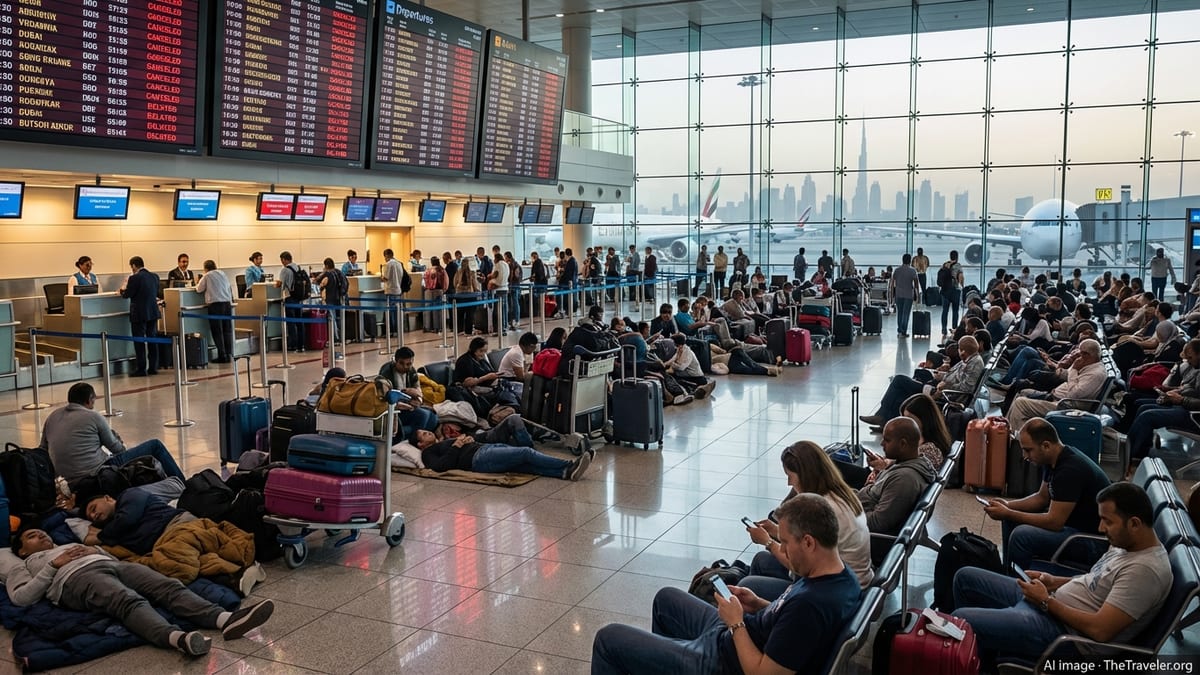
As cancellations mounted, airport terminals in Abu Dhabi and Dubai quickly filled with stranded passengers searching for information and alternative routes. Authorities in the UAE said they were working with airlines to provide food, water and accommodation where needed, while encouraging travellers to remain in contact with carriers rather than heading directly to the airports.
Foreign embassies, led by India’s missions in Abu Dhabi and Dubai, issued specific advisories for their nationals caught in the disruption. The Indian Embassy said it was in touch with UAE authorities and airlines to ensure that Indian passengers stranded at the airports receive assistance during the temporary and precautionary airspace closure. It urged nationals to remain vigilant, follow instructions from local authorities and avoid non-essential travel until the situation stabilises.
Other governments advised citizens transiting through the Gulf to check flight status frequently, factor in the possibility of extended layovers and consider rerouting through alternative hubs in South or Southeast Asia when possible. Consular teams have been deployed to major UAE airports to provide on-the-ground support, particularly for families, elderly travellers and those with urgent medical or visa concerns.
Airport officials in both emirates stressed that regular updates would be provided as soon as there is clarity on the reopening schedule and that reopening, when it comes, may initially be partial, with capacity ramped up gradually to avoid overwhelming ground operations.
Travelers Face Uncertainty, Longer Routes and Rising Costs
The sudden shutdown of key Gulf airspace has upended travel plans for tens of thousands of passengers worldwide, many of whom rely on Dubai and Abu Dhabi as transit points between Europe, Africa, Asia and Australasia. With flights cancelled or diverted mid-journey, travellers reported sleeping on terminal floors, queueing for hours at airline counters and struggling to secure last-minute hotel rooms in already crowded cities.
Travel industry experts warned that even once some services resume, itineraries may involve substantial detours, longer flying times and higher fares. With carriers forced to skirt large swathes of closed sky, routings that normally pass through the Gulf could be pushed further south or north, adding hours to journeys and increasing fuel burn at a time of already elevated operating costs.
Tour operators and corporate travel managers are advising clients to build in extra buffers for time-sensitive trips, such as business meetings or onward cruise departures, and to keep flexible tickets wherever possible. Some travellers have chosen to postpone non-essential journeys altogether, wary of potential further escalations in the region.
Insurers and airlines are meanwhile reviewing how disruption from evolving conflict zones will be treated under existing policies and fare rules. Passengers are being urged to retain all documentation related to delays and cancellations, as claim processes may vary depending on whether flights were proactively cancelled by carriers or affected by official airspace closures.
What Passengers in Abu Dhabi and Dubai Should Do Now
Authorities and airlines in the UAE are strongly advising passengers not to proceed to airports unless they have confirmed flight rebookings. With check-in halls already crowded and security protocols heightened, arriving without a valid, operating flight risks adding to congestion without improving chances of an early departure.
Travellers currently in Abu Dhabi and Dubai are being encouraged to monitor official updates from airports, airlines and local authorities, and to rely on verified channels rather than social media rumours. Those with pressing onward connections, including students returning to universities overseas or workers whose visas are expiring, are being prioritised by some carriers where capacity allows.
Hotels across both cities have begun offering special rates or extended-stay options for delayed passengers, while some airlines are providing meal vouchers and transport to partnered properties. However, availability may tighten if airspace restrictions continue into the coming week, prompting calls from consumer advocates for clear guidelines on when carriers must cover accommodation and when travellers need to turn to insurance.
While there is no firm timeline for the full reopening of UAE and wider Gulf airspace, officials in Abu Dhabi and Dubai insist that safety will remain the overriding consideration. For now, stranded passengers are being urged to stay patient, conserve essential travel funds, and keep a close eye on rapidly changing advisories as the security situation evolves.