


More news on this day
Passengers on United Airlines flight 1942 from Eugene, Oregon to Denver experienced significant disruption when the Airbus A320 operating the service diverted to Grand Junction Regional Airport, interrupting the scheduled journey and triggering a cascade of delays and rebooking challenges for travelers headed to Colorado and beyond.
Get the latest news straight to your inbox!
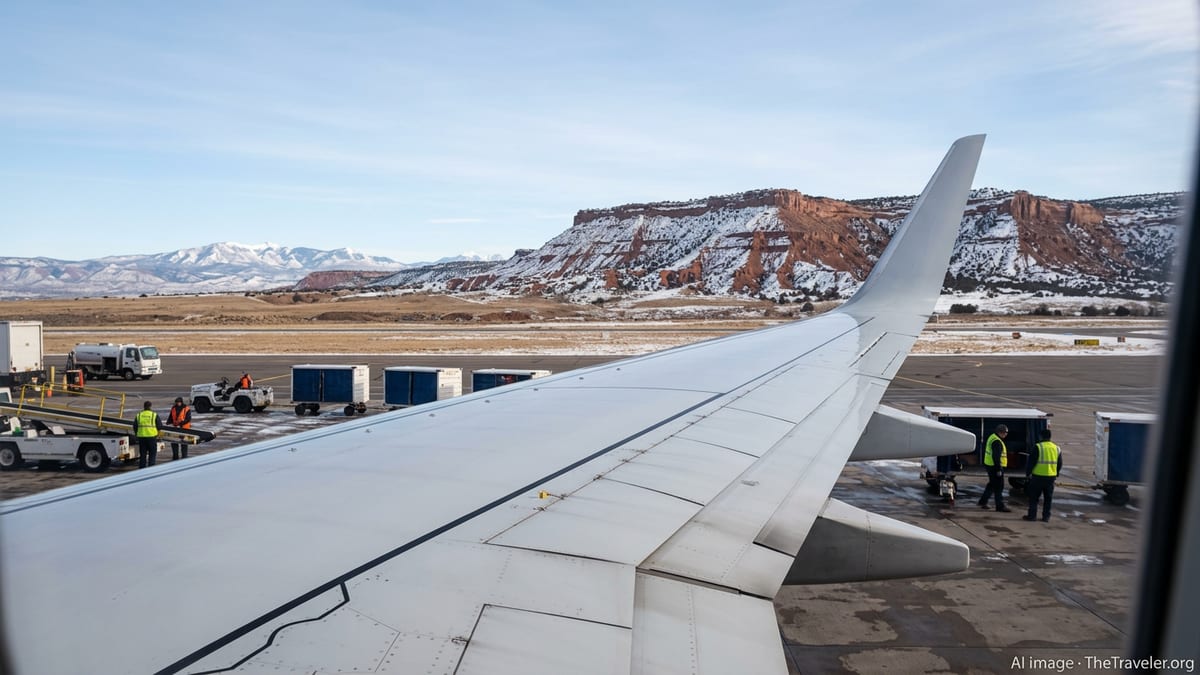
What Is Known About United Flight 1942
Publicly available flight-tracking information shows that United flight 1942 was scheduled to operate from Eugene Airport to Denver International Airport using an Airbus A320-232, a narrow-body jet commonly deployed on domestic routes in the western United States. The service is part of a regular pattern of United flights linking smaller Pacific Northwest cities with Denver, a key hub for onward connections across the country.
Tracking data indicates that the aircraft departed Eugene on time or with only a modest delay before heading southeast along a typical routing toward Colorado. Instead of continuing directly to Denver, the flight diverted to Grand Junction Regional Airport, a facility located on the Western Slope of Colorado that frequently serves as a diversion point when conditions or operational constraints affect Denver.
Available records list the aircraft type as an Airbus A320 family jet and associate the service with United’s mainline operation rather than a regional affiliate. The diversion effectively transformed a routine midcontinent leg into a multi-stage journey for those on board, with their original plans dependent on how quickly the aircraft could continue onward or how rapidly new arrangements could be organized.
While specific technical or operational reasons for the diversion have not been detailed in public reporting, the decision to interrupt a scheduled flight typically reflects a combination of safety, air traffic control direction, and airport capacity considerations rather than passenger preference.
Grand Junction’s Role as a Diversion Airport
Grand Junction Regional Airport occupies a strategic position in western Colorado and is accustomed to handling traffic that cannot immediately reach Denver. The airport is served by multiple daily flights to Denver under normal conditions, including services operated by United and its partners, and it is equipped to receive mainline jets such as the Airbus A320 family. Its geographic location across the Rockies makes it a practical alternate when weather, congestion, or other constraints affect Denver operations.
Historical schedules and traveler accounts show that Grand Junction periodically sees spikes in unscheduled traffic during periods of strong storms, capacity reductions, or ground stops at Denver. On such days, several inbound flights may divert there temporarily while carriers wait for improving conditions or reassess their network plans. This pattern aligns with the use of Grand Junction as a safe nearby option for United flight 1942 when continuation to Denver was no longer practical at the planned time.
The arrival of a fully loaded A320 from Eugene therefore fits into a broader pattern in which Grand Junction serves not only its local catchment area but also functions as a relief valve for Denver’s complex and often weather-sensitive operation. The airport’s facilities, including gates that can handle mainline narrow-body jets, make it suitable for holding passengers, refueling, and preparing aircraft for a subsequent short hop to Denver once circumstances allow.
However, when multiple diversions converge on a smaller airport, ramp space, staffing, and gate availability can become constrained, extending ground times and affecting how quickly diverted flights can move on to their intended destinations.
Impact on Passengers and Downline Connections
For travelers on United flight 1942, the diversion translated into an unplanned stop, extended travel time, and uncertainty about missed connections at Denver. Because Denver International Airport functions as a major hub, many passengers on the Eugene service were likely booked onward to other cities across the United States. A delay of several hours or an overnight disruption can force rebooking across already busy flight banks and ripple through itineraries involving hotels, car rentals, and meetings.
Industry practice and publicly available guidance suggest that in diversion scenarios, airlines often face complex decisions about whether to continue the same aircraft to the intended destination, substitute another aircraft, or move passengers to alternative services from the diversion point. When the diversion airport, like Grand Junction, has existing scheduled service to Denver, travelers may sometimes be reassigned to later flights, space and crew availability permitting.
In some cases, diversion-related delays can bump passengers into legal rest requirements for flight crews, triggering duty-time limits that may prolong disruptions. Weather and air traffic constraints at Denver, if present, can also persist into the evening, limiting the number of additional flights that can be accommodated and making it difficult to quickly absorb diverted passengers back into the system.
Travelers on flight 1942 face the same challenges commonly reported during such events: uncertainty about departure times, limited real-time information, and the prospect of overnight stays or extensive rebooking for those with tight or complex connections beyond Denver.
Broader Operational Context for Denver and United
Denver International Airport sits at high elevation and is known in aviation planning as a demanding environment, particularly during summer heat or winter storms. The combination of altitude, runway length requirements, and rapidly changing weather can lead to ground stops, arrival flow restrictions, and congestion in the surrounding airspace. When these factors converge, airlines frequently reroute or hold traffic, leading to diversions to airports such as Colorado Springs and Grand Junction.
United, which maintains a major hub at Denver, operates a dense schedule of narrow-body aircraft including the Airbus A320 family. This concentration of flights allows for extensive connectivity but also means that disturbances can spread quickly across the network. When several inbound services divert or hold, the result can be a queue of aircraft and passengers competing for limited slots once operations normalize.
Publicly available network data shows that Grand Junction is already tied into Denver’s schedule with multiple daily flights, and traveler reports describe instances where mainline aircraft like the A319 and A320 regularly operate the short hop. These existing links make it easier for the airline to slot a diverted aircraft into a later departure window, but they do not eliminate constraints created by crew usage limits, ground handling capacity, and maintenance requirements.
The diversion of United flight 1942 from Eugene fits into this well-documented pattern of operational complexity around Denver, highlighting how a single flight’s interruption can reflect wider pressures on a large hub’s infrastructure and airline scheduling.
What Passengers Can Expect After a Diversion
Public guidance from airlines and aviation consumer advocates outlines a relatively consistent sequence of steps following a diversion like that experienced by United flight 1942. Once the aircraft is on the ground safely, the operating carrier typically assesses fuel status, crew time, maintenance needs, and the situation at the original destination before deciding whether to proceed, wait, or cancel the remaining leg.
If the aircraft can continue and a workable arrival slot at Denver becomes available, passengers may remain on board for a period while crews coordinate with operations and air traffic control. However, if the expected delay extends beyond set limits for tarmac delays or crew duty times, passengers are usually brought into the terminal, where gate agents and customer service representatives can begin rebooking efforts or arranging accommodations.
At a smaller diversion airport with an existing United presence such as Grand Junction, some travelers may be able to secure seats on later scheduled departures to Denver or, in a few cases, reroute through other hubs on available partner services. Those with missed long-haul or international connections may face longer rebooking times as airlines work within seat inventory constraints across their global networks.
For passengers on flight 1942 and for others affected by related disruptions, the combination of a diverted aircraft, a constrained hub, and high demand can produce significant travel stress. Monitoring official airline channels, airport updates, and flight-tracking services remains the primary way for travelers to keep track of evolving plans as the operation recovers.